Co-creators Magdalena Puchalska and Patrick Burley-Brown explore Pity Parade
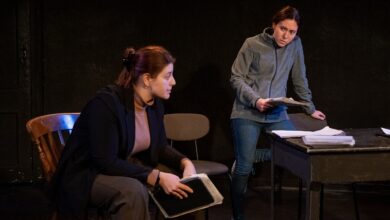
What starts as a darkly comic dilemma; a Polish immigrant forced to write a funeral eulogy for a man she dated for a mere three weeks, unfolds into a layered exploration of unprocessed loss, displacement, and personal reckoning. Sparked by an automated voice message on a GP hold line and developed between Kraków and London, Pity Parade earned high praise from us (full review here) during its Camden Fringe run at the Hen and Chickens Theatre for its emotional resonance and sharp execution.
Ahead of fresh performances at Lower Marsh Arts Club for Lambeth Fringe (25 and 26 September), co-devisers Patrick Burley-Brown and Magdalena Puchalska discuss building the show from scratch, overcoming the pitfalls of narrative monologue, and how returning to one’s native language opens the door to genuine healing.
For a 3pm slot at Camden Fringe show, Pity Parade already felt strikingly polished, fully formed, and ready for a mainstage run. What has been the show’s journey to reach this point?
M: It all started at the end of 2024 when I got asked to be a part of the SITFY International Theatre Festival that was happening in my home city of Kraków. Only it was a monodrama festival and I had no clue what to perform. I spent weeks, in panic, trying to find a suitable play until Patrick suggested we write something together. He had this idea for a play that we used as the basic premise for Pity Parade of someone’s partner dying of flu only a few weeks into the relationship (inspired by an automated voice message he kept listening to while on hold at his GP surgery).
P: We joined forces, sat on the floor for 3-hours with A5 pieces of paper and came up with a story. The next four months consisted of redrafts and rehearsals until the performance in May. Then when it came around to perform at The Camden Fringe we began rehearsing it again two months prior, three times a week for eight weeks, changing tiny bits here and tiny bits there to polish it as much as we could.
The show is credited to both of you as co-writers and co-devisers, with Magdalena performing. How did your writing dynamic come about and how does it work in practice?
P: The show is half based on Magdalena moving to the UK on her own and half on my dealings with grief. We would write separately and write together and then every few weeks we’d put what we had written on its feet, realise it was rubbish, and start all over again. Rinse and repeat until it’s not rubbish anymore and we have a play!
M: The collaboration came surprisingly easy to us, despite not having worked with one another creatively in any capacity before this project. To be completely frank, we met for the first time three months prior to starting work on Pity Parade so it could have been a complete disaster for both our relationship and the play if it turned out we didn’t work well together in that department. I still remember the first time we rented out a studio to try and put the very first draft of the play on its feet. Barely anything from that script made it to the final version. There was so much of Olga’s narration in it back then, it was very difficult to balance it out in addition to all the other characters speaking.
P: We realised that the narration was static. It was retelling a story that had happened in a previous time, making it passive and, frankly, dull. Taking out that narration and having the characters (or rather Olga’s interpretation of the characters) in the space created more action and made the situation itself more immediate
The inciting incident; Olga being forced by a dead boyfriend’s mother to write a eulogy for a relationship that only lasted three weeks, brings a strong element of dark comedy. How did you use this absurd situation to explore the strange, often performative expectations society places on how we are “supposed” to grieve?
P: In the play Olga is suffering from a huge case of imposter syndrome. How could she possibly have the right to express her grief in front of an audience in which probably every individual has known Charlie far longer than her? Within this concept she explores her relationship with grief, the people she has lost in her past whose loss has gone unprocessed. Through this act of reliving the past she can confront the things she needs to and begin the process towards healing.
Beyond the loss of Charlie and her sister, the play touches on Olga grieving the distance from her home in Poland and her past self. How do you feel the immigrant experience and geographic isolation intersect with personal grief in Olga’s journey?
M: A lot of the time it isn’t until a big shift in our lives happens that things suddenly start coming up to surface. Moving to another country, alone, is where it all begins for Olga, although the catalyst for her finally facing up to her past is Charlie’s death. Or rather being asked to speak at his funeral because, as much as she could avoid talking about her own grief from the past, this time there isn’t a way out because it’s about someone else. She can’t refuse Charlie’s parents just like she refused herself over and over for years.
The show ends in Polish, and even not being able to understand what is being sung, it is still deeply moving. Why was it important to shift away from English in the climax, and what does returning to her native language represent for Olga’s process of facing up to her life?
M: I think, oddly, it’s sometimes easier to use your non-native language to talk about things by creating a little distance between you and the words. You can almost hide behind the persona it creates. Or the persona you think it creates. And even though I don’t believe you’re any less yourself “in another language”, I find the immediate connection to your mother tongue fascinating. The visceral nature of it.
P: In the final scene Olga is caught, by Charlie’s mother, in the act of running away again. However, instead of her expected confrontation she finds acceptance. These things are hard and they take time. Olga then realises she is done with running and hiding; she is ready to reprise her life and take on the harder parts. She is ready to return home.
And if you did have to write an eulogy for a three week long relationship, what would the opening sentence be then?
P: “It wasn’t me I swear.”
M: Irrelevant because I’d probably just start crying from the stress of it all and never get a single word out.
Many thanks to Magdalena and Patrick for their time. You can catch Pity Parade at Lower Marsh Arts Club (formerly The Glitch) when it plays as part of Lambeth Fringe on Friday 25 and Saturday 26 September.