Alexandra Shaw discusses Where Would You Like To Start?
What happens when the friendships of your youth start to feel masked by social veneers? Running at The Drayton Arms Theatre from Tuesday 3 to Saturday 7 November, Alexandra Shaw’s compelling new play, Where Would You Like To Start?, delves into changing relationship dynamics, professional doubt, and deep-seated human connection. Directed by Alasdair Linn and featuring an exceptional four-person cast, this funny, 70-minute story explores the neurological and physiological impacts of how we communicate with the people we love most.
We sat down with Alexandra to ask about inspirations, therapy sessions and connections.
What was the initial spark or real-world observation that inspired you to write Where Would You Like To Start?
One real-world observation was how, in emerging adulthood, the depth of connection with others and people’s ability to show up fully can be put on a leash by a variety of aspects: lower confidence, less fulfilment, financial position, values, perspective. How there can be a myriad of strings inside people picked, plucked, and played by these aspects not visible to anyone’s eye: tuning their responses. It sparked me exploring people showing up in unfettered spaces, such as in therapy, and within more fettered social dynamics – any differences being one of the central themes of the play.
The play’s plot turns on an overheard therapy session. What made a therapy setting, and specifically an eavesdropped moment, such a compelling device to fracture the characters’ dynamics?
There is the simultaneous delicacy and strength in engaging with therapy. The reality that there can exist a different kind of intimate space between two people other than in a romantic relationship or friendship, and the space is for one person to choose what they share in it: be it consciously or from the sub-conscious. This being overheard takes away that choice, and initiates possible catastrophic consequences – from the violation of trust and from the content of what was overheard.
The title Where Would You Like To Start? feels like both a standard therapist prompt and a wider invitation for self-reflection. How did you land on this title, and what core question does it pose to the audience?
I often leave titling until towards the end of writing a piece, unless it comes to me early. This title uses the cliché of the opening of a therapy session, but also it is ultimately the beginning of any dynamic: such as working through a disagreement, getting to know someone. It encompasses the beginning of a range of interpersonal connections, in intention at least, that either open, close, or narrow a gulf.
In your writer’s note, you discuss exploring boundaries, asking “how much is enough, how far is too far, do you ever really know another’s truth?” How did you approach writing these intense emotional thresholds while keeping the characters relatable?
I’m particularly intentional with the dialogue I write – it’s crucial that it’s relatable, and as compelling as can be. Here, I tried to ensure the emotional thresholds are within each and every character, that they engage with their emotional peaks or troughs within the reality of who they are.
As both the writer and producer of the show, how has balancing the creative side of character development with the practical mechanics of mounting a production shaped your journey to the stage?
Often at the point of the Director beginning work with the actors, the script holds almost everything I need it to. I will then be present at rehearsals to help clarify any facts and share any offers. Then, I’ll be working to get the production set up and going. Trust is of paramount importance on all sides.
The Drayton Arms Theatre puts the audience right in the room with the drama. How does an intimate theatre environment heighten the tension of an overheard secret?
An intimate theatre environment heightens the tension of the overhearing of the secret first of all, for two reasons. One, we are right near to the person as their ears prick up to the session, right near to their eyes as they widen to what they hear. Two, we have the ancient, painful dramatic irony that the other person is unaware of what’s happening. Them / us witnessing the other person’s earnest sharing evokes pathos, there’s almost a sadness in our guilt, that makes us really feel for them. Thus, from the dramatic irony, every future intake of breath the overhearer takes where this could come to light, we take an intake of breath too. The tension continues.
When audiences leave The Drayton Arms Theatre after the show, what conversation or question do you hope they are continuing on the journey home?
We would hope that audiences perhaps continue conversations about connection and what it takes to be honest with ourselves and with others: also discussing questions such as ‘What would you have done?’ ‘How should we nurture changing friendships? Should we?’. There is also the central question of the play – is it true that you can only ever trust yourself? – which we hope brings audiences to fresh reflections, affirmations, or both.
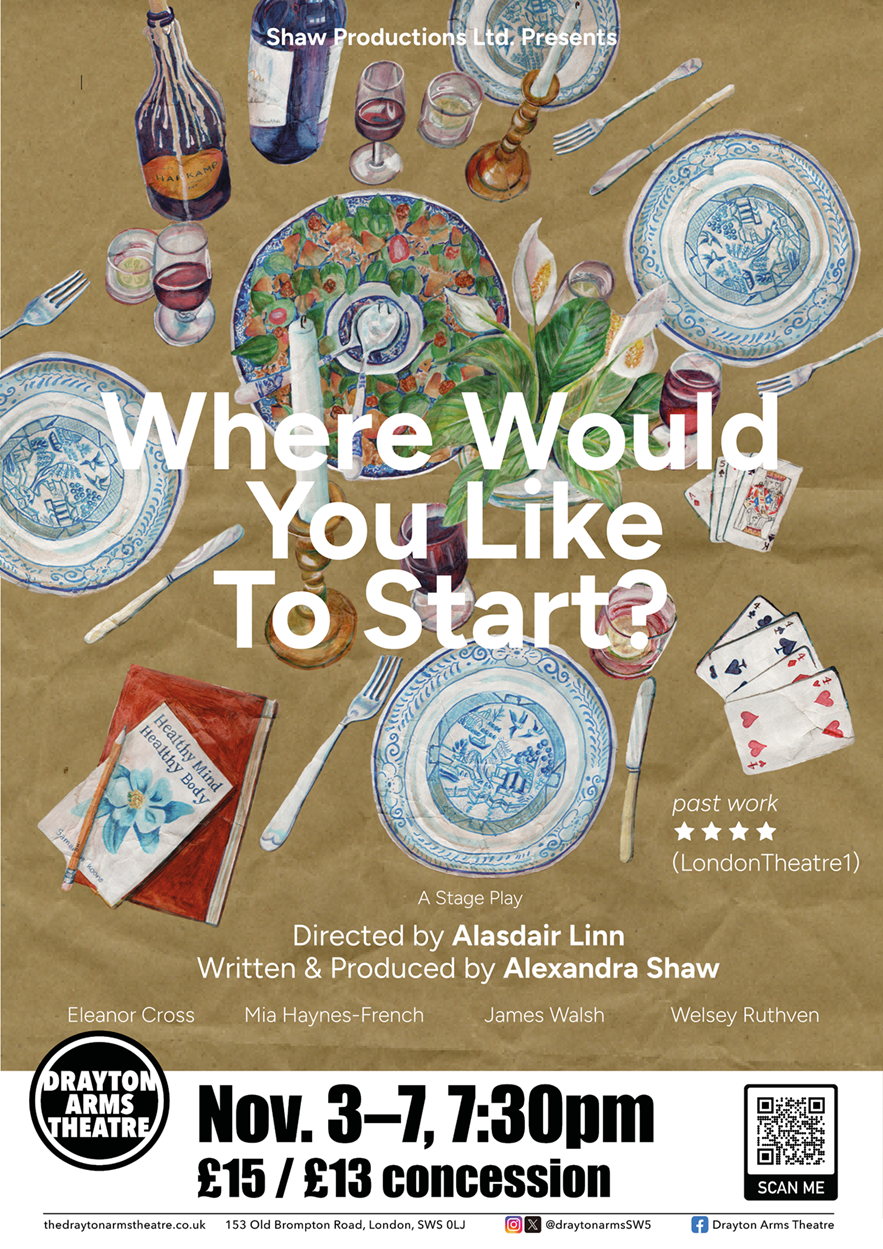
Many thanks to Alexandra for their time to chat. Where Would You Like To Start? plays at Drayton arms Theatre from Tuesday 3 to Saturday 7 November.