Interview: An instruction booklet goes from page to stage
User Manual for a Broken Machine

Namoo Chae Lee talks us through User Manual for a Broken Machine
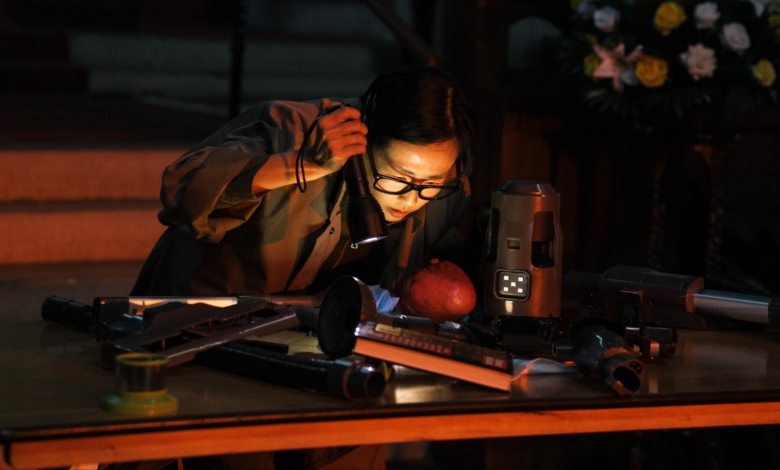
The Voila! Theatre Festival is always packed with amazing productions, but this autumn one in particular demands our careful attention. Written and directed by South Korean theatre-maker Namoo Chae Lee, User Manual for a Broken Machine sees three performers following a user manual as they explore how to fix a broken vacuum cleaner. Well that’s an intriguing premise if ever there was one! We wanted to know more, so invited Namoo in for a chat about all things instructions.
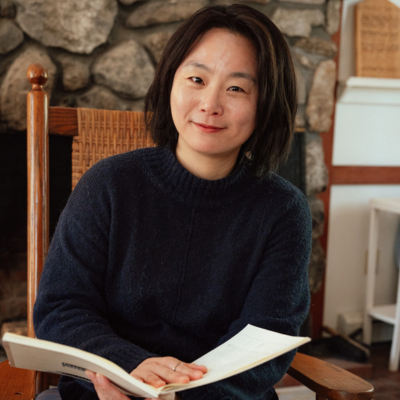
Photo: Oriana Camara courtesy of MacDowell
Hi Namoo. Thanks very much for stopping by to talk with us about User Manual for a Broken Machine. Can you give us a brief overview of the plot?
It starts with a manual for a broken vacuum cleaner. A musician, a mover and a reader try to make sense of the instructions and fix the machine. Along the way, we find out what this particular machine and its manual mean to us. It’s physical, musical and quite absurdly funny.
Nobody really reads a manual until something goes wrong. But if you read it closely, it’s a strange text. It seems neutral, but it assumes so much about who you are and what you should be able to do. I use its structure to tell a personal story about growing up in a high-pressure society and moving to another country.
It’s a deeply Korean story, but the relationship between a user and a manual is something many people can recognise, especially If you’ve ever tried very hard to function and still been told you’re doing it wrong, there’s something in this show for you.
In the end, the show asks “What happens when you can no longer follow the instructions? And what if the instructions were wrong from the beginning?”
You have a history with objects and puppets, having worked with the political puppetry company Bread and Puppet Theatre. Has that background influenced how you imagine everyday items like this vacuum cleaner?
I can’t say no. Every object has its own stories, and paying closer attention to those things can be part of puppetry, I would say. I feel that puppetry is a materialised version of poetry. It’s also about giving materials another life, turning them into something meaningful to us.
But I think my curiosity about ordinary things began with my training in journalism. I’m very conscious of who chooses what becomes news and how a story is presented. I’m hugely influenced by Susan Sontag’s On Photography. For me, it’s about who holds the lens and how they see what is in front of them.
I’m interested in what sits behind things that seem mundane or natural. Who made them? How did they arrive here? Why do we use them in this particular way? Everyday objects have political and historical lives, even when we don’t notice them. The vacuum cleaner is one of those objects.
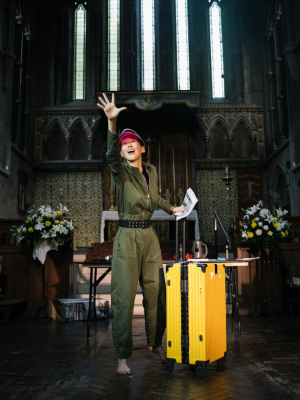
Tell us about your theatre collective KASSNA – who and what it is and how you’ve worked together on this production.
KASSNA is an interdisciplinary performing arts collective working across text, movement, music and technology. The word originates from “a woman who wears men’s hat” in the southern part of Korea, which later developed into a derogatory term, and we’re reclaiming the word.
For me, KASSNA began with an uncomfortable position. As a first-generation migrant artist, I often feel expected to defend my culture or act as a cultural ambassador. But I also left because of its misogyny and things I found difficult to live with. So what am I defending? Where do I stand?
I don’t feel entirely at home in either country. Through KASSNA, I wanted to make room for people who have that complicated relationship with their cultural heritage, without expecting them to represent a whole country or culture.
We began the first R&D for User Manual in February. We took time to find its style and language, then its dramaturgy, and how the text, movement and music could work together. Each of us creates material through our own practice, but we keep developing it together in the room. For the November performances, we’re bringing live cinema and an AI character into that process. We’re still asking what each form brings to the story. Each has to have a reason to be there.
User Manual is very much an interdisciplinary work. Can you tell us about the different techniques you use to take an instruction booklet from page to stage?
I consider myself a deviser, but I’m also very text-driven. I start by reading the manual closely. On the first reading, I look at its structure. On the second, I look for what hits me personally.
Then I bring those passages or questions to my collaborators, and they respond through movement or music. Sometimes their responses take me somewhere I hadn’t expected. I collect what comes out of that and start putting it into a structure.
And then, Excel files! Haha.
The script has columns for movement, music, text and, later, video. I want to see what each language is doing at any particular moment. Sometimes they work together, and sometimes they betray one another. Finding those possibilities was one part of the work. Putting them together so an audience could follow the piece was another.
I’m not sure I’d call these techniques. I joked in the rehearsal room that there were no artists here, just technicians bringing their own skills: movement, acting and music. There’s something about that practical approach that suits a show about fixing a machine. My part is to put those skills and materials together, finding the rhythm and dramaturgy of the piece.
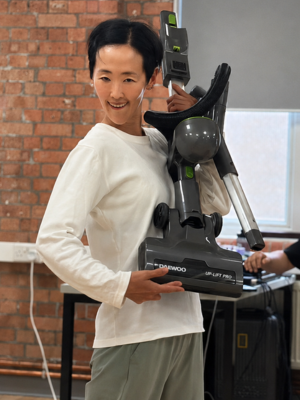
You’re writing about society from a South Korean perspective but are the themes in the play universally recognisable?
I think a story has to be specific to become universal. This story is Korean because it comes from the experience I can write about most honestly. But it’s about someone trying to understand society and do what is expected of them, until they break down. Who decides whether someone is functioning well? If you can’t function in the expected way, does that make you a failure?
Those questions come from my own experience, but they don’t belong only to Korea. I think people in the UK will recognise the pressure to keep working, fit in and prove that they’re useful. Many of us have followed the instructions exactly and somehow made things worse.
I grew up watching Mickey Mouse and reading Shakespeare in South Korea. I had no problem connecting with an American mouse or lovers in Verona written by an English playwright. I didn’t need to share their background to care about them.
As a migrant artist, I sometimes feel responsible for explaining the cultural background so that nothing gets lost. But I’m learning to trust the audience more. They might not recognise every reference, but they can recognise the feeling of trying hard to do everything right and still finding that things don’t work. That’s where I hope we meet.
With a number of important political themes at the core of the writing, how do you manage to keep things upbeat?
Connection, I think.
During the R&D, Paul Hunter from Told by an Idiot mentored us through Bold Makers. This was one of the questions I brought to him. I wanted the show to communicate with people, but I worried I might get so caught up in the ideas that I’d lose the audience.
His advice was very simple: connect with them. Find the moments when you’re actually sharing something with the people in the room. And be damn serious about it. Do not take a joke as a joke, but be authentically serious about it.
That stayed with me. The performers are trying, failing, helping and interrupting each other. I think there’s a lot people can recognise in that, and the humour comes from those interactions and authenticity.
And, to be fair, the situation itself is quite absurdly funny: three people trying very hard to to fix a hoover that doesn’t suck!
The show itself doesn’t follow strict rules, as it’s morphing from an immersive performance environment at Holy Cross Church during the Bloomsbury Festival to something rather different at Theatro Technis. What can you tell us about that and how might it change the relationship with the audience?
The space and the audience are the final elements of the show. For me, that’s the last stage of devising. You only really find out what you’ve made when people enter the room.
I think the biggest difference is how the space prepares the audience. Walking into a church puts you in a different frame of mind from sitting in a black box theatre. The venue brings its own story, and we have to find a way for our story to meet it.
Holy Cross Church already had so much in it that I wanted to focus on the three performers and their relationships with one another and with the space. It’s a place associated with faith and something we cannot necessarily see. Whenever we asked the system to answer us, we were aware that there was a cross above us. That became part of the show.
At Theatro Technis, we have more freedom to shape the space, and we’re introducing live cinema and an AI character. We want to explore how those tools might open up other ways of communicating with the audience. They also let us look more closely at what’s behind the instructions. When you interact with a system, who are you actually dealing with? A person? A company? An algorithm? Nobody?
That changes what the audience has to work out: who is speaking, who is controlling whom, and where to look. We’ll only know how that changes our relationship with them once we’re in the room together. I see the two versions as different stages of the same script.
Thanks very much to Namoo for telling us about getting this fascinating show to work. User Manual for a Broken Machine plays at Theatro Technis from Wednesday 11 to Thursday 12 November as part of Voila! Theatre Festival.