Interview: Fusing Yoruba legend, vibrant Afro-Cuban dance and playful puppetry
Dance Umbrella 2026

Miguel Altunaga on reworking Eshu at the Crossroads for Dance Umbrella 2026
This year’s programme for Dance Umbrella, London’s annual international dance festival, sees a selection of amazing productions and events. Eshu at the Crossroads from Theatre-Rites blends Yoruba legend and playful puppetry with Afro-Cuban dance, choreographed by Miguel Altunaga. Here Miguel shares more about the production, its characters and its development for 2026.
Hi Miguel. Thanks very much for stopping by to tell us about Eshu at the Crossroads. What can you share about the story and how the performance of it fuses multiple international influences?
As an Afro-Cuban British artist, I’ve always been deeply interested in exploring Yoruba content – its folktales, mythology, folk dances and spiritual rituals that permeate daily life and culture. These elements have influenced my artistic voice and have always felt like a rich well of inspiration.
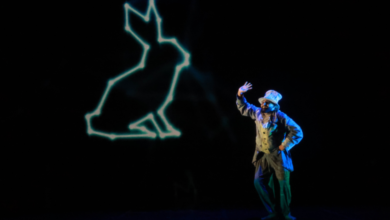
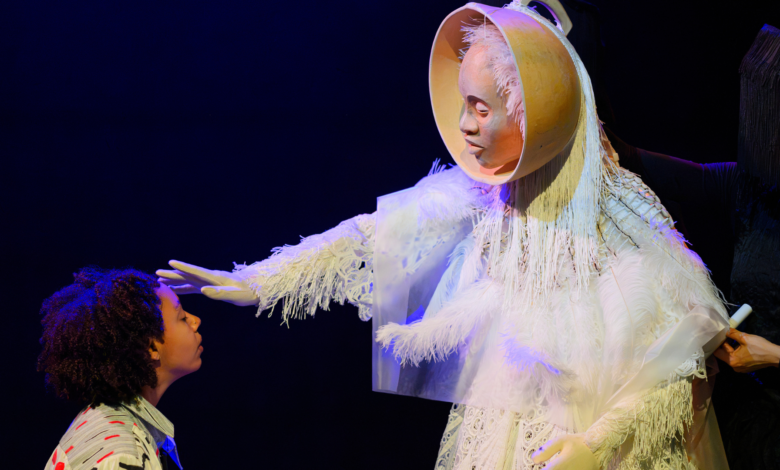
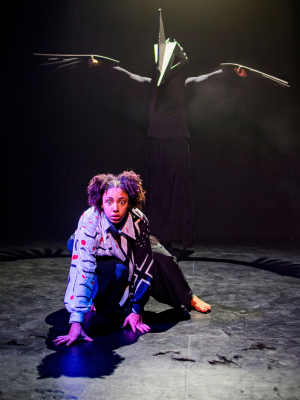
For years, the Yoruba deity Eshu has resonated with me. He is a trickster and guardian of the crossroads, an influential figure in the Yoruba pantheon. His complex nature – playful, unpredictable, wise and deeply connected to the forces of change and possibility – has captivated me. I felt a persistent need to respond to this connection through my art. The central character in the production is a Traveller who we first meet at a literal and metaphorical crossroads – and they have lost their way. Eshu appears in many forms throughout the Traveller’s journey: as a half-body puppet, as a black and red coat and in head form, constantly there to disrupt and challenge the Traveller, but also to open up new possibilities. That ambiguity is important: we never quite know whether Eshu is creating an obstacle or guiding the Traveller towards another path.
Eshu first performed outdoors at the Norfolk & Norwich Festival, but it’s come indoors for 2026. What were the challenges of reinventing the show for touring to different locations and venues?
It’s rare to have an opportunity to revisit a production, but it was always Theatre-Rites’ and my intention to create a 30-minute outdoor version first, and then extend the production for indoor touring. We were so grateful for the support of Without Walls and all the festivals who programmed the show last year – we reached over 6,000 people and created a wonderfully engaging outdoor experience. Being able to adapt and develop the production for our 2026 tour has allowed the show time to breathe, and we’ve been able to push the dramaturgy further.
We’ve had over three weeks to rehearse with our cast of three: Edie Edmundson, Zia Husbands and Amari Webb-Martin. Edie is an incredible puppeteer and was part of the original cast. Zia and Amari are both talented up-and-coming dancers, and we spent the first week of rehearsals learning the 30-minute outdoor version. After that we were able to focus on the sections that needed expanding and had time to explore the two Eggun, played by Edie and Amari, as ancestral spirits who can be mysterious, playful and unsettling, and to deepen the journey of the Traveller, played by Zia.
Puppets play an important role in the production and you have some stunning, impressive designs here along with direction from the fabulous Puppet Whisperer herself, Sue Buckmaster. How has the choreography been influenced by the dancers’ requirement to interact with objects?
Collaborating with Theatre-Rites and the visionary expertise of Sue Buckmaster has been instrumental in bringing Eshu to life.
One interesting aspect of the show is the blending of traditional Yoruba elements with contemporary performance techniques like puppetry, physical theatre and dance. We worked closely with master puppet maker Naomi Oppenheim to create representations of Eshu that transform throughout the story, reflecting his ever-changing, unpredictable nature. In addition to Eshu, we’ve incorporated other Yoruba-inspired deities and characters, each with unique qualities and roles that shape the narrative. The choreography has had to respond to the objects rather than simply sit alongside them. A puppet or costume can change the dancer’s weight, rhythm, focus and relationship to space. Sometimes the performer leads the object; at other times it feels as though the object is leading the performer. That exchange has been a fascinating part of creating the movement language.
Who is your favourite character in the show and why?
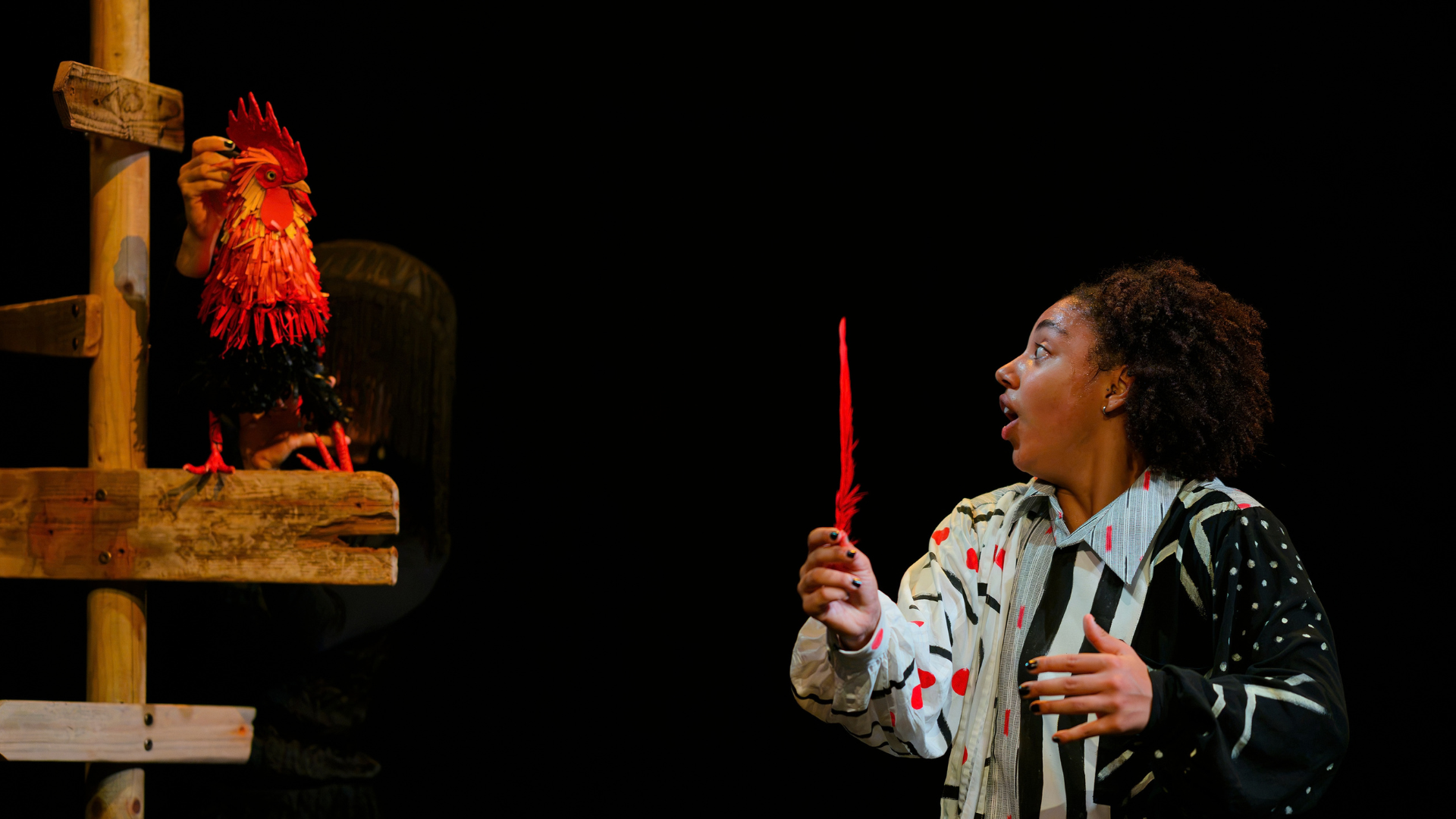
It has to be Eshu! I’m fascinated by the fact that you can never completely pin him down. He is playful, mischievous, unpredictable and wise, and in our production, he doesn’t appear as one fixed character. He keeps changing form and finding different ways to interfere with the Traveller’s journey. I love that contradiction in him. You’re never quite sure whether he is creating a problem or helping you find your way through it. Sometimes the disruption itself is the lesson. That also makes him incredibly exciting choreographically because his energy can live in a puppet, an object, a rhythm, a movement or even another performer. He doesn’t need to be physically present for you to feel that he is somewhere in the space. For me, that mystery is part of what makes Eshu so compelling.
What can you share with us about the music and how it’s performed?
The music has been specially composed by the brilliant Domenico Angarano, who created a 30-minute score for the 2025 outdoor version and has worked with us to extend his composition for the 2026 indoor version. Domenico worked closely with me to identify specific musical influences and joined us in rehearsals both this year and last. He starts his process by providing an initial composition and then, as the choreography and puppetry develop, he enhances and embellishes his composition. He also worked with an incredible number of different musicians who recorded percussion, brass, strings, piano and vocals. The music isn’t played live during the show, but it has the richness and energy of live musicians because so much of it was created and recorded through those collaborations.
Intercultural multimedia work like this is clearly fascinating for an adult audience but this production is specifically opened up to appeal to a wider family audience. Why is it important to also engage with children and families?
I think we’d describe the show as cross-artform: a space where dance and puppetry connect. Puppetry seemed like a perfect medium to capture Eshu’s shifting, dynamic nature – his ability to transform, deceive and guide.
Theatre-Rites are experts in creating work that appeals to all ages, but are particularly celebrated for making work for children and families. My memories as a child in Cuba are full of Eshu celebrations, so it felt only right that we should create something that would speak to a young audience. Children are such a sophisticated audience and are used to moving freely between different forms of storytelling. They don’t necessarily need everything explained. They respond instinctively to rhythm, images, humour, transformation and mystery. I think that gives us permission to explore complex ideas such as choice, uncertainty and identity without simplifying them.
How are audiences likely to feel after seeing the show?
I hope people leave the show inspired by the richness of Yoruba culture and its stories. I want them to experience wonder, curiosity and a sense of connection – to themselves, to others and to cultures that may be different from their own.
Most importantly, I hope children recognise something of themselves in the Traveller’s journey. We all arrive at crossroads in our lives, sometimes without knowing which direction to take. The story reminds us that uncertainty doesn’t necessarily mean we are lost; it can also be the beginning of discovery.
The show is magical, transformative and playful, but underneath that playfulness are ideas about choice, resilience and possibility. I hope audiences leave feeling that challenges can become opportunities for growth, and that sometimes finding your way involves being curious enough to take an unexpected path.
Eshu at the Crossroads is a family adventure for ages 5+. It will tour across England including The Albany, Deptford (Saturday 24 October), CASA at Brixton House (Sunday 25 October) and The Place (Tuesday 27 October).