Great choreography, revision help, and emotional support for teens: Simile is all of the above in a mixed bag of form.Rating
Good
There’s a lot going on in the world right now, and for teenagers the pressure can be intense: negotiating juggling stress from social media and the difficulties of life, all while having to take exams. Simile is an unusual production from Highly Sprung, taking a variety of teenage problems and pressures, and exploring them in a multidisciplinary piece that encompasses dance, verse, drama, and music. All the essentials are there to entertain and inform on important themes, yet as a whole the piece is ultimately rather bemusing.
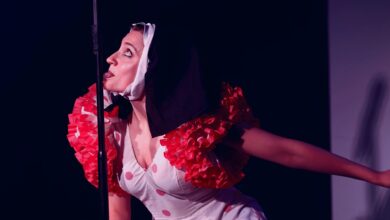
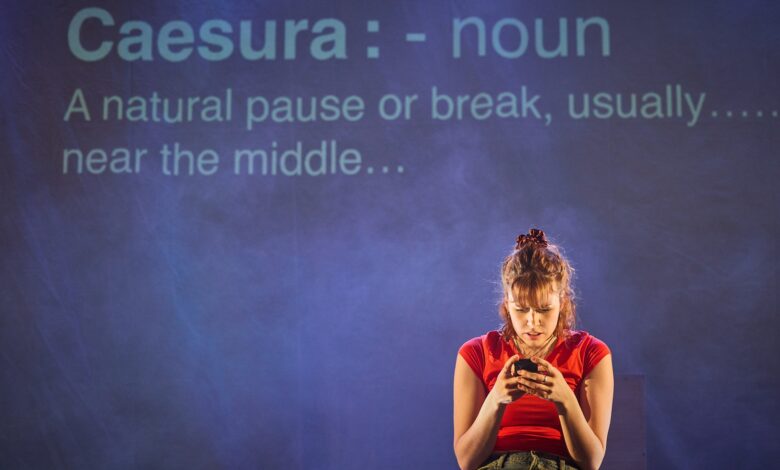
A giant phone screen is projected at the back of the stage, with a countdown clock ticking by, marking the time left before the poetry exam three friends are revising for together. Abby (Colleen Hedley), Fi (Emily Robertson) and Sam (Luis Dunn) hit the stage, phones in hands and staring into their screens, each trying to persuade themselves to get off their socials. Their movement is slick and agile as they negotiate the same space at the same time. With the exam approaching, they’re unable to study effectively as external issues distract them from what should be their priority.
There’s plenty to admire in this play. Much of the dialogue features pieces from the GCSE anthology of modern poetry Worlds and Lives – extracts from poems are woven into conversations throughout, making them familiar and helping to reinforce key quotations for the audience. Additionally, definitions of poetic terms (such as caesura and enjambement) flash up on the rear screen. Although these are useful as a revision aid, it isn’t entirely clear if they relate directly to the concurrent action.
Alongside the academic assistance there are multiple threads about relevant teenage issues, such as identity, respect, how people promote themselves on socials and how they are perceived by others, catfishing, and internet safety. We’re encouraged to find ways to express hidden feelings. The set itself is constructed from a series of mobile box units, which echo ideas of the trio trying to get to grips with identity, and these are often moving, creating a sense of instability. However, it’s not always clear what the priority of the narrative is: revision technique, or building a platform for exploration of challenging themes and coping mechanisms?
The trio of performers work well together, often enacting the emotional responses of the characters in fluid and expressive movement within intricately choreographed scenes. At times this creates abstract space that’s perfect for discussions of difficult subjects such as consent and intimacy. At others the ideas of real and emotional understanding blur, disconnecting the audience from the storyline rather than drawing them in. It becomes harder to track the character and plot development when the three are behaving non-realistically. There’s excellent lighting and music work in the show, and it would be easy enough to use them to emphasise these binary positions of action and emotion more starkly, as well as adding texture to the narrative and signposting more clearly how the different disciplines are being used.
Simile is clearly a considered play that creates opportunity for very valid conversations, and it’s full of all the right stuff. It features good performances, has effective moments of humour, and demonstrates innovative use of form. Yet the production feels like it’s not entirely sure what it wants to achieve. Is it a revision tool, a commentary on teen social pressures, or a device to suggest ways to express yourself? It’s probably all of those things, and with a little more marked distinction the whole would have more clarity.
Co-written by Mark Worth, Highly Sprung, and Jasmine Gardosi, with The Co-Creatives Group (young writers and creatives aged 13-18).
Simile is aimed at ages 13+ and has now completed its run at Jackson’s Lane theatre. Further tour dates can be found on their website.