All round excellence in this stunning debut – you don’t need a physics degree to be moved by this unmissable new work, inspired by Newton’s laws of motion.Rating
Unmissable!
It is not often that I am reminded of my uselessness in understanding physics. However, tonight the programme for Relative Motion does just that, even as it helpfully gives a rundown of Newton’s three laws of motion, which were the inspiration for Stephanie Greenwood’s first full length play. You don’t actually need to understand them though; they’re relevant in that the story is triggered by unconnected beings glancing off each other. Here, one person’s bag hits another person, setting in motion a real, intense and emotional relationship, which has no rational scientific interpretation.
The setting is the early train to Stevenage on the Peterborough line, platform three, which will become the leitmotiv to this 75 minute two-hander. The tropes of train travel provide lightscape (Ciaran Cunningham) in overhead neon strips, suggesting rails or trains rushing by, while the soundscape (Roly Botha) intensifies and transmogrifies the announcements and the ping-pinging of doors about to close. It’s all really impressive, I must say.
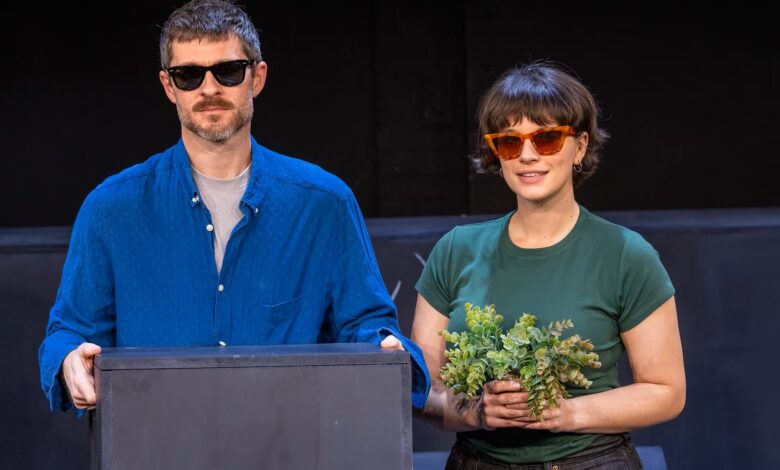
Greenwood also stars as Sam, a PhD research student who teaches A level physics to pay the bills, alongside Sean Hart as Paul, a budding published writer. They are truly excellent, grabbing the flowing dialogue by the scruff of its neck, bringing out the naturalism, the humour, the pain, the vulnerabilities and, dare I say it, the immense insecurities that each character possesses. Sam is very hyper and nervy, which could easily put off any potential suitor, but Paul relishes her energy and quirkiness. Initially he comes across as confident in himself and his social persona, but in his own way he is just as insecure as Sam.
Greenwood cleverly charts their progress together after an initial fish curry when their relationship blossoms. This is, however, always through the optic of Sam’s delivery, which is quite neurotic as she simultaneously deals with a mother dying from cancer whilst desperately trying to get a research posting. Greenwood usefully drops in time references to help us follow the trajectory of these bodies in space – the intervening times where dinners with parents are successfully negotiated, and the parties with Paul’s mates, where the couple’s first rift occurs and mobile phone silence ensues. This latter is the one moment that didn’t ring true, as suddenly they are back together again without a scene of explanation or reconciliation – a rare blip for me.
Wiebke Green directs with flair and ingenuity, using Kit Hinchcliffe’s set to brilliant effect. The four black boxes on a black floor complement the black wall at the back and Green has her actors using all possible levels. She exploits the idea of characters being in their own world, orbiting each other, sizing each other up and coming together. The real emotional state is mirrored in the staging. Sam’s use of the set as a blackboard to explain to class (and us) Newton’s laws is ingenious.
There is real love between the two characters, though the repeated “I love you” becomes a worrying mantra to cover insecurities on both sides. The couple’s last rupture is once again because of words and actions misinterpreted. Sam insists she is not “broken” and the final action is shocking, though Greenwood provides us with an alternative ending, which is perhaps unnecessary.
But undeniably the force of this shows hits us, inert objects at rest in our seats, and we are set in motion on a fascinating trajectory. Ultimately we respond with a matching level of engagement and heartily applaud this highly impressive debut – bravos all round!
Written by Stephanie Greenwood
Directed by Wiebke Green
Set & Costume Design by Kit Hinchcliffe
Lighting Design by Ciaran Cunningham
Sound Design by Roly Botha
Movement & Intimacy Direction by Ali Bianchi
Stage Management by Mikaela Mondlane
Produced by Very Rascals & Feuille Dooley Productions
Relative Motion plays at Southwark Playhouse Borough until Saturday 5 December.