

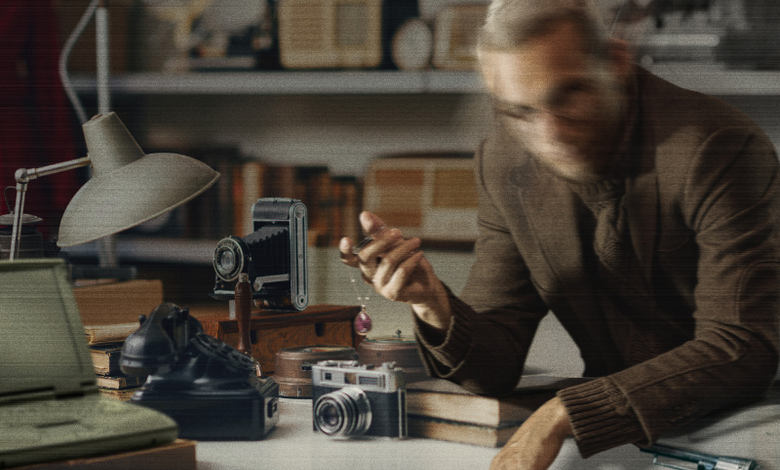
Nina Atesh and Nick Benjamin takes us inside Uncle Monty’s Antique Shop
Selected from over 50 competitive applications, Pither Productions brings their sinister new creation, Uncle Monty’s Antique Shop, to Lion and Unicorn Theatre this October, as part of the venue’s Here | For season. We sat down with writer Nina Atesh and collaborator Nick Benjamin to unpack their chilling quartet of psychological horror shorts, the power of object-led storytelling, and what it means to be backed by a pioneering model designed to elevate bold, audience-aware work.
Uncle Monty’s Antique Shop brings together four psychological horror shorts in one uncanny setting. How did the concept of an antique shop serve as the framing device to connect themes of memory, control, and buried violence?
Nina: This was actually Nick’s idea! A couple of years ago we collaborated on another anthology called ‘Tales From the Hellfire Club’ with two other writers, and that show was presented by this sort of macabre circus ring master, and was more about nightmares and your worst fears being realised. After that we really wanted to resurrect the idea of an anthology and Nick and I discussed how we could make a place that tied to the idea that objects can hold stories attached to those that owned them. Without giving too much away, the shop basically acts as this sort of endless library of objects that people have brought in and donated to “Monty” for one reason or another.
Nick: I’ve always been weirdly drawn to antique shops. I know it sounds strange, but whenever you step into one, it’s like you’re surrounded by countless ghosts of the past. Each object holds it’s own story and energy. Part of the fun as a customer is trying to work out what that story might be. Maybe it’s the history nerd in me talking, but to me there’s something infinitely appealing about being in a building where swords of forgotten warriors and pens of great writers are kept next to china dogs bought for someone’s Great Aunt Ethel. That setting is just begging for a good ghost story, or tales of the unexpected (reference completely intended). For me the setting just writes itself……oh, and not going to lie but I was also partly inspired by ‘The Simpsons‘ Treehouse of Horror III segment “Clown Without Pity”……if you know, you know!
Horror in intimate fringe settings can be intensely atmospheric. How do you construct genuine tension and dread in a black-box environment like the Lion & Unicorn Theatre?
Nina: Anyone who knows me or is familiar with my work will know I’ve done a fair few spooky shows in intimate settings like the Lion & Unicorn, so this isn’t a new approach for me! I always believe that horror should be an intimate experience, especially when it’s particularly psychological rather than big gory sequences; it allows audiences to feel really close to the action and they come away feeling like they’ve ‘lived’ it, rather than just watching something from the safety of behind a screen or the back row of a grand theatre. We’re working with a really fabulous lighting designer, Brett Kasza who is really helping us construct this world of not only the shop itself, but the worlds of the stories we’re going to see. I think in a small black box theatre like the L&U, you have the opportunity to really elevate tension with simple but brilliant lighting and sound design, without having to have these really grand sets or complicated sequences that you can’t do on a fringe budget! Some of the best, weirdest and spookiest stuff I’ve seen have been on small stages like this.
Nick: Yeah, I completely agree with Nina on this one. To me good horror is, and will always be, an intimate experience. That’s how the genre started after all. The first horror stories were told around campfires or to children snuggled in bed. They had a purpose, whether that was to teach a lesson, urge caution or to simply test the bravery of the listeners . As both a writer and watcher of horror, I’ve never been taken by excessive gore. To me it’s all about creating an atmosphere. Over the years I’ve worked pretty heavily in immersive theatre, where the venue is one of your key assets. However, when the venue is stripped back to a black box theatre it provides an enthralling new challenge. Now you are relying solely on the quality of the story and the skills of the storyteller. Once again this calls back to the origins of the horror genre. We’ve come full circle, back to the days when tales of the strange and paranormal were told in hushed voices around the glow of a campfire.
Writing and creating as a duo, what was the collaborative writing process like for balancing four distinct narratives into a cohesive theatrical experience?
Nina: It’s so funny, because we didn’t set out to write things that linked naturally or to have this connective theme. We both had some ideas we floated around for the individual stories and then when we brought them together we were like… wow these could actually all exist in the same universe! The Photographer and Deadlocked I think in particular could essentially be part of the same narrative; one is directly set within a political system and the other is the result and effects of a destructive political system. And that was a complete happy accident; Nick wrote Deadlocked years ago and then condensed it for the purposes of this show, and I wrote The Photographer just as a short piece in response to the current uprising of fascist leaders we’re seeing across the globe at the moment. Then I had this idea of, well let’s link every short to a psychological condition; which is how we ended up with the tag lines of Power, Violence, Memory and Control (all of which link directly to each piece).
Nick: Yeah, it’s funny how things work out! I’ve always been a great admirer of Nina’s work. Her style of theatre is very much my cup of tea, and I think that’s why our work naturally gels. There wasn’t really any aspect of the writing/production process which felt forced. It all sort of naturally came together. I think it helped that we have the same interests when it comes to the horror/thriller genre. It’s always better to have a point of reference that you can both understand and call back to.
Out of more than 50 applications, Uncle Monty’s Antique Shop was selected as one of the featured productions in the inaugural Here | For 2026 season. What did it mean to the company to earn a spot in this supported model?
Nina: I think we’re still quite taken aback by this! The quality of work we’re alongside in the program is really humbling, and we’re just very honoured to be a part of it, and that David (Brady, artistic director of Lion and Unicorn Theatre) has given us this chance to elevate our work. Anyone who is involved in fringe theatre knows how difficult it is to make nowadays, but I think sometimes theatres and artistic directors can get blindsided and don’t actually recognise QUITE how much of a struggle it is for emerging companies. It’s a constant struggle and it takes it out of you; I know so many fantastic writers, actors, directors who have had to take a step back because of the strain it puts on their well-being (mental and physical!) So initiatives like this, that support and nurture new work, is so important. I really hope other theatres follow by example!
Nick: It’s always a pleasure to have your work appreciated. The theatre industry has been really struggling since the covid pandemic. We like to think that the pandemic is done and forgotten about, but the effects are still being felt. I’ve seen so many companies go silent, so many theatres shut down, and creatives just give up. I myself had a moment where I was like ‘do I really want to keep fighting to be in this industry?’ New writing always seems to be the first to go. To be able to put on our work in such a fantastic venue, it’s honestly a dream come true. Our hope is to create something which has longevity, and hopefully inspire others to bring their work forward. What makes me laugh is that I swore off directing and producing my own work a couple of years ago, and was determined to focus more on solely acting. I suppose I can blame Nina and the Lion and Unicorn for bringing me back into the fold.
The Here | For initiative is designed to help companies “level up” beyond standard fringe constraints through financial, rehearsal, marketing, and mentorship support. How has this level of backing changed your creative approach or production ambitions for this run?
Nina: I think the biggest thing for us, as creators but also producers, is the time it’s freed up for us. The Here|For initiative is essentially a co-production model, so having help with someone taking over things like PR and marketing is just invaluable, and really allows us as writers and directors to focus on the creativity that’s involved with putting a show like this together. Now we can head into rehearsals and have fun, and not be constantly worrying about the admin that needs to go into building and promoting a fringe production. Time really is the most valuable thing of all!
Nick: I have so many grey hairs from the stresses of wearing so many different production hats in the past! When you produce your own work, without any support, I imagine it feels the same as being a single parent. You’re constantly juggling different jobs, all the time worrying whether your doing the right thing. As a result we often forget one of the major rules of theatre…..have fun! Honestly, why do we work in this industry?! It’s not for the money or job security, it’s because we love what we do! Having that extra support really helps us to focus on and enjoy the main aspect of our work, the show itself. I always believe, if we have fun in the production process the product is always better.
If you had to pick one object from your own life that belongs in Uncle Monty’s Antique Shop, what would it be and why?
Nina: Gosh, that’s a good question! I want to say something like my phone; but that’s so boring – so I’m actually going to say my childhood bear ‘Ben’. He’s been EVERYWHERE with me since I was probably about a year old. He came to Uni with me, has been at every house I’ve ever lived in since, and he’s actually currently sitting on a shelf in my current flat, so yeah, he’s seen a lot! I’m sure he’d have some stories to tell…
Nick: I do love a good childhood bear. They see us through so much in our lives. I think I’m going to go with my reading chair. When I graduated uni my parents bought me this winged armchair. I absolutely love it! I should really replace it, but I just can’t. It’s where I relax after a hard day, it’s where I sit in the morning as I get ready for work. It’s where I’ve written countless unseen scripts, sent hundreds of applications, read too many books to even consider. It’s where I’ve slumped exhausted, cried out of frustration and celebrated with a good whisky. It’s seen a lot and is very much part of my story. Plus it looks like something Edgar Allen Poe would have!
Many thanks to Nina and Nick for the chat. Uncle Monty’s Antique Shop plays at the Lion and Unicorn from Tuesday 13 to Saturday 17 October as part of their Here | For season.
You can read more about the Here | For season in our interview with David Brady here.


One Comment