An intricately woven debut piece: highly entertaining, but grounded in terrifying truths connected by almost invisible threads.Rating
Excellent
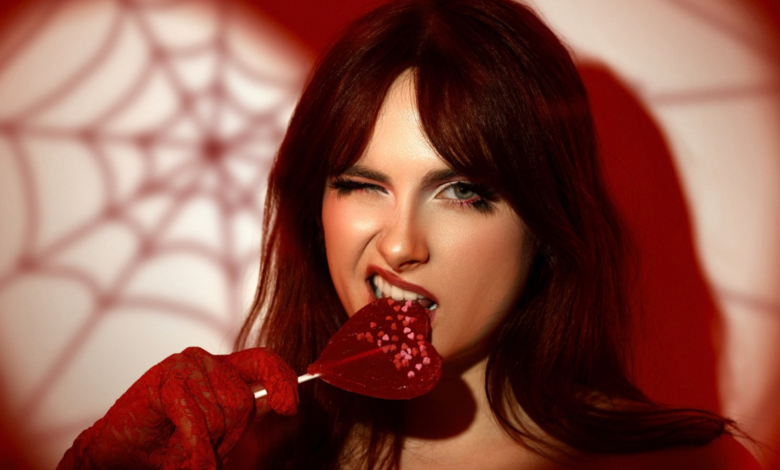
It’s the night before Halloween. As the lights go down at the Bread & Roses Theatre for Hourglass, a black meshed glove scuttles out from behind the black back-curtain. It gradually draws with it a young woman, and Alice Mayer as Charlie emerges onto the stage. Her hair is glossy scarlet, her red and black clothing tightly buttoned, and a bright red hourglass shape stamped on her back: the mark of the black widow spider.
Charlie is at the centre of a series of unfortunate events which have convinced her she is turning into a black widow. Describing a succession of toxic relationships she’s had with men, her anecdotes are nonetheless hilarious, and she quickly has the audience ensnared. She amuses with her playful puppet friend Emma, wild and untamed dancing, and comedic use of a hotdog… However, each relationship ends in a horrible death for any man directly involved with her.
Mayer is captivating, delivering a measured, quietly manipulative performance. At one point she frames Charlie as a Disney princess, innocent and shiny as she bursts into warbling song, before later going through a wild and untamed ‘ho phase’. But even as she stumbles over the term “copulatory suicide”, as if it’s too hard for her pretty little brain, it soon becomes obvious that this is intelligent, confessional storytelling which masks horribly unsettling truths.
From early childhood Charlie has experienced abusive male behaviour, within a society complicit in making violence from men acceptable. But now an hourglass has turned. Time is running out and an audible, ticking clock marks the inevitable approach of a future where unchecked action has appalling, violent consequences.
In this debut piece, grounded in personal experience, Mayer’s writing is meticulously structured and paced. Events twist and turn, incrementally forming a web that wraps the spectator up in presumptions, judgements, and complacency. In its staging, it’s often the unstated that makes the subtext explicit – the costume changes that signal Charlie’s emotional state, and a curated soundtrack that concisely places the action in time periods and places.
Layers of psychological threads connect until the web is complete and at the centre a moment of graphically-described horror is revealed that stops us in our tracks. The intensity is palpable. The play challenges the judgement Charlie faces for how she looks, what she wears, how she moves – perhaps by this audience, initially enjoying the stereotypes in a hilarious night out.
Questions arise about consent, gaslighting, victim shaming, and those who enable assault to go unpunished. Her terrifying truth must be abstracted for her emotional survival, with the form of the drama momentarily changing shape into verse, allowing Charlie to voice her unspeakable experience in a distanced, liminal space. Any residual humour becomes shadowed by darkness in a twist that is unexpected and satisfying.
This is an excellent production by Mayer, with its power held in its precision storytelling, each slim thread adding to a spiral of deadly decline, combined with its comedic elements. But where it really bites is in the traces it leaves behind for the audience to take away: those understandings of gaslighting, how a named police officer might dismiss the importance of sexual assault, how language is twisted to redescribe it, and how ordinary people can be complicit through complacency.
It’s an excellent choice for GrimFest, and a chilling warning to us all that the sands of time are running out on toxic masculine behaviour.
You can read more about the show in our recent interview with Alice Mayer.
Written by Alice Mayer
Produced by Caleb Lee
Lighting design by Celine Effendi
Stage Manager: Mega-Hollie Robertson
Hourglass has now completed its run at the Bread & Roses Theatre as part of GrimFest.