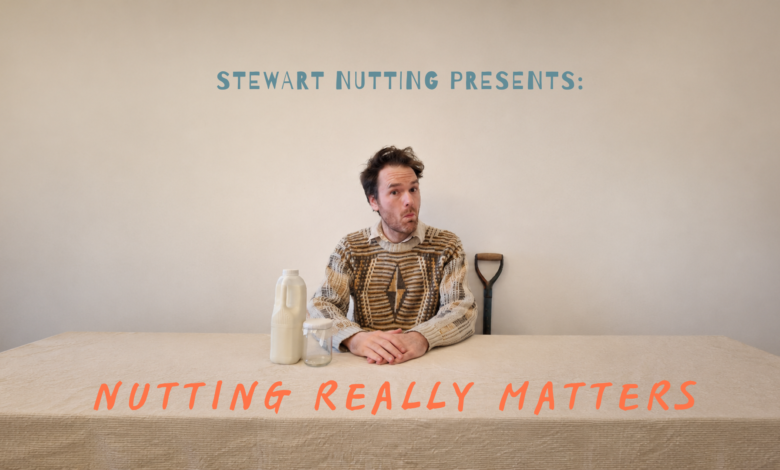
Stewart Nutting on ‘Nutting Really Matters’ at Aces & Eights
After the success of our 2025 Camden Fringe Interviews, we thought it only right to attempt a repeat for 2026. So throughout July we’ll be publishing new interviews each day to give a taste of what to expect from London’s best fringe theatre festival. The festival starts Monday 3 August this year, so we may give ourselves a couple of days off inbetween the end of the interviews and the first shows… then again, we might not.
You can find out more about Camden Fringe, along with details of every show playing this August here. You can also find all of this year’s interviews as they are published here.
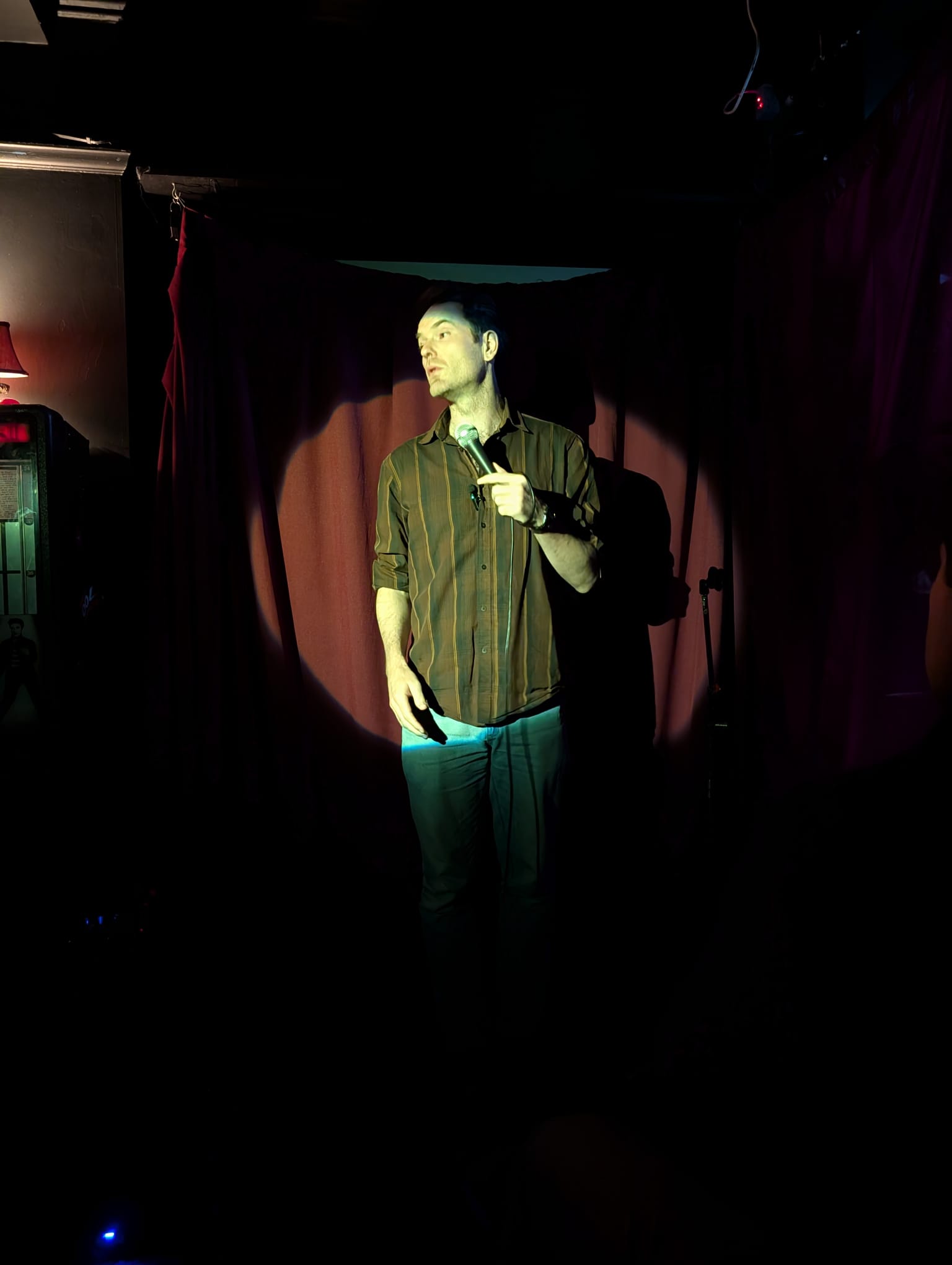
What do you get when you mix three years of open mic gigging, overthinking, nihilism, awkward social failures, and a jar that allegedly contains Mikhail Gorbachev’s fart? You get Nutting Really Matters, the debut stand-up comedy hour from Leicester-born comedian Stewart Nutting.
Coming to Aces & Eights this August for Camden Fringe 2026, the show is a thoughtful, slightly bleak, and quietly whimsical exploration of trying to care in a world that often feels entirely meaningless. Turning big existential questions into deeply human, laugh-out-loud moments, Stewart tackles anxiety, burnout, and emotional survival with a sharp blend of story-led reflections and absurd fixations.
We caught up with Stewart to discuss turning alarming dinner-party thoughts into stand-up, settling creative disputes between writer and performer, and why success means making people feel a little less alone in their overthinking.
If you had to describe the vibe of Nutting Really Matters in just one sentence, what would it be?
The vibe is thoughtful, slightly bleak, and quietly whimsical comedy about trying to care in a world that often feels meaningless, brought to life through personal stories, awkward social observations, and absurd fixations that turn big existential questions into funny, human moments.
Why is 2026 the absolute right moment for this debut hour?
For me personally, 2026 feels like the right time because this show is the culmination of about three years of writing, gigging, and figuring out what kind of comedian I am. It’s my debut hour, so it feels like the clearest expression so far of my voice as a performer: story-led, reflective, a bit absurd, and interested in how people keep going when life feels uncertain.
More broadly, I think it’s a good time for a show that talks honestly about anxiety, burnout, and meaning, but does so in a way that is ultimately affirming. The world feels quite unstable and exhausting, and I don’t think audiences necessarily need a lecture about that, but there is something comforting in laughing at the contradiction of it all.
What was the “eureka moment” behind putting this specific hour together?
There wasn’t one dramatic lightning-bolt moment. It was more that, while writing for the open mic circuit, I noticed I kept gravitating towards the same kinds of material: overthinking, nihilism, awkwardness, social failure, and the strange little things people cling to when they’re trying to make life feel meaningful.
At some point I realised those bits weren’t separate. They were all circling the same question: how do you keep going, and even enjoy life, when you’re not entirely convinced any of it matters? It felt like the kind of show I would have liked to see when I was younger and struggling with some of those questions myself.
Is the final show how you originally envisioned it when you started?
The original idea was more linear: a kind of chronological evolution of my philosophy over time. Childhood, nihilism, existentialism, then some sort of resolution. As the show developed, it became more thematic and more cause-and-effect based.
It now jumps around a bit more in time, but that actually makes it feel more cohesive. Instead of simply saying, “this is what I thought at this age,” it follows the patterns underneath: trying to fit in, trying to explain the world, trying to connect, and eventually trying to choose what’s worth caring about.
How does performing this material feel compared to everyday life?
It’s quite a natural role for me because I’m essentially playing a heightened version of myself: someone who overthinks, tries to make sense of everything, and occasionally says something so bleak in a social situation that it should really come with a safeguarding policy.
The show gives me permission to verbalize things I might not say in normal life. There’s something quite liberating about taking thoughts that would be alarming over dinner and putting them in a context where people have opted in, and where the jokes stop it becoming unbearable.
What has been the biggest challenge in realising the writer’s vision for the show?
As both writer and performer, there have been some creative differences. The performer wanted to incorporate more circus skills; juggling, acrobatics, possibly a hula hoop section, but the writer felt that might distract from the key themes of nihilism and emotional survival. We’ve compromised. The show is broadly as the writer intended, except at the end I hula hoop while juggling knives and flames.
What does “success” look like for you this August beyond selling tickets?
Success would be people leaving feeling that they’ve seen a comedy show first and foremost, but also that they’ve taken something small and reassuring from it. Because the show deals with quite bleak subject matter at times, the challenge is making sure it still feels funny, open, and human rather than heavy. If people laugh, recognise themselves in it, and leave feeling slightly less alone in their own overthinking, that would feel like a real success.
Who would play you in the Hollywood adaptation of your future autobiography?
Ideally I’d play myself, but if we’re casting properly, I’d be honoured by anyone from Neighbours. Alan Fletcher, who played Karl Kennedy, would bring real gravitas. Harold Bishop would also be excellent, although possibly too much raw sexual charisma for the part.
If your show was a love letter, what would it be to?
It’s probably a love letter to my younger self, growing up in Leicester around the early 2000s and trying to deal with thoughts he didn’t really have the tools for yet. It’s not saying, “don’t worry, we solved everything.” It’s more saying, “we found a way to live with the questions, and occasionally even have a nice time.”
Did writing the show answer any of the big philosophical questions it set out to explore?
Not really. The show starts with me trying to work out whether life has any inherent meaning and ends with me trying to decide what to do with a jar that allegedly contains Mikhail Gorbachev’s fart. If anything, the questions got stranger. But I think that might be progress.
Many thanks to Stewart for spending some time chatting to us. Nutting Really Matters will play at Aces & Eights on Thursday 20 August as part of Camden Fringe.