

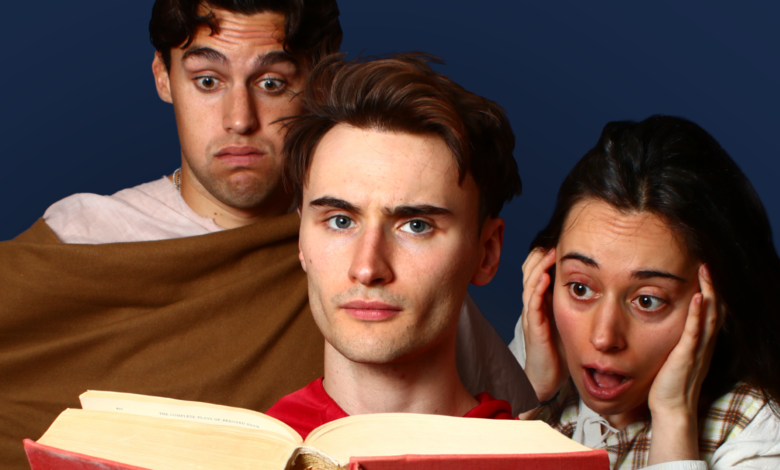
Writer and Director Esalan Gates discusses God Save Us!
History has a habit of repeating itself, especially when it comes to money, religion, and the absurdities of those in power. In God Save Us!, writer and director Esalan Gates takes us back to 1066 in the wake of the Norman Conquest. But rather than a solemn historical drama, Gates delivers a sharp, comedic farce that draws striking parallels between 11th-century peasants grappling with an alien legal system and the modern struggles of navigating economic uncertainty and social upheaval.
Ahead of the show’s run at the Lion & Unicorn Theatre as part of the Proforca Theatre Company’s Here | For season, we sat down with Esalan to chat about reclaiming ordinary stories from history, blending Gothic aesthetics with cheeky modern warm-ups, and finding lightness amid heavy themes.
What initially sparked the idea to write God Save Us!, and what drew you to 1066 and the aftermath of the Norman Conquest as a comedic backdrop?
I had the idea for a couple of years that there was a parallel worth exploring theatrically between the way the lower-classes are excluded from conversations around money, and the way in which medieval peasants were barred from an understanding of their own religion. The church in those times was the centre of their lives: it was also the communal hub, and the church held real economic and legal power.
I then read Normal Women by Philippa Gregory, in which she details the lives of regular women throughout history, given that typically only women of very high status are remembered . She briefly mentions a Yorkshire woman named Asa who is noted in the Domesday Book: she was able to retain her landownership throughout her marriage and subsequent divorce. Another woman wouldn’t get divorced for centuries following the 1066 invasion, and in Yorkshire alone, the number of female landowners decreased by 79% between 1066 and 1086. Asa and her predicament as she grapples with a new administration who rejects female power is the historical struggle that the play revolves around.
I also think there is a lot of power portraying serious issues against a comedic backdrop – I’ve found that it’s easier to explore nuance and contradiction as the genre lends itself to it, and the lightness serves as a counterbalance.
Joan’s scheme involves putting on a village morality play, which spirals out of control. As a writer, what made theatrical storytelling itself such a fun lens to explore ordinary people reclaiming agency?
I love a play-within-a-play, especially when the script is filled with secrets and deceitful villains; it becomes a wonderful way for the characters themselves to be intentionally subversive and control their narrative in miniature.
I’m also keen to embrace materiality amidst the increased acceptance of artificial intelligence in our everyday lives, and a medieval play-within-a-play is fertile ground to employ classic theatrical techniques that rely on real artistry. I’m lucky enough to be working with the brilliant Set & Lighting Designer, Tom McVeigh, and stunning Costume Designer, Sarah Randall. A feature of our play-within-a-play is the use of what we’ve termed ‘live footnotes’ that Joan (Julie Joubert) has directed her partner-in-crime, Stephen (Charlie James-Howard), to brandish across the stage at various inflection points. Tom has painted giant A1 notecards with illustrated Gothic letters. Intentionally making space within a script for the team to create art in the real world feels increasingly significant as so much of our lives and creative input and output is digitised and automated. It’s also a Brechtian nod given Joan’s socialist politics – not that she would know that!
Theatrical storytelling is so much fun within a play, but it’s important to make sure the cast don’t feel like there’s a pressure to try to portray their characters as ‘good actors’ themselves – we had lots of conversations in the rehearsal room about the style of acting at that time, and how it’s full of demonstrative gesture. We landed on something that pulls on medieval theatrical storytelling with some cheeky anachronistic flair: Stephen performs classic modern-day warm-ups that any audience members in the theatre industry will get a kick out of.
Although set nearly a millennium ago, the premise touches on alienation caused by changing laws, tax shifts, and gatekept information. How much were you looking at contemporary society when writing about these 11th-century villagers?
I find it really useful to write about today through the eyes of a different time – I remember realising in school that Shakespeare wrote so many different plays about changes in leadership because of the enormous disruption caused by volatile monarchic rule throughout the 1500s, ending with Elizabeth I’s lack of an heir and the public’s consequent escalating anxieties about what fresh hell awaited the country upon her death.
The play is very much about language and how elitist attitudes operate in both right- and left-wing politics. The church services are all in Latin and now being whispered to prevent the villagers’ understanding; the French have just invaded and the language of power and court is no longer English; Asa is from Yorkshire where there was a large Viking presence and her accent is unheard of when she arrives in the village; the priests deliberately use complex words and references to alienate the villagers and encourage resignation towards their predicament; the use of the live footnotes is all well and good for Joan, who was taught to read by the local nunnery where she grew up, but the rest of the village can’t understand the point she’s trying to make. I feel like we’re living in a time where we have more access to information than ever, and yet there is almost an intentional attempt to misunderstand each other, even a disinterest in it in favour of spouting our own opinion, be it online or in person.
How does God Save Us! build on your previous writing with Codex Theatre?
The remit of Codex Theatre is to make work that takes complicated, inaccessible ideas and to break them down into clear, entertaining stories. Pop Goes the Dollar did that through taking the 2008 financial crash – an event with a nuanced and tricky lead-up – and turns it into a thrilling drama full of heart. The seed of God Save Us! was an exploration of the mirroring of our relationship with money and the historic relationship between the medieval lower classes and the church; as I wrote, the show grew beyond that to encompass several other themes, but I do find that I often begin a new project from the perspective of something economically interesting.
You both wrote and directed God Save Us! How does your director’s brain interact with your writer’s brain during rehearsals; do you find yourself rewriting on the floor, or do you strictly protect the text?
I’m a lot better at it now. The first time I directed my own writing, I was 20 and mortified at hearing my own words aloud in the rehearsal room. Now, I’m much stronger at dropping my writerly insecurities and switching gears into directing mode; I edit live, I’m not precious about lines and am always keen to go with the best idea in the room, it doesn’t have to come from me. There are a couple of jokes in God Save Us! that emerged from line fluffs or spontaneous re-phrasings by the cast that suited their characterisation better. I’m always intent on protecting the play, not the text; what that means is that I will make every decision in service of what is best for the play as a theatrical experience, and if that means cuts, I’m more than happy to do that.
Codex Theatre was selected out of over 50 applicants to be part of Proforca Theatre Company’s Here I For season at the Lion & Unicorn Theatre. What does being part of a curated season supporting breakout fringe work mean for you and the company?
It’s an incredible opportunity, I’m so grateful to David Brady and the Proforca team for offering this chance to theatre professionals and companies who are working to make that leap from early to mid-career. An endorsement – both literally and financially – of this sort is invaluable in itself, but the support and encouragement has been instrumental in allowing this play to flourish. It’s also lovely to be part of a season of work and therefore a wider community of excellent theatre-makers, and I’m so excited to see the other shows by Pither Productions, LadyBird Productions, and of course, Proforca.
The Here I For scheme provides financial, rehearsal, and marketing mentorship to help shows scale beyond a single fringe run. How has this extra structural backing impacted the scale and ambitions for God Save Us!?
It elevates my capacity, crucially. I have often been both director and producer – including on the one-man show, Maybe I Should Stop, that I just finished touring the UK with support from Arts Council England which also began its journey at the Lion & Unicorn Theatre in 2024 – but the additional responsibility as a writer makes a project like this a heavy burden without support, especially as I also work full-time in Development at the Bush Theatre. A great example of the lightened load is the PR support we’ve received from Matthew Parker as part of the Here | For season; it means that I can operate as a creative for a far greater percentage of my time, leading to a stronger rehearsal draft, as well as presence of mind as a director in the rehearsal room and design meetings. The financial support also allowed me to work with an incredible creative team and not resign myself to shortcuts: we’ve worked with a brilliant Fight Director, Orlando Squires, and Assistant Fight Director, Annie Porter, which has been such a joy and elevates the quality of the work exponentially.
When audiences walk out of the Lion & Unicorn Theatre after 75 minutes of medieval chaos, what do you hope stays with them most?
I hope they had the biggest laugh they’ve had in a while, and then search up Asa and changes to women’s rights in the wake of the Norman invasion in 1066. It’s both a big, silly farce with small-town hijinks and slapstick physical comedy, and a sly provocation that it hasn’t always been a steady upwards trajectory for women’s rights. It’s so easy to say, “well, at least it’s better than it used to be”, but these days it feels as though the idea that we can’t slip backwards is becoming increasingly uncertain.
God Save Us! will play at Lion and Unicorn Theatre from Tuesday 6 to Saturday 10 October as part of the Here | For Season.
You can read more about the season here.




One Comment