Playwright Paul Kalburgi and director Kay Brattan discuss We’ll Always Have Paris
A famous movie line. An intimate black-box theatre. And a profound look at the things we lose, and find, in the wake of grief.
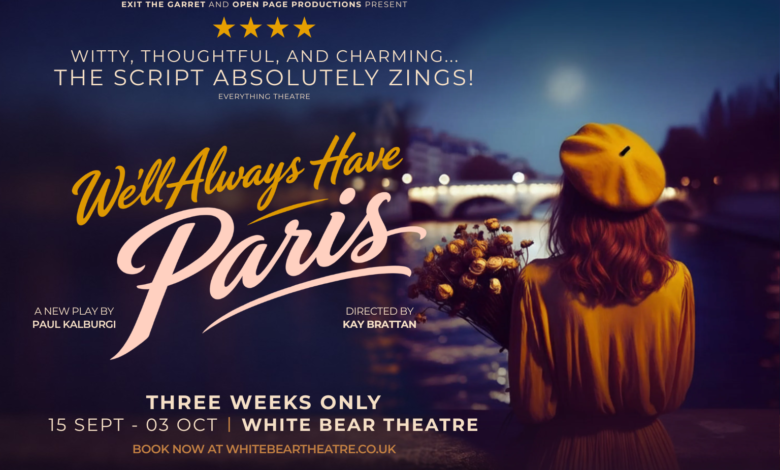
We’ll Always Have Paris first captured audiences during Bespoke Plays’ script-in-hand series (you can read our review here), proving instantly that it was a play destined for a bright future. Now, it is set to make its official world premiere at Kennington’s White Bear Theatre. It’s a brave, bittersweet new piece of writing that pulls no punches.
Just before they head deep into rehearsals, we caught up with writer Paul Kalburgi and director Kay Brattan to discover what makes this cleverly scripted story a must-watch. Film buffs and theatre lovers take note: this one is well worth the travel (and luckily, the commute to Kennington is much shorter than a trip to France).
How would you describe We’ll Always Have Paris in one simple sentence?
Kay: We’ll Always Have Paris is a story about the journey we go on when we’re searching for a new beginning.
Paul: I’d echo that… “a rom-com with a broken heart”, one that begins where most love stories end.
The title invokes one of cinema’s most famous lines about memory, nostalgia, and bittersweet looking back. Was that always going to be the title or did it become obvious only during the writing process?
Paul: The title came quite late in the writing process, once I realised just how deeply cinema had become woven into the DNA of the play. Ginny experiences the world through films, they’re her escape, her comfort, and the lens through which she understands love. We grow up believing in meet-cutes, grand gestures and happy endings, so when life doesn’t follow the script, where does it leave us? That’s where we find Ginny.
Before it found its title, the play was actually called Two Person Assembly, a reference to Ginny repeatedly trying, and failing, to assemble an IKEA Billy bookcase on her own. It became a lovely metaphor for rebuilding a life that was never meant to be built alone.
The show started life as part of Bespoke Play’s script-in-hand performances. What did that experience teach you about your play and its characters?
Paul: The staged readings at the Union Theatre were a fantastic opportunity to take the draft that emerged from the earlier R&D workshop and see what actually stuck. Every playwright secretly worries, does this actually work in front of an audience? The script-in-hand performances answered that question. I discovered where people laughed, where they cried, and where the play still needed work and a little tightening for pace.
The readings also gave us the opportunity to experiment with casting too, and I genuinely couldn’t be happier with the result. Cyril Blake and Eliza Williams join Miranda Colmans as Ginny, to create an extraordinary trio. Multi-rolling takes a very special kind of actor; between them, Cyril and Eliza play more than a dozen characters, so I’m incredibly excited to watch them populate Ginny’s world and bring her story to life.
And how much has changed since that work-in-progress performance?
Paul: The DNA of the play has remained remarkably consistent. There have been no wholesale rewrites, but I’ve spent the last eighteen months interrogating every scene, every joke and every emotional beat, always asking whether it earns its place. As a result, this first full production is leaner, sharper and tighter, particularly in terms of plot logic and storytelling.
Some of the biggest changes, especially around the opening of each act, have actually come from the practical realities of staging the play, and I genuinely think it’s stronger because of them. I’m also very aware that the play is being published alongside the production, so I’m quite keen for the published playtext to be as close as possible to the version audiences see on stage.
There are clearly plenty of throwbacks to the classic days of movies, from the title all the way through to your lead character working in a cinema. Are there lots of hidden easter eggs for cinephiles to hunt out in the script?
Paul: Oh, so many! There are obvious references, hidden quotations, visual nods, tiny props, parallel lines of dialogue, and a few moments only the most obsessive film lovers are likely to spot. But equally, you don’t need to recognise a single one of them for the story to work.
Kay, how did you get brought onboard as director, and what was it that attracted you to this script?
Kay: When I first read the script, I immediately connected to Ginny’s story. Over the last few years, I’ve gone through some life-changing events. My father passed away suddenly in 2023, and since then it feels like my life has been divided into two timelines: the one where he was here, and the one where he isn’t. Since then, stories about grief have kept drawing me in, because in many ways they’ve helped me process my own. Grief isn’t linear. It ebbs and flows, pulls you backwards and forwards, and makes you do things you never imagined you’d do.
I found myself on a journey that wasn’t all that different from Ginny’s. In the wake of losing my dad, I realised how short and unpredictable life is. I took a leap and travelled to the other side of the world to tell someone I loved how I felt. It didn’t end the way I’d hoped, but it taught me that if I had the courage to put my heart on the line like that, then I had the courage to keep doing brave things.
That’s why Paul’s play resonates with me so deeply. It’s easy to think this is just a romantic story, but I don’t think it is. I think it’s about finding the courage to begin again. It’s about choosing yourself, embracing change instead of fearing it, and understanding that your happily ever after can’t begin with someone else, it has to begin with you.
The White Bear has a stellar reputation as a ‘New Writing Powerhouse’ but, like many fringe venues, it offers an intimate, close-quarters relationship between the actors and the audience. How are you planning to use that compact geometry to heighten the play’s emotional tension?
Paul: The White Bear was always my first choice. Because it’s so beautifully intimate with it’s dual aspect thrust, the audience aren’t simply watching Ginny’s journey, they’re very much sharing the space with her as she navigates it.
I think what I admire about the White Bear is that it doesn’t simply stage new writing, it curates it. Michael’s programming is consistently ambitious, introducing London audiences to outstanding new plays from both the UK and overseas, so it just felt like exactly the right place to premiere this play.
Kay: There’s very much a fly-on-the-wall quality to this piece, but because Ginny speaks directly to the audience throughout, they become much more than observers. They’re her confidants, her cheerleaders, the people she turns to when she needs someone in her corner.
That’s something we’ll continue exploring in rehearsals, but I love the idea that the audience’s relationship with Ginny shifts alongside her emotional journey. As she changes, so does their role in her story.
The White Bear is the perfect space for that kind of intimacy. I keep thinking about the tiny independent cinema I grew up going to with my dad. It was old, full of character, and felt completely different from a multiplex. It wasn’t just somewhere you watched a film, it felt like stepping into another world. You knew the building had stories of its own, and there was something deeply personal about sharing that experience with a room full of strangers. That’s the feeling I want this production to have.
Paul: We’ve also been very ambitious with production design and staging, so I’m also incredibly excited for audiences to walk into the space. I won’t spoil anything, but We’ll Always Have Paris is technically far more ambitious than people might expect from fifty-seat fringe theatre, and I hope what’s waiting for them before the play even begins feels quite special.
Kay: Absolutely. With a beautiful set, carefully chosen projections and an emphasis on storytelling, I want the audience to feel as though they’re stepping into one of those nostalgic little cinemas where the space itself has a personality. Somewhere that invites you in, wraps itself around you, and lets you laugh, cry and fall in love alongside Ginny.
If you were heading away for a romantic (or purely platonic, the choice is obviously all yours) weekend, would Paris be your destination of choice, or could we tempt you with somewhere else?
Paul: The correct answer is Santorini, that’s where I married my husband. But having said that, Paris definitely has an almost mythical allure for writers. I’m actually heading there next week, and one of the things I’m most excited about is seeing the two Ionesco plays that have been running together every night since 1957; possibly the longest continuously running fringe productions anywhere in the world! I’ll also be making the obligatory pilgrimage to Shakespeare and Company to pick up a copy of Ulysses, which I’m finally going to read. That’s probably about as romantic as it gets for a playwright.
Kay: I’d happily go back to Paris, but if I could choose anywhere right now, I’d probably pick Bucharest. There’s something incredibly appealing about the idea of visiting Dracula’s Castle. Maybe it’s because I was a massive goth in my twenties, but haunted places have always felt strangely romantic to me. Forget candlelit dinners, I want misty forests, old castles and ghost stories.
Our heartfelt thanks to Paul and Kay for their time. We’ll Always Have Paris will play at the White Bear Theatre from Tuesday 15 September to Saturday 3 October.