Interview: Dickensian drama, a silent movie score and an intriguing tearoom of secrets

Roman Stefanski gives us a taste of Mr Moore’s Bizarre Secret Society
It’s always exciting to learn about a new family production, but especially so when it brings a touch of mystery along with it. This October, Mr Moore’s Bizarre Secret Society, written by Gloria Danili and directed by Roman Stefanski, comes to the stage at the Bridewell Theatre – and how intriguing is that title? We were keen to find out more about the show, so rang for Roman to spill the T.
Hi Roman. Thanks so much for stopping by to tell us about Mr Moore’s Bizarre Secret Society. Firstly, what can you reveal about the plot?
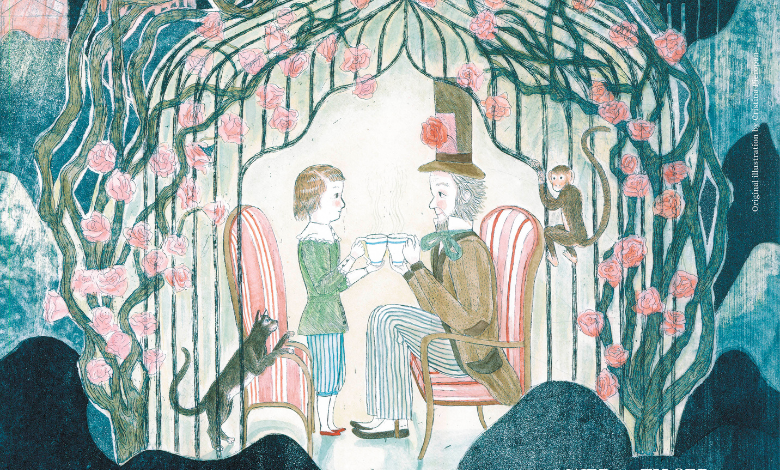
The story is about Mr Moore, who comes from an orphanage, but is cast out when debt collectors come to visit. He goes to London, where his journey coincides with the young Leopold’s journey into town: Leopold is going to live with his strict uncle, the authoritarian lawyer Vernon. So these two characters are running side by side, and cross over with each other. Mr Moore happens to stumble across a fantastic conservatory full of overgrown plants. But unlike any other conservatory, this particular one was where a certain princess enjoyed tea tasting in the past. Mr Moore and Leopold then form their own bizarre society of tea tasters, one that causes them to get in trouble with the law, including Vernon and indeed including Queen Victoria.
What features of the Victorian setting have you enjoyed leaning into as director?
I so much enjoyed going to see Charles Dickens’ house, when we filmed our trailer there. I didn’t realise that he had lived in the King’s Cross area, and we actually visited his home. It is spine chilling or goosebumping seeing the various things related to him – realising that, yes, this is the desk where he wrote various stories; this is the style of the furniture; this is the room; this is the food they were eating. That is inspirational. Obviously, as a fringe theatre production we can’t have all the Victorian trinkets we saw, so we have to be a bit inventive with things, and we have lots of exciting suggestions used in the design, from lighting to projection, to link us through into Victoriana in a nice, evocative way – let alone the acting and various bits of scenery that bring the era to life.

How’s it been working alongside writer Gloria Danili?
She is so excited and passionate about the show and its world, her eyes sparkle. She knows Sarah Finch (who plays Queen Victoria), who knows me, and so the three of us have had great fun bringing this all from page to stage. She’s a prop collector, and her love of theatre is just delightful. Gloria loves theatricality and has a wonderful vocabulary as well, so she uses exquisite sentences in her script, and subsequently there’s a real charm to the play. We’ve done a huge amount of work in adapting this children’s book for the stage, and she as the writer has had an enormous amount to create, while somehow being able to let go of things, which I would find very difficult. I have a huge amount of respect for her being able to do this. I myself am hopeless about letting things go. I’ve got a house full of stuff that I should dispose of physically, let alone mentally!
Can you tell us about the music for Mr Moore and how it adds to the atmosphere?
With any production it’s about how you convey the style, so working with Jane as the designer, we’re coming up with lovely, lovely, simplified things that can have meaning. Then with Neil, the composer, it’s about how to make things meaningful in music terms. Neil and I have actually worked together a few times years back, so it’s a joy that we were able to invite him to join us. There is a wonderfully theatrical but sort of cinematic element to his music: it’s episodic, creative, scenery descriptive – that sort of thing. And he’s great at his job. He seizes an idea, sends a recording, and you can really feel the story in it. So, a skilled composer, an engineer, and with a range of abilities. We’ve seen him on TV; he follows films, and he’s an accompanist to the old black and white, silent movies. I’m delighted to be working with him again on the show and thrilled by the lovely motifs, and rich, evocative themes he has conjured.

You have some outstanding names in the cast list including Michael Bertenshaw, who is such a familiar face on stage and screen, and the voices of both Linda Bassett and Michael Rosen. Tell us about what they bring to the show.
They bring that experience and gravitas, but also a love of theatre that’s common amongst actors. TV and film bring in the dosh, but theatre brings in the spirit, brings in the joy, brings in the live action and the one-to-one with audiences. Delightfully, these three pros are tickled pink to be part of the production. They love the script, and they’re keen to join in. Linda and Michael Rosen I’ve worked with before and it was great fun. Linda was for TV, and Michael was for another play. And again, when you have colleagues that are also great veterans like these, it’s lovely to share time and space and beliefs with them and to then create together, making the story work. Michael Bertenshaw, I haven’t worked with before, but as you say, he’s a TV fixture as well, and he’s got a delightfully wicked glint in his eye. So I’m thrilled with the team because we’ll be able to really come up with ideas and try out things to make it work. It’s a quick process. We’ve only got two weeks to rehearse, but with a group of pros like this we are able to pick up and run fast and far. It’ll be great, great fun to work with all three of them and I’m just delighted already.
This is a production for all ages, rather than only for children. What do you enjoy about producing work that the whole family can enjoy together?
Well, initially, Gloria wrote something for an older audience, but the charm in the way that she writes is really very encompassing for the whole family, so it reaches down to the eight-year-old and naturally opened up the range. For me, I just love a family show where everyone is being entertained, from the youngest to the oldest. I’ve worked in TYA (Theatre for Young Audiences) nearly all my life, and the personal joy I have is sharing a production and watching the young audience take it on board, learn from it, become entertained by it. I mean, the most beautiful noise, really, in theatre is where you have a young, young child, maybe three or four years old, chortling with joy. That just warms you up no end. It puts a smile on my face, and I feel personally proud that I’ve been giving good work to a young person that is actively affected by it, knowing how the experience of the work colours their future. We’ve had many audience members that have stepped into the theatre business, whether it’s backstage or onstage out front, and I get a buzz out of the fact that I’m able to create work that’s all-encompassing, inspiring, and reassuring, entertaining, fun.
How does the intimate Bridewell Theatre fit the style of the play?
Bridewell is an amazing space because it is was a swimming pool, with wash house and laundry facilities. I mean, we’re talking a beautiful Victorian building, so it’s a natural, natural space for our Victorian show to perform in – and I mean, we literally are playing on top of the swimming pool! To be clear, we’re sitting on top of it as opposed to in it. But you’ve got those wonderful green and white glazed tiles enhancing the shape of the space, and there’s a gallery above (which is of course where the changing cubicles were) that adds to the variety of playing spaces we can use to entertain the audience. It’s also restrictive, requiring us to adapt ourselves to those spaces, which is challenging, but is awesome as well.
The show runs for a week at the start of October, but do you have plans to take it elsewhere after this?
You very much hope that the various producers and venues coming to see the show may say “Oh yes, we must take it further, take it internationally, or make it bigger and let it go onto a main stage somewhere” or perhaps “This is charming enough to fit into this particular space, or that particular space”, so those are great, great fun ideas and hopes, fingers-crossed expectations. In reality, a lot of shows are ready to be picked up on, but they’re amongst hundreds and thousands, so part of a carousel there. But definitely, we’ll find what the feedback is like. We’ll find what the buzz is and the interest is, and if it is delightfully successful, then hopefully, yes, something will happen, and it’ll maybe go to Edinburgh next year. Definitely, it is not to be put away, but it will be there, ready and waiting to leap into action at some space near you for a future outing.
Thanks very much to Roman for giving us a secret glimpse into this intriguing production.
Mr Moore’s Bizarre Secret Society is a family show and plays at the Bridewell Theatre from Wednesday 30 September to Saturday 10 October.