Puppetry, original music and beautiful stagecraft work together to create a gentle, funny retelling of the Pied Piper, seen through the eyes of a heroic rat. Rating
Good
What’s the most difficult audience to keep entertained, do we think? I’m quite sure that several rows of wriggling children between the ages of 5 and 8 on a Saturday morning must be near the top of the list. All demanding entertainment, whilst consuming endless snacks, and keen to be vocal about any disappointment or boredom. This is exactly what Steve Tiplady faces at the press performance of The Pied Piper: A Rat’s Tale at the Little Angel Studios in Islington. Worry not: he and the play are more than up to the task.
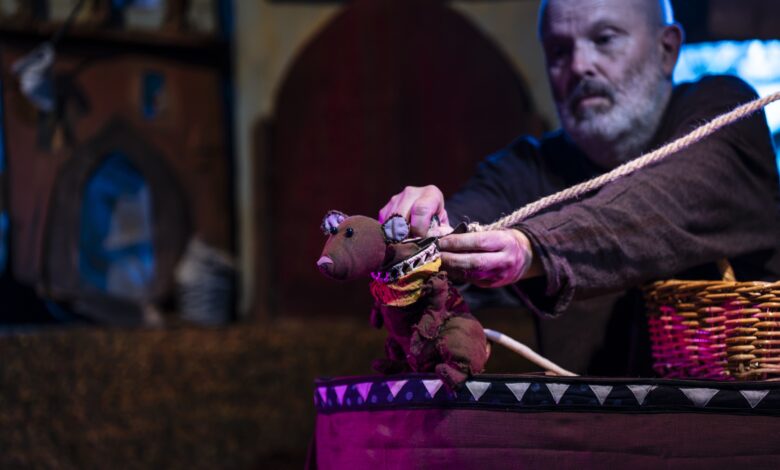
This is the most delightful of productions: gentle, kind, funny and intricate, with the most articulate and imaginative of puppets. Even before the action starts, the studio echoes with the sound of (appropriately) traditional pipe music. The initial set, designed by Michael Fowkes, is simple: a dark studio, two curtains at the back painted to form a green mountain range, and a decorated plinth front and centre. Soft lighting changes, designed by Kate Hounslow, emulate lapping waves.
Tiplady opens by immediately breaking the fourth wall and introducing the audience to the delights of rats. They are much better than cats and dogs, he assures them, promptly listing their many attributes before turning out with a conspiratorial gaze to proclaim, “And they can swim!”.
The show retells the Pied Piper of Hamelin from the perspective of Horatio, our rat hero. We learn first of the importance of family to him, through his grandfather Rathbone, and of how rat friends use tickling to cement their love and friendship. Horatio overcomes his fear of swimming but gets caught in the river current and heads “round the bend” to the land of the giants.
Then the centre-stage curtains open to reveal a backdrop of the town of Hamelin, which is beautiful: seemingly simple, but so cleverly constructed and instantly recognisable. Lights dance in the background to simulate journeys, while puppets of all shapes and sizes, human and animal, keep the story moving at a suitable pace. Throughout, Tiplady maintains a dialogue with the audience, who remain engaged and interactive, with a few location-relevant jokes thrown in for the adults.
A number of child-centred themes run through the tale, such as the need for kindness and acceptance, reinforced by several characters. The mayor’s greed is dealt with appropriately and the traditional ending is adapted to spare the children any existential dread.
Midway through, a particularly complex sequence involving several puppet changes and a lot of movement between upstage and downstage feels slightly clunky, but I have no doubt this will ease with time.
Tiplady stays focused on his audience, often moving in and out of the front row, as the children creep forward bit by bit, transfixed by the action. There is enough nuance to allow older children to engage with more complicated ideas, and he reaps his reward at the end, when they shout out the answer to the final riddle, drawing on information he gave them at the beginning.
Gentle without ever being dull, and funny for the grown-ups as well as younger children, this is a story that reaches all age groups and really is a treat for families with young children.
Written by Michael Fowkes, Steve Tiplady and Sally Todd
Performed by Steve Tiplady
Directed by Sally Todd
Set and Puppets Designed by Michael Fowkes
Composed by Mikey Kirkpatrick
Lighting Design by Kate Hounslow
Stage Management by Alex Hobbs
The Pied Piper: A Rat’s Tale plays at Little Angel Studios until Saturday 7 November.
Like what you’ve read? Then why not join the ET mailing list
Hear more about what we’re up to, shows to see and news about our Etties Awards