The pain of Oscar Wilde's extraordinary prison letter made palpable in a transfixing solo performance that beautifully blends intellectual and corporeal understanding.Rating
Excellent!
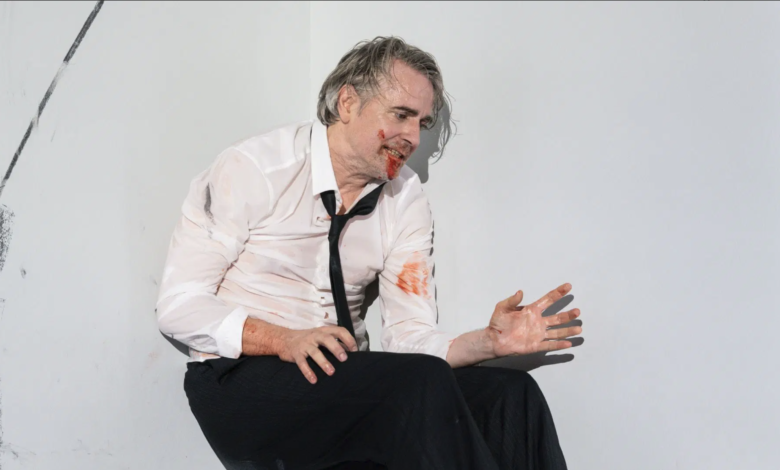
The term De Profundis translates as ‘from the deep’. Tragically, it was at the utter, lowest part of his life that Oscar Wilde wrote this amazing 50,000-word letter to his former lover, from Reading Gaol. He was imprisoned for two years for ‘gross indecency’ in a homosexual relationship, illegal at the time. Directed by Oliver Reese, the work is brought vibrantly to life here at the Coronet Theatre in an astonishing solo performance by Jens Harzer, simultaneously spoken in German and captioned in English. Mirko Bonné’s translation of the text runs for a full hour and 50 minutes, with the dramatisation accentuating and embellishing the original’s already profound depth and richness and the intensity of the performance passionately manifesting both the trauma of incarceration and the liberation of imagination.
With striking stage design by Hansjörg Hartung, Wilde’s cell is described by a half-box elevated above the stage in isolation. At times bounded by radiant light, the space is nonetheless always claustrophobic as it becomes the poet’s coffin for this half-life of imprisonment, where his only sustenance is his own artistic genius. Harzer first appears from darkness with merely his face and part of a theatrically funereal dress coat visible: one of the greatest of poets reduced to a shadow, yet still shining through. His decline then becomes clear: his garments are dishevelled, his props and possessions contained in a plastic bag. The shadows are interminably evident in clever staging where the small performance area is repeatedly redrawn by lighting that shrinks his world to nothing and makes the time within his sentence uncertain, even as its passing is marked.
Harzer gifts us an epic performance containing power, poignancy and deep humanity. With nowhere to go and reams of monologue to deliver, he keeps constantly active in jittery, repetitive physicality that underscores Wilde’s fragility, yet with fiercely emotional and moving speech. Through the early part of the letter, Wilde is a shining, ethereal visage as he describes the impact of the toxic relationship. He accuses his partner of lacking imagination and reveals how their proximity suppresses his own talent. As he describes Wilde’s mortal suffering, Harzer has him seek contact, reaching to touch walls and reimagining the space in whatever way he can to make change, however small; then, in his mental decline, graphically depicts shocking self-harm. But the production then transports us more deeply into Wilde’s imagination, where he escapes his prison. Through his exquisitely lyrical words and by heightening our senses, his genius is allowed clarity and soars. Even as the prisoner’s physical and mental limitations become palpable in his restricted, stifling space, we hear music and he still sings, despite his humiliation.
We are compelled to endure without pause alongside Wilde, but at times this hardship is softened by the exquisite lyricism of the words and Jörg Gollasch’s evocative soundtrack and music which shifts us incrementally through time. Temporal progression is also deftly marked by episodic set and lighting (Steffen Heinke) changes that give texture within an extraordinary unyielding performance.
Completing his sentence, Wilde appears as an unbreakable force made concrete as he steps from the box to address us in the closing section. Still today, his De Profundis offers themes that timelessly challenge – what it is to be human, to have a soul, to understand and be responsible for oneself, all of which are particularly relevant in a world where prejudice and intolerance are on the rise. This is a superb production with huge impact, truly achieving the Berliner Ensemble’s objective of making the audience think but also feel deeply.
Text: Oscar Wilde
German Translation: Mirko Bonné
Direction: Oliver Reese
Stage Design: Hansjörg Hartung
Costume Design: Elina Schnizler
Music: Jörg Gollasch
Lighting Design: Steffen Heinke
Dramaturgy: Johannes Nölting
De Profundis plays at The Coronet Theatre until Wednesday 7 October.