Director Cressida Brown has been nominated for ten Offie Awards, serves as the Artistic Director of Offstage Theatre, and has worked everywhere from the Young Vic to the Royal Shakespeare Company. Now, the award-winning director is taking on the digital world in Screens, currently playing at Theatre503. We caught up with Cressida to learn more about the play, putting Pokemon Go onstage and the slight difficulties that arise when your Producer and one of your actors are one and the same.
What was it that first attracted you to Screens?
Funny margins! I’d never seen anything like it. When I opened it on my computer Stephen [Laughton, playwright of Screens] had divided each page in half. One side was the written dialogue laid out like a traditional script, and the other side was packed with online content he wanted the audience to see. Ultimately in performance we ended up losing a lot of online content, but I was attracted to the challenge of making these two worlds live in unison onstage.
What should audiences expect from this show, and what do you hope they’ll take away from the production?
As with everything I direct, I hope that the audience will feel surprised throughout. I’m attracted to plays that do not attempt to answer, but rather raise, complicated questions. I hope that the audience will reflect on how they tend to automatically identify other people, as well as how they choose to present their own identity to the world every day.
How did you approach the show as a director? Did you have a specific vision in mind going in?
I knew immediately that it should not be staged realistically. I was brought on quite late, and it was actually quite nice not having any time to think about what my overall directorial vision might be, as it allowed that vision to develop collaboratively with the actors in rehearsals.
Screens covers a number of themes of identity issues. Was it a challenge to try to cover all of these in a single play without them merging into one?
Yes, is the honest answer. There is an awful lot to unpack in the show.
I approached it by being really clear with the actors about what their dramatic function was and how it was unique. We tried to be really clear about what made each of the characters’ personal journeys and revelations about identity completely different to, and opposed to, one another.
We did a lot of work pinpointing each scene’s major turning points and how each character changed and transformed accordingly from start to finish. We had to be particularly strict on ourselves, as the material is so rich we knew there was a danger it could say too much and therefore nothing at all.
Theatre503’s work tends to take on very modern themes, including the internet and social media. Was it difficult to find ways to display this digital world in a new way that works for a theatre audience?
I’ve never directed a show that depicted social media before, so it was all new to me. In fact, I think a lot of the digital content was even new to the audience. In one scene we have Pokemon Go being played, so it really was fresh off the internet.
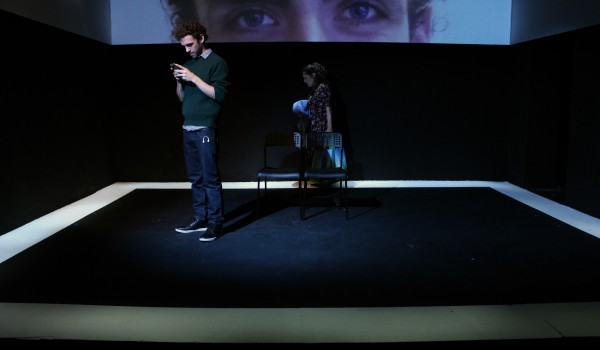
I certainly learnt that having any sort of digital content is a lot trickier than it looks. Budget and the restrictions of the space mean that you might have a rainbow of ideas that would look great at the Barbican, but really don’t translate well to a small space like 503. As so much of the digital content is projected simultaneously with the live action, you really need to be clear through font, size, image, speed, and placement when you want the projections to interrupt the live action and when you want it to support it.
We decided that less was more, and to veer on the side of abstract; I and Richard Williamson, the video designer, worried that if we attempted to be too realistic, we would get lost in the detail of icons, rather than grab the dramatic essence and intention behind each projection.
What was the thought process behind Screens’ very minimalist design?
The only props were mobile phones and the dead cat. These were the only props that felt important to me, so why bother with any others!
Georgia Lowe (Design Consultant) and I saw each of the scenes as people unable to communicate properly with one another, so we wanted to play with the idea of every scene being a boxing match. On the outer edges of the ‘boxing ring’ was a secret online world shut off from personal relationships – the only relationship on these outer edges was your phone. Inside the ‘boxing ring’ you were confronted with individuals with whom you had to disarm of their phone (or their cat!) in order to have a proper conversation.
And of course the ‘boxing ring’ looks a little like it could be the screen of a TV or a phone. We didn’t shy away from the implication that all these characters are trapped in their own way by screens.
Paul Bloomfield has the unusual dual role of actor and producer in this production. Did that duality make things easier for you during the creative process, or did it have its own challenges?
I would always advise any director to make sure your producer is not one of your actors. Fortunately Paul was very good at swapping his producer’s and actor’s hats with ease – but my giving ‘actor feedback’ to the other creatives in our private production meetings certainly got thrown out of the window very quickly as Paul was present!
Finally, what’s next for you?
I’m continuing work with Offstage, my theatre company, but also focusing on a book I am compiling for the centenary of the female suffrage in the UK in 2018. I am interviewing female theatre practitioners from all walks of theatrical life – from casting directors to stage managers – in order to celebrate their contribution and to record their outlook on theatre. So, next I’ll be the one asking the questions.
Screens plays at Theatre503 through 3 September. Tickets can be booked here.