


Assembly Roxy – Central
A bizarre, bewildering comic curiosity that exquisitely exploits the peculiar space between life and animation. You will gasp, you will laugh out loud. You will remember it to your dying day.summary
Rating
Unmissable!
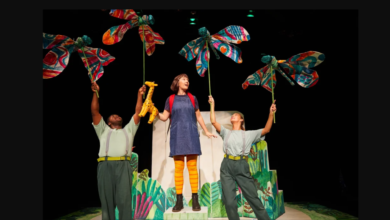
You will surely never see another show like this one! Famous Puppet Death Scenes is a quite extraordinary performance about death, itself excitingly alive with invention. It consists of a series of bizarre, often absurdly comic scenarios in which numerous odd characters meet their demise. Each capsule story is meticulously crafted, with an enormous variety of puppet forms used alongside human actors, but all have deaths as a common theme – some more gruesome than others.
There is an exquisite, grotesquely warped aesthetic to the production, which is equal parts bewitching and bewildering. The stage is set as a traditional puppet theatre, draped in theatrical red and white striped curtains, with a circular screen above, reminiscent of an ‘all seeing eye’, on which captions are displayed. A repetitive series of endlessly inventive – often stunningly beautiful – sets provide the backdrop for each gory scene.
The stories are performed with poised, professional precision by the talented team of Louisa Ashton, Aya Nakamura and Teele Uustani, who not only skilfully characterise and manipulate puppets but employ impeccable timing in their delivery, resulting in truly electric tension and explosive laughter. The excruciating anticipation of what might come next is almost tangible, leaving the audience perching on the edge of their seats, till relieved only by another death. The stories are often hysterically absurd or ridiculous – such that at times I was laughing so hard I was literally crying – but can be piercingly simple; enacting a last breath, but spotlighting it at centre stage.
Highly defined and atmospheric lighting gives accent exactly where needed, or leads the eye across the set to emphasise points in the performance. A captivating, exotic, eclectic soundtrack offers anything and everything from high end opera to fart sounds. This makes the use of language largely unnecessary, so when words are spoken they have a huge impact – usually comical.
The show is a fascinating exploration of human emotional manipulation. The art of puppetry itself demands intimate imaginative engagement between the spectator, the puppet and its operator, where the audience must suspend disbelief and willingly relinquish control. Here, we empathise with the delightfully characterised puppets, but then laugh as they are destroyed coldly in front of us, enjoying their distress, drawing out a curious form of schadenfreude from within us.
The audience is also subtly led by the captions. Sometimes they display titles of scenes, but occasionally they show only single words, perhaps suggesting the audience applaud, or that there be screaming. It’s almost as if they are not only commentary but commands, manipulating the audience response in another way. This all begs the question ‘who are the puppets here?’, which is underscored at the close of the show.
If there is one show to really and truly make you feel alive at the Edinburgh Fringe, it’s got to be Famous Puppet Death Scenes. It’s an absolutely magnificent, enormously enjoyable production. In death there is life!
Directed by: Peter Balkwill, Pityu Kenderes & Judd Palmer
Costumes by: Jen Gareau
Lighting and technical direction by: Amelia Newbert
Sound by: Mike Rinaldi
Set by: Riley Miljan/Tech Art Custom Creations
Famous Puppet Death Scenes plays at EdFringe 2022 until 28 August. Further information and bookings can be found here.



2 Comments