A one-woman fairy clown fever dream
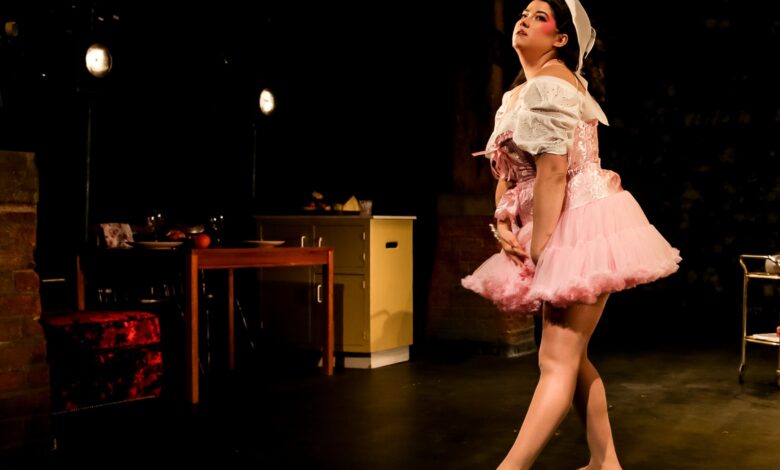
There is a specific kind of chaos that can only exist at the intersection of pink glitter and a desperate hustle. In Party Favour, coming to the intimate Etcetera Theatre this month, audiences are invited into the hallucinatory world of Fiona: a “full-time fat disaster” navigating the treacherous landscape of Los Angeles.
By day, she’s a professional party princess; by night, she’s a reluctant stripper chasing an “extra fat tip” in the land of green juice and high-stakes exploitation. It’s a “one-woman fairy clown fever dream” that promises to be as uncomfortable as it is hilarious, tackling the blurred boundaries of girlhood nostalgia and the grueling reality of modern work culture.
We sat down with Bite The Hand‘s Alexandra Sophia Ashe (writer/producer) and Shelby Corley (writer/performer) along with Kay Brattan (director), the creative team behind this provocative new production to discuss the power of the “clown,” the dark side of the Hollywood hustle, and why audiences should be prepared for a party unlike any other.
For anyone seeing the phrase “one-woman fairy clown fever dream” for the first time, how would you describe the vibe of Party Favour?
ALEXANDRA: The vibe of the show is as if you’re trying to piece together a dream you had, where the setting was your sixth birthday party: the chaotic and unhinged energy mixing with your sugar-coated memories, everyone’s sticky with sweat, glitter and paint, and you’re throwing up all the cake you’ve eaten and are already going in for round two. All of this accompanied by an EDM remix of your favourite childhood song!
What was the initial “lightbulb moment” that made you realize Fiona’s story, a part-time party princess turned reluctant stripper, needed to be written.
SHELBY: In the musical Les Misérables, there’s a quiet moment when the innkeeper’s bawdy, conniving wife Madame Thénadier sings: “I used to dream that I would meet a prince, but God Almighty have you seen what’s happened since?” I wondered what Madame T. would look like today. A girl who grows up dreaming of living in Barbie’s Fairytopia, until she’s bombarded with a capitalistic world where she needs at least two jobs in order to just survive. Like Madame T., Fiona is not awarded the privileges that come with being beautiful by today’s standards. She is almost reluctantly independent, not wanting to relinquish control of her life but at the same time unable to let go of her girlhood dreams. To Fiona, “having it all” doesn’t mean a career, family, and the free time to pursue hobbies, it means being a princess, having a Prince Charming, and the free time to develop her fairy magic. I knew that this inability to let go of one’s dreams, no matter how impractical, was a feeling that many people could relate to in today’s world.
You’re working with director Kay Brattan, who makes movement a vital element of her work. How is she helping you bring out the more physical elements of the show?
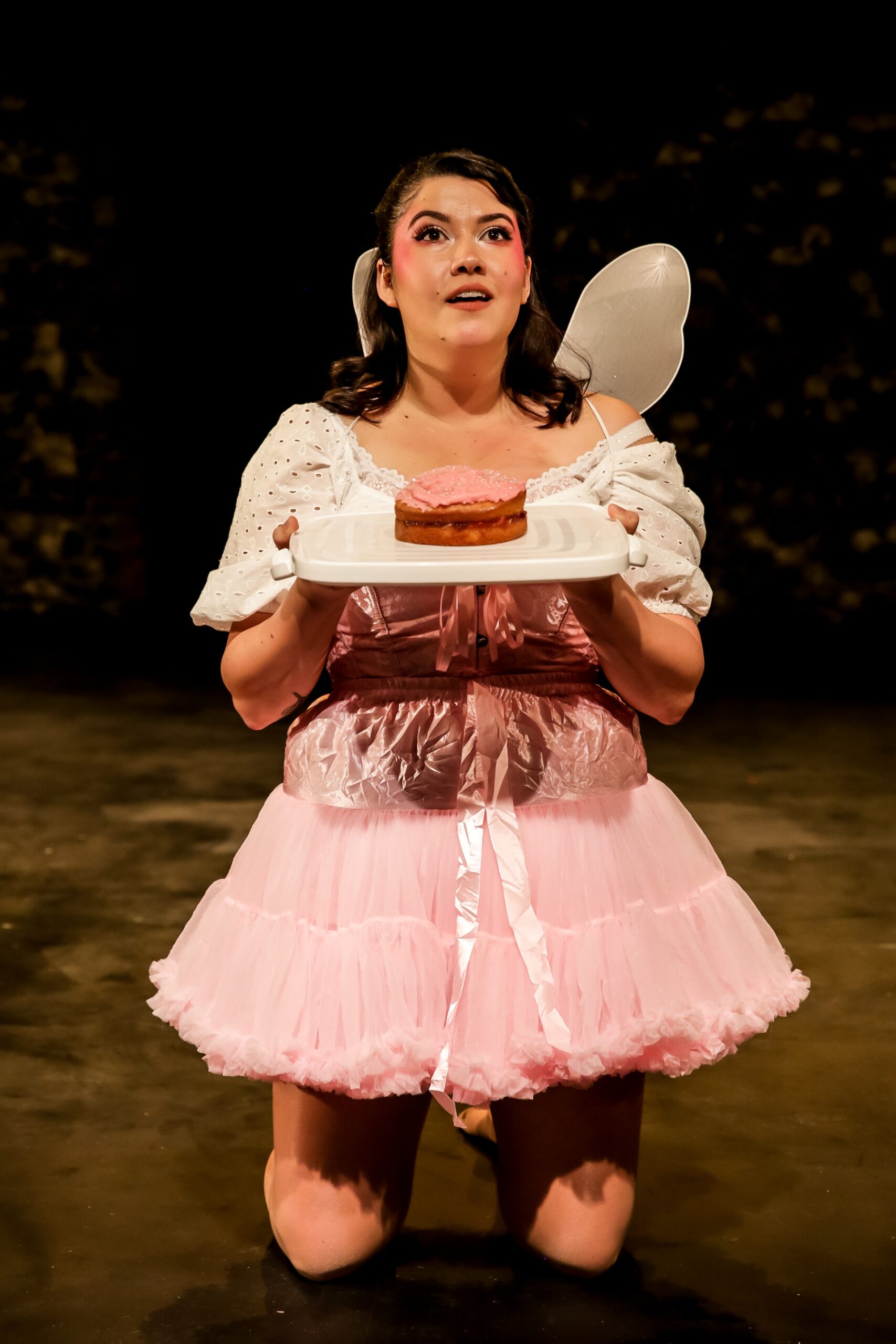
SHELBY: When Kay read our script, she immediately understood that this was a clown show, and we were both excited to have fun and go crazy with the physical comedy. I’m really thankful to work with a director who has such extensive training and experience with clown. Kay uses techniques from Lecoq and combines them with Laban efforts to guide me through the physicalization of multiple characters and moments. Kay and I have also worked together before, so we have a really strong shared language and creative partnership where it’s really easy – and so much fun – for us to figure out what works, how to bring each character to life, and how to keep the humour alive, even in the uncomfortable moments.
How does the physical performance help tell a story that words alone might not be able to capture?
KAY: Words are one thing, but behaviour and body language say so much more when they’re specific. The way someone moves or reacts tells you what’s really going on underneath. In this show, those physical details drop us straight into Fiona’s memory of a chaotic kid’s party – it builds the world around her and lets the audience fill in the gaps. It’s that embodiment that really transports you, turning empty space into something vivid and alive.
The play is set in the “green-juiced hustle culture” of Los Angeles. Why was LA the perfect backdrop for a story about exploitation and the “extra fat tip?”
SHELBY: I grew up in Los Angeles as a chubby, queer, Dora The Explorer lookalike. Especially as I got older and was surrounded by growing L.A. influencer culture, athleisure, and gentrification, I would either feel completely invisible and unworthy, or hypervisible with every flaw on display and open for commentary. It wasn’t until I moved to the UK that I realized all of the L.A. quirks that I had assumed were normal, were actually pretty messed up.
ALEXANDRA: I think that in LA, the feeling of exploitation is palpable. A major city in the U.S, and a seat of U.S and global capitalism, LA has long been a place where people migrate to from all over the country and throughout the world in order to pursue their dreams. The “American Dream – ”this idea that you can be a self-made millionaire, that you just have to “lock in” and eventually all of that hard work and sacrifice will pay off – while growing more and more fantastical in the past few decades, is still such a pervasive and omnipresent concept. In a place like LA, you can feel really close to that dream coming true while being so far away from it, because it’s part of the culture. The stratification of wealth is very distinct, but the lines between the layers seem blurred, because people want to present themselves as closer to realizing that dream than they are.
SHELBY: This show is for those people, the ones like Fiona, who still feel like they need to buy the $20 smoothies even though they’re making $14/an hour at work, the ones who are chasing the feeling, the illusion of almost being there, of everything you’ve wanted almost being within your reach.
Party Favour tackles the “blurred boundaries” of modern work. What do you hope the audience takes away regarding the lengths people go to just to “make ends meet” today?
KAY: That old promise – get a degree, get a job, get a house – just doesn’t hold up anymore. Between the cost of living, job scarcity, and everything else going on globally, people are being pushed into corners. The show asks: how far would you go just to stay afloat? And what happens when the morally dodgy option is the thing you’re actually good at (or at least think you could be)? It’s about the compromises we make – and how far we’re willing to stretch them in a pretty unforgiving world.
What is the most rewarding, and the most terrifying, part of putting on a one-person show where there’s nowhere to hide on stage?
SHELBY: Even though I’m the only actor on stage, I never feel alone because I have a scene partner in my audience. Especially with this show, we’re hyper aware of the fact that there’s nowhere to hide on stage and so we use that to our advantage. I’m inviting the audience into the discomfort of being watched. They can’t hide from me either. So Ha!
ALEXANDRA: I think this play cleverly gets around being a one-woman show in engaging its audience as much as it does, so the fourth wall comes and goes. It’s rewarding to have that kind of mutual trust: the performer trusting the audience to give as much as they get and the audience trusting the performer to facilitate this story safely and in an exciting, engaging manner. And the beauty of it being clown is that you’re in constant dialogue with the audience, keeping your finger on the pulse, being dynamic in knowing what’s working and when to pivot, and taking care of the audience while asking them to trust you in moments of discomfort and vulnerability – something Shelby is able to navigate beautifully as a performer.
If someone is on the fence about booking a ticket for a Tuesday night (or the following three nights when it plays) in Camden, what is the one thing they’ll see in Party Favour that they won’t find anywhere else in London right now?
ALEXANDRA: I’ve had the pleasure of being able to sit in on a rehearsal or two with Kay and Shelby, and watching the two of them develop one scene in particular had me laughing harder than I have in a long time. No spoilers, but I can almost guarantee nobody in our audience will have seen something quite like it – let’s just say, what happens in the Bouncy Castle stays in the Bouncy Castle! If you want to be a part of the exclusive club who knows (and can never unsee) its secrets, you have to grab a ticket.
Our thanks to Alexandra and Shelby for taking time out to chat with us. You can catch Party Favour when it plays at Etcetera Theatre from Tuesday 12 to Friday 15 May.