Provokes and unsettles theatrical convention as it explores queer, non-binary and contradictory emotions grappling with acceptance.Rating
OK
Pity Party has an opening musical backdrop of “It’s my party and I’ll cry if I want to”, suggesting sad, introspection. But it turns out that writer and performer Emma Bailey is defter with the performance, the self-effacing display of need showing an interesting sense of awareness. This is a raw, brave, and self-indulgent piece as it battles with theatrical conventions and squirms with the immersive personal journey of love, want and rejection – not only of others but at times of oneself.
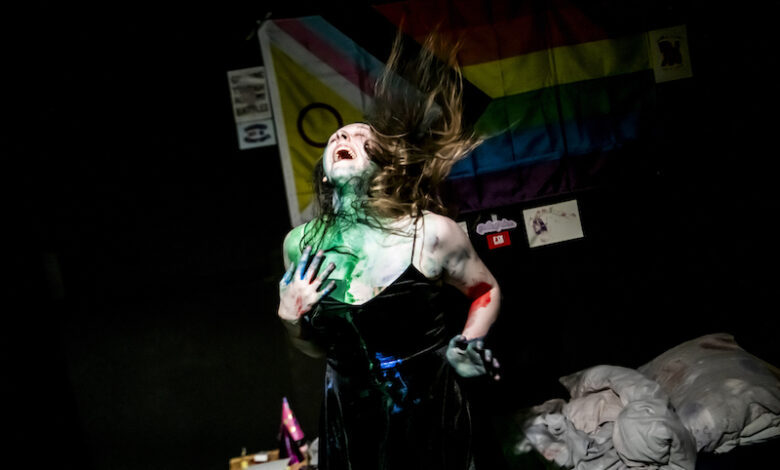
Baileyis covered in a sleep-suit, on a crumpled bed, surrounded by strewn, dishevelled possessions. This is a happy birthday event without the happy; a physical performance that matches the unhappy chaotic display of Tracey Emin’s Unmade Bed – at once repellent but at the same time perhaps familiar and intriguing.
This disabled, queer performer from Portsmouth grapples with a birthday celebration – alone again. Bailey’sperformance is committed as they strip bare emotional bones. Theymumble into a mic, opening with a declaration of being queer and disabled, going on to voice the shallow questions that would trouble many a teenager; what’s the point of sleep, why wear clothes, why do we smile? There is often little exploration of feelings, but rather it moves from moment to moment, verbally and emotionally chaotic, as fleeting ideas collide.
Some are revealing, such as the mother’s birthday card which reads “to my darling daughter”. But, Baileyimplores us, which of these words could our performer possibly be?Bailey thinks their mum could have done better, which probably applies to us all. This provokes interesting thinking about being loved and in love.
Confused identity is tackled from the start, with the performer dressing and undressing, unsure which outfit to put on. The delivery here is under vocalised, as many lines are, but the idea of ‘putting on’ in front of an audience is interestingly collaborative. There is a continual challenging of theatrical conventions, which is engaging, even if the content and performance skills are not always fully evident. Interestingly, the outfit decided upon is a slip of a dress and when a male member of the audience (played by Ismael Akram) joins Baileyon stage, confusing attitudes are played out; friendship, adviser, playmate with possible attraction – could this be friends with benefits?
Music again highlights the contradictions in the scenes, with the lyric “the dark days are over”. We know this is not the case. Life can drive you crazy, which is tenderly communicated with Bailey singing the song ‘Crazy’. A refrain echoes the piece itself: “who do, who do you, who do you think you are?” It suggests that nothing is concrete or solid. We realise that thinking and being ‘different’ is difficult to navigate for others and for oneself, as things are not solid but fluid.
Although the play naturally feels underdeveloped, as a work in progress, Pity Party is thought provoking. The piece closes with a frantic dance, smearing of paint on body and face, covering up, once again – just like the start.
Written, directed and choreographed by Emma Bailey
Assistant Director: Ismael Akram
Produced by D&Q Theatre Marketing – Ismael Akram
Pity Party has now completed its run at Bread & Roses Theatre.