Desperately seeking …LERV, Ginny can’t find that man in her life who’s real and not out of the movies. This new play charms but ultimately misses its mark.Rating
Good!
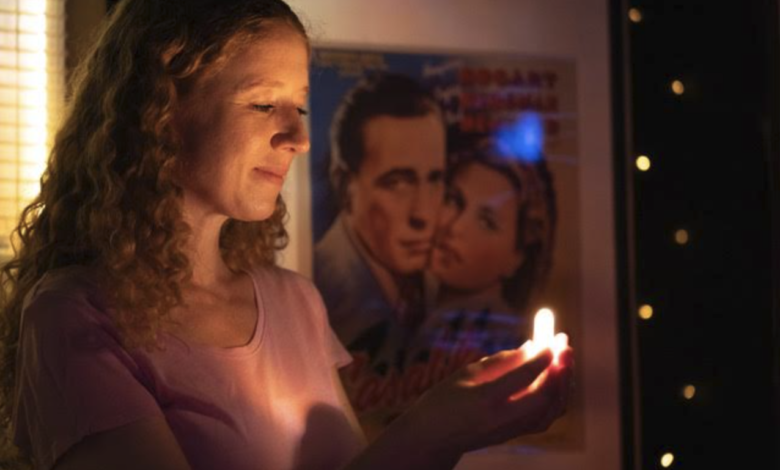
Have you never felt, when you’ve watched a film, “Why can’t my life turn out like that? What’s wrong with me?” Well, Ginny has! And as she’s an usherette in a cinema — that seems to show just movies from the thirties and forties (budget constraints, I would say— excerpts from modern films are notorious rip-offs). She is constantly surrounded by flickering couples living happily ever after. Except that, of course, her own reality is very different; there is no Purple Rose of Cairo moment for her. We find Ginny (Miranda Colmans) desperately swiping left on a variety of wankers (literally) who have messaged her; some meet-ups happen, but inevitably they are, to a man, disasters. There is some fun to be had here, and Paul Kalburgi, whose brand-new play this is, doesn’t miss a trick. He makes Ginny the centrepiece, talking to us, to herself, reacting to other characters that sporadically intervene: an old school friend and an interfering mother (an excellent performance from Eliza Williams, our new Anita Dobson – surely EastEnders awaits??) and various men, including the elusive Seb, a gym instructor in Paris plus a sweet, unassuming sales guy in IKEA. Cyril Blake impressively covers the whole gamut of types he is asked to create, most memorably a camp guy at the French gym where Seb supposedly works.
Yes, Ginny finally gets out of her ‘bedroom, IKEA, cinema’ routine and finds herself in Paris, trying to track down this Seb, the guy she has fallen for but who mysteriously stops returning her calls. He has become very ill, which triggers Ginny’s trauma of losing her first fiancé and of losing her father. Right at the end, we find out that Ginny is writing a screenplay on a thirties typewriter, but why wait so long for this to be introduced?
The setting changes from bedroom to IKEA to cinema by an ingenious design by wirter Kalburgi: a series of wheeled panels, giving a louvred effect that can be turned round to reveal different backdrops. The problem is that there are some clunky changes between very short scenes, especially with cinema seats being brought on and off to little effect.
Despite its initial charm, my main beef with this new play is that it is basically too long: 75 minutes for the first half and then 45 minutes for the second. There is not enough development of plot and dramatic tension to sustain this length. It should be a 70-minute work with no interval. It is essentially a monologue, and for us to engage with a central character, it needs much more layered psychological insight. Why not use the mother-daughter relationship more? They have both lost loved ones in tragic circumstances, and as it stands, theirs is the only relationship in the play that is explored and relatively substantial (thanks to Williams’s commitment). I just found it one-note dramatically. What are the stakes that increase the tension for the plot to reach a climax or some sort of resolution? Colmans, as Ginny, needs more meat to get her teeth into. Throwaway sardonic frustration at her life over this length of time is not enough to really connect with her. It is an amiable piece with some excellent dialogue, along with some appealing, committed performances, played out against an effective set, but it needs cutting and radical reworking.
Written and set design by Paul Kalburgi
Directed by Kay Brattan
Light and sound design: Gabriel Burns
Associate Producer: Annie Power
Presented by Exit the Garret with Open Page Productions
We’ll Always Have Paris plays at the White Bear Theatre until Saturday 3 October