American Dreams, deadly sins and unhappy lives: Bernstein and Weill combine for a bold and stimulating evening of operatic contrastsRating
Excellent!
Trouble In Tahiti and The Seven Deadly Sins are two short operas by Leonard Bernstein and Kurt Weill respectively. They have been performed together before, although on the face of it they have very little in common. Bernstein’s Trouble In Tahiti is altogether more jazz-inflected, and initially lighter in tone; it is also Bernstein’s only opera for which he wrote both the music and lyrics, but beneath the bright surface, things become considerably darker as the story unfolds. Weill’s piece, on the other hand, with a libretto by Bertolt Brecht, is classed as a ballet chanté – a sung ballet – and was written in the 1930s as a biting critique and satire of capitalism. It is aggressive, angular and stark, recalling the world of German Expressionist cinema, despite being set in America.
The evening begins with Trouble In Tahiti, which, despite the title, is set not in Tahiti but somewhere in middle America. It follows an unhappily married couple, Sam (Jack Holton) and Dinah (Alexandria Moon), who appear to be living the American Dream; the reality, naturally, is somewhat less glossy. His work consumes him while she fills her days fretting, visiting her analyst, and going to the cinema – in this case to see the titular Trouble In Tahiti. As the opera progresses, we are given glimpses into their inner thoughts and the growing emptiness of their lives. Other performers populate the stage as friends and co-workers, at times acting as a kind of Greek chorus, and at others as a scat-singing jazz trio, all while shifting furniture and props with impressive efficiency.
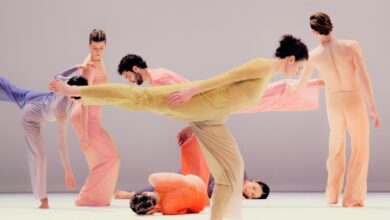
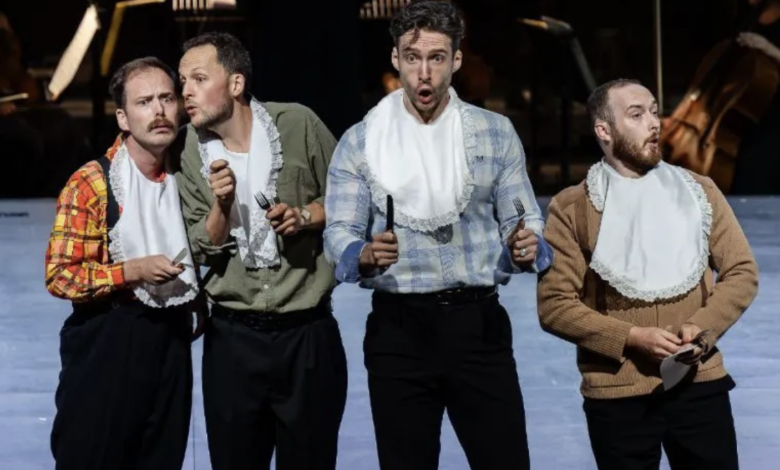
The Seven Deadly Sins is a very different proposition. Structured around seven scenes representing the titular sins, Anna is played by two performers: Anna I (Stephanie Wake-Edwards) sings the role while Anna II (Yanki Yau) expresses her through dance. Four additional singers represent Anna’s family and also function as a Greek chorus, greedily eyeing the money she earns to enable them to build a house, whilst travelling across America and making it by whatever means seem necessary.
Of the two, The Seven Deadly Sins is the stronger and more cohesive work. Trouble In Tahiti occasionally feels fragmented and disjointed, whereas Weill’s piece has a sharper sense of purpose. Sung in the original German, it is helped enormously by subtitles which allow the audience to keep up with Brecht’s increasingly savage narrative.
Both operas are superbly staged. Designer Peiyao Wang makes inventive use of a series of large boxes which, in Trouble In Tahiti, represent different locations while also trapping the unhappy characters in increasingly claustrophobic spaces. The same boxes reappear in The Seven Deadly Sins, though here they are used in a more abstract and slightly less imaginative fashion.
Valeria Perboni directs both pieces with assurance and a clear understanding of their very different styles. The fifteen-piece orchestra, conducted superbly by Lewis Gaston, provides excellent musical support, although it did occasionally overpower Moon, which was a shame.
This is Opera Prelude’s first production at Opera Holland Park, and the company deserves considerable credit for showcasing such impressive talent. A great deal of work has clearly gone into this one-off performance and, hopefully, they will be back next year.
Opera isn’t for everyone, and these two pieces are hardly the gateway drug for anyone looking for melodic Puccini. But bring together the work of two of the twentieth century’s greatest composers, add some inventive staging and a talented company, and the result is an evening that may not always be easy on the ear, but is certainly interesting, stimulating, and well worth experiencing.
Conducted by Lewis Gaston
Directed by Valeria Perboni
Movement/Choreographed by Monica Nicolaides
Design by Peiyao Wang
Lighting Design by Jacob Gowler
Video Design by Ryan Davies
Trouble In Tahiti & Seven Deadly Sins has completed their performances at Opera Holland Park