Review: ORWELL: The Road to 1984, Upstairs at the Gatehouse
Camden Fringe 2026


A powerful show that builds into a persuasive biography of one of England's most celebrated writers.Excellent
Rating
This biographical study begins with George Orwell on his deathbed, oxygen mask clamped over his face, before jumping back into his childhood for a chronological journey that ends up back in the same bed. It’s perhaps an overused dramatic technique, as seen recently in the Here Comes J Edgar! at the King’s Head, but it remains an effective way of topping and tailing the story.
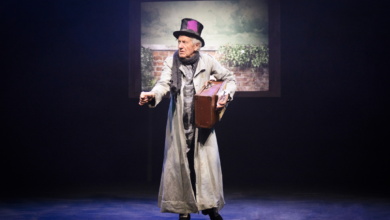
Orwell is played by Mark Stratford in this one-man show, adapted from Orwell’s own essays and books with skill and brevity by Guy Smith, who also directs. It explains how Eric Blair came up with his pseudonym, toying with Edward Burton and Kenneth Miles before settling on George (solid, English, steadfast) and Orwell (the river that ran near his parents’ home in Suffolk).
Initially, Stratford’s delivery is too declamatory, as if he’s narrating Orwell’s story at a public lecture. He leads us through his schooldays at St Cyprian’s school, where he’s beaten with a riding crop for persistently wetting the bed – his first taste of institutional injustice – and skips over his time at Eton, where he edits the school magazine and takes tentative steps towards creative writing.
When Orwell joins the Indian Imperial Police in Burma he witnesses the “unspeakable wrongness” of an execution at the gallows, his first real experience of man’s inhumanity to man. But it’s not until he’s called upon to deal with a rogue elephant that Stratford really stops narrating the story, and starts performing it. His portrayal of a sensitive man in a wholly inappropriate job, goaded into shooting the elephant so as not to look foolish in front of the crowd of villagers, is emotionally engaging and dramatically persuasive. It’s at this point that the play really comes alive.
The action moves to Orwell’s visit to Paris in 1929, where he expects to be welcomed into café society but ends up as a restaurant dishwasher, the lowliest of jobs, before being brutally treated for pneumonia in a Paris hospital. He witnesses the death of a man in the next bed from cirrhosis of the liver, and realises “this is how the lucky ones die, the ones who live to be old” – before deciding how much better it is to “die with your boots on”. But here Smith falls for Orwell’s own narrative; yes, he may have eked out a precarious living as a plongeur, but at any time he could have packed his bags and returned home. After all, his parents did have the wherewithal to send him to Eton.
A slightly overlong sequence reduces The Road to Wigan Pier to a close examination of boarding house owner Mrs Brooker (a perpetual invalid) and her grubby-handed husband, lingering on the awful food and its preponderance of tripe. Orwell’s stint in the Spanish Civil War leads him to realise that fascism and Stalinist communism are equally pernicious totalitarian regimes, which causes him to write Animal Farm (initially turned down by several publishers, including T S Eliot at Faber & Faber).
It’s not until the end that we see him crafting the opening paragraphs of 1984, beating the wording into perfection until he produces the phrasing we know so well.
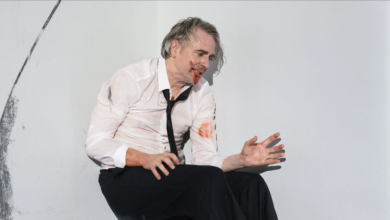
Despite a somewhat slack start, Stratford’s performance builds in both confidence and emotional range as the story progresses. A couple of curiously long costume changes (from pyjamas into a suit and tie, and back again) disrupt the action by taking place behind a hospital screen, for no apparent reason: his trousers remain unchanged, and he could just as easily have slipped a jacket on in full view.
To keep an audience captivated for 80 minutes is demanding for any actor, and Stratford’s delivery builds into a powerful and convincing performance. Chloe Park’s subtle sound design adds both special effects and stirring music to underly the more emotional moments, persuading without swamping the action. Guy Smith’s adaptation of the original writings manages to thread his life story into a single coherent narrative, building from injustice piled on injustice into Orwell’s final nightmarish vision of the future as “a boot stamping on a human face forever”.
Adapted by Guy Smith
Director Guy Smith
Sound Design Chloe Park
Orwell: The Road to 1984 runs at Upstairs at the Gatehouse until Sunday 30 August.