

Interview: Serving the truth about queer representation in sport
Fairlight, touring musical

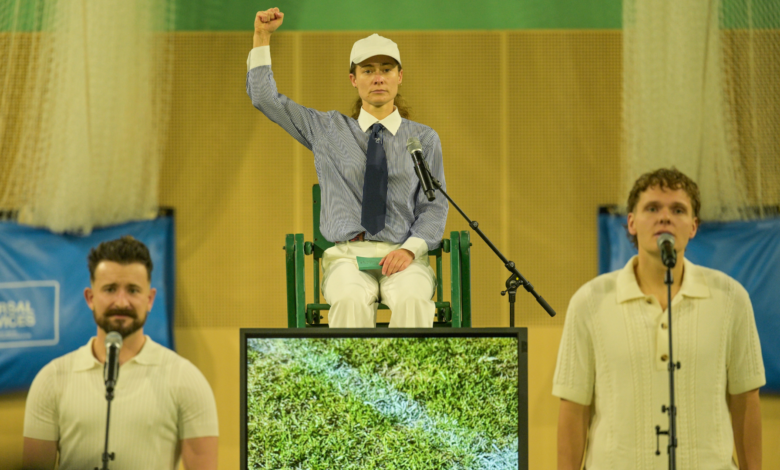
Alexandra Taylor on touring new musical Fairlight to tennis clubs.
Gender issues in sport may be a very current subject at the moment, but it’s certainly not a new one. This summer, a brand new electropop musical, Fairlight, tours at tennis clubs across England, interrogating the difficulties of being gay in the world of sport and the historical lack of visibility for LGBTQ+ players. We wanted to know more about this unique combination of elements, so asked Artistic Director and Librettist Alexandra Taylor if she could tell us more.
Hi Alexandra. Thanks very much for taking the time to tell us about this fascinating production. Firstly, what can you tell us about the story and characters in the show?

The show is a love story between two men, based on the real life inventors of lawn tennis – Harry Gem and Augurio Perera. There is no historical evidence that the real Harry and Augurio were anything more than friends – but there’s also no evidence that they weren’t. In the 1860s, when they were hanging out and inventing a new sport, being gay was illegal. From our modern perspective, we know there were gay men at that time, who lived and loved without leaving any trace of their relationships behind. Fairlight poses the question, what if Harry and Augurio were two of them? This love story is interwoven with other elements – the rules of tennis, interviews with current LGBTQ+ tennis professionals, readings of prosecutions of gay men in the Victorian era, and even live tennis playing.
Where did the idea for the production originate and what’s been the research process to adapt it into a live performance?
Michael (Wolters, the composer and co-artistic director) wrote a piece for the Commonwealth Games in 2022 about homophobia in basketball. It was one of the producers who mentioned that lawn tennis was invented in Birmingham by two ‘close friends’. Michael was intrigued, and set me on the case to investigate. I discovered pretty quickly that the ‘more than friends’ suggestion wasn’t supported by the historical record, but neither did it shut it down. The more I read, the more the potential of a queer reading of their relationship opened up. That intriguing ‘what if?’ question could also be applied to modern tennis. At that time, in 2022, there had never been an LGBTQ+ professional male tennis player – only Brian Vahaly, who came out after his retirement from the game. The theme of queer invisibility began to evolve from there.
Lots of different things fed into the research process. I got in touch with Bob Holland, a tennis historian, who has been incredibly supportive of the project. Michael and I visited the Birmingham Archives, to look through Harry Gem’s scrapbook, donated by his widow after Harry’s death. We spent a long time trying to track down the music to an operetta Harry wrote – the text was published but sadly no trace of the music remains. I read books on the history of tennis, found Harry’s original ‘Rules and Laws’ of the game, and accounts of prosecutions of gay men from the period. There are also the hand gestures used by modern line judges that we’ve used in our choreography, as well as research into past and current LGBTQ+ professionals in tennis who we approached for interviews, and reports on homophobia in sport. All of this fed into the creative process, and contributed to the show becoming what it is now.
What have been the most striking facts you’ve uncovered in your investigations?
How resistant sports organisations can be to the message. ‘Homophobia isn’t a problem at our club, therefore the show isn’t relevant to our members.’ That attitude. And of course, those are the very people who need to see it. We also struggled to get sports brands to sponsor the show. We’ve received an enthusiastic response in the arts world and in the LGBTQ+ community, but the resistance within sport was even greater than we anticipated. Which only proves the need for the show, and makes us even more determined to get it out there.
The language used in the newspaper reports of prosecutions of gay men in the Victorian era was also really shocking. The vitriol and utter disgust. I’ve read and heard them performed dozens of times, and it still upsets me.
And I just love the chaotic nature of the invention of lawn tennis. We’ve simplified it a lot for the show. In reality, there were all sorts of people inventing all sorts of different versions of similar games, all around the same time. While I will staunchly defend the claim that Harry and Augurio were the chief inventors of tennis as we know it today, there are others with different opinions, and the game went through a few iterations before settling into its current form. But many of the rules written by Harry and Augurio in the 1870s are very much in its DNA.
Can you tell us about the music and your choice to use modern electropop for a tale about a very traditional sporting field?
We positioned the show very purposefully as a musical. At first, we considered the format of an oratorio, a very particular narrative form of musical storytelling that is very static and only acted out through song, not action. In fact, a lot of that aesthetic is still in the show. But we quickly realised we wanted to make the show as accessible as possible, because we wanted as many people as possible to come and see what we have to say. That’s why a musical is the ideal format. Choosing electropop was because of a random yet very specific connection: In 1979 the Fairlight CMI sampler was introduced to the world of pop music and sampling became a major technique used in music. The Fairlight also came with some demo discs containing samples. Some of these demo samples became very popular amongst 1980s pop artists such as Kate Bush and the Pet Shop Boys and are now iconic sounds of that era of pop music. As, by complete coincidence, the sampler and Augurio’s house share the same name, we decided to take that as our musical starting point. The music for Fairlight not only contains samples from the Fairlight demo discs, but we’ve also made our own samples, such as ball bounces, umpire calls and the typical tennis player grunting.
It’s a fabulous idea to stage the performances actually at tennis courts and sports centres. How did that come about and how did you select the locations?
I think it was Michael who suggested it, and once he’d said it, it just seemed obvious. Not only in terms of reflecting the subject matter, but also in what we wanted to achieve – to highlight the topic in sports spaces. That’s where messages about inclusivity need to get through, if sport is going to be a truly welcoming environment. Putting on performances that have something to say in art spaces is safer and easier, taking them to the people who should hear what we have to say is trickier. Ultimately, people who are into the arts will always come to the tennis court, but sports people won’t necessarily come to an art space.
Our initial hope was to offer Fairlight to audiences attending grass court tournaments, and we reached out to all the main tournaments in the UK. As mentioned before however, we encountered varying levels of resistance, so our final list of venues was to a certain extent self-selecting – we are taking the show to the venues that were open to working with us to make it happen.
What challenges does performing at these non-conventional venues bring for the cast and creatives?
So many! The first hurdle is getting the venue on side. Tennis clubs and tournaments are unsurprisingly focused on one thing – tennis. Saying ‘We want to stage a musical on your courts’ is very much outside their comfort zone. Even once we have a ‘yes’, then there are a lot of logistical hurdles. Chairs, for one. We’ve had to buy 40 chairs that we’re transporting to several venues. Access to power, van parking, unloading tech equipment, protecting court surfaces, access to the general public – there are a lot of logistics that are a given in traditional theatre spaces, but are totally alien to a sports club. But by far the biggest challenge has been the weather – having to have a back-up wet weather plan for every venue. If I had a magic wand to deliver blue skies for every performance, I would have a lot fewer grey hairs!
What has the response to Fairlight been within the sporting world, and what do you hope opening up these conversations will achieve going forward?
It’s been really interesting to see which people and organisations within the sporting world have really embraced and supported the show, and which ones haven’t. It’s become very clear to us how much work there still is to do to make queer people feel safe and welcomed within sporting spaces. Fairlight will have achieved its mission if people within sport, at all levels, realise that just saying ‘We don’t discriminate’ is not enough – making a place truly inclusive requires concrete, visible action. Not just in tackling homophobia and discrimination, but in actively welcoming and celebrating diversity. Things are changing – there are two out players in the men’s game now – but there is still a long way to go.
Thanks very much to Alexandra for talking to us about this fascinating piece of work.
Fairlight tours across England until August 2026, including at Wimbledon Park Tennis Courts on Thursday 9 July. See below for specific details of venues and dates.




One Comment