Misguided and unconvincing.Rating
Poor
Not all Shakespearean characters are created equal, nor should they be performed as such. Case in point, Richard III: the antihero par excellence, he is also a complex, seductive, deeply human character, with a visible disability integral to his identity. Despite this, the part has been performed overwhelmingly (and, certainly by this point, boringly) by able-bodied actors ‘cripping up’, i.e. adopting props and movement to mimic Richard’s disability. Nicolás Pérez Costa’s Richard III professes to leave behind ‘traditional staging’, presenting itself as an adaptation for contemporary audiences ‘who want to see Shakespeare re-imagined for the modern world.’ If there was anything remotely innovative about this production, however, I must have missed it in the midst of the inadequate movement sequences, confused and confusing cuts to the script, and the sheer horror generated by the misguided performance of the titular character.
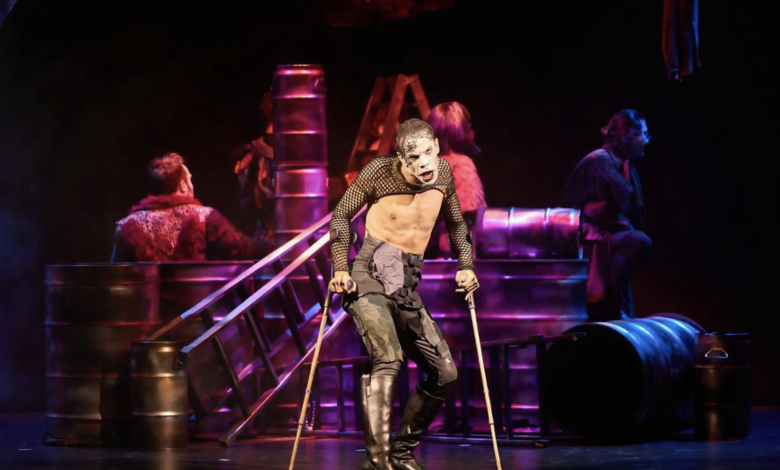
Interpreted by a self-directed Pérez Costa, this particular Richard ‘crips up’ by using a pair of crutches, jerking his limbs and his face, compulsively thrusting his tongue out of his mouth to whirl it around his white-greased face. The unpleasant result is a conglomeration of much older and vastly more successful interpretations (Antony Sher’s Richard, for instance, was already on crutches in 1984), and of a caricature villain from the Batman franchise. Unlike Heath Ledger’s Joker, however, Pérez Costa’s Richard is shockingly uninteresting, due in part to some nonsensical editing. The decision to cut the Duchess, whose continual belittling of her disabled son motivates some of his violent backlash against the world, flattens Richard into monotone demonisation.
Had I not come to this conclusion after seeing Arthur Hughes, the first actor with a visible disability to perform Richard on the RSC stage, Pérez Costa’s performance would have been enough to persuade me that an able-bodied actor (definitely this able-bodied actor) might simply be unable to convey Richard’s multifaceted worldview. His take on the king is at best utterly unconvincing, at worst painfully offensive. No matter how nefarious his intentions, it’s usually hard not to fall under Richard’s spell; in this case, I was flooded with relief whenever he left the stage.
The rest of the cast demonstrate, if nothing else, considerable energy. In fact, the most impressive aspect of the production on press night is the professionalism with which the ensemble kept going in the airless Cockpit Theatre, weighted down by several layers of dark lace, velvet and fur, performing in front of an audience violently fanning themselves in an attempt to maintain consciousness. In spite of this admirable energy, the dialogue proves hard to follow. It’s always refreshing to hear Shakespeare performed in accents other than received pronunciation, but no clear directorial choice addresses the international outlook of the cast. Instead, volume issues exacerbate the incomprehensibility of the lines, delivered at a neck-breaking speed which leaves syllables, words, and meaning behind.
A general lack of rhythm riddles the performance, turning moments of supposed tension into unintentional comedy, most often when cast members beat out of tune on the green barrels that constitute the set. While not exactly original, these made for an adequate use of the space (which was in thrust, rather than in the round configuration promised by the promotional material for ‘this physically driven reinterpretation’). The barrels also provide an interesting makeshift horse for the final battle; it’s a pity you couldn’t wait for Richard to fall from it, and there an end.
A kingdom — I thought, when finally released — a kingdom for my time.
Producer: Nicolás Pérez Costa
Director: Nicolás Pérez Costa
Fight Coordinator: Mathew Miles
Richard III plays at The Cockpit Theatre until Saturday July 11