A timely return to Charlotte Perkins Gilman’s seminal text.Rating
Excellent
Charlotte Perkins Gilman’s The Yellow Wallpaper has been analysed and interpreted endlessly since its publication in 1892. The latest to do so is the Indigo Arts Collective, as part of the Wanstead Fringe festival.
The production brings Gilman’s story to the present day, tying in the narrative with the recent trial of Lindsay Clancy. During scene changes, a whispering voiceover recounts cases of postpartum depression and psychosis that resulted in serious harm, or death, to mother and child. Tracing this little-understood issue through time highlights just how stigmatised the condition continues to be, and the lack of support typically given to those suffering from it. Closing with such a news-dominating example, still in contention at the time of the show’s debut, is striking.
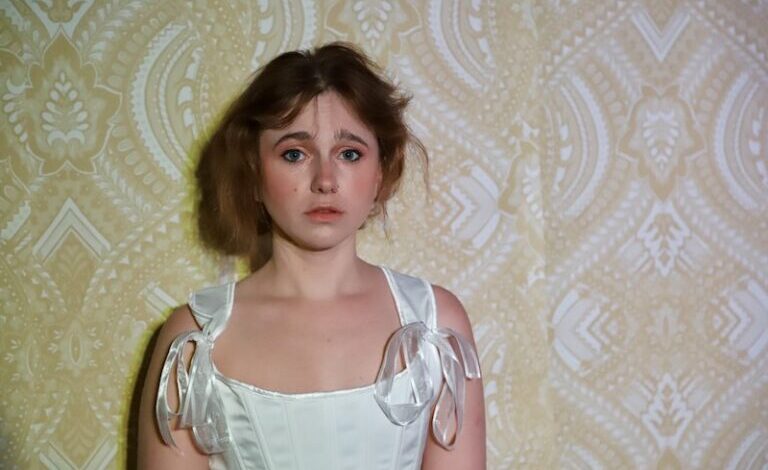
Kenzie Wynne is extremely compelling in this one-hander, giving texture and nuance to the troubled woman’s emotional state. Her portrayal never feels one-note, nor is the character’s decline into more acute madness entirely linear. There’s a lot of material to work with here, and Wynne never seems out of her depth.
There are some hiccups with the technical side of things, however given that this is the show’s first outing and that it was produced on a limited budget, it’s undoubtable that these will be ironed out. The voiceover (Sean Dale) – which Wynne interacts with as it stands in for her unseen husband, John – is sometimes too distorted to properly hear, and the case accounts are a touch too whispery and have been recorded slightly too close to the microphone, giving a slightly ASMR feel to things.
In other aspects, though, the production design is clever and well-executed. The titular wallpaper is slowly removed, piece by piece, from clothing rails at the back of the stage, uncovering a nightmarish collage of shadowy figures and button-eyed women. Wynne’s costume is gradually deconstructed item by item, and her careful updo becomes more dishevelled as the narrative unfolds. The latter is thoughtfully subtle, so that the first couple of devolutions are barely noticeable. It’s only when things reach a point of ‘abnormality’, outside of social acceptability, that the woman’s decline can no longer be ignored.
While psychiatric care and the understanding of women’s health have improved since Gilman was inspired to write The Yellow Wallpaper, there is still a long, long way to go until it becomes anything approaching sufficient. Gilman’s work, unfortunately, remains pertinent more than 130 years – and writer-director Shea Donovan illustrates that in a sophisticated, thoughtful way.
Adapted and directed by Shea Donovan
Produced by Indigo Arts Collective
The Yellow Wallpaper has concluded its run at The Bull as part of the Wanstead Fringe festival.