A triumph as an actor suffering with Alzheimer’s turns Beckett’s monologue into a profoundly moving meditation on memory and the ageing process. Rating
Unmissable!
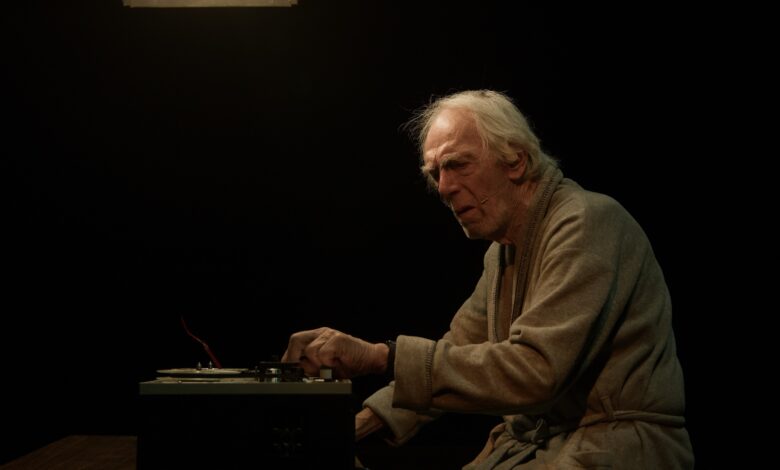
An old man shuffles onto the stage. He has three-day-old stubble and his hair is unkempt and greasy. He’s wearing a battered old dressing gown and well-worn slippers – he looks as if he hasn’t slept for a week. He stares out into space, not saying a word. He opens a drawer and takes out a banana. He eats the banana and throws the peel on the floor. He shuffles about and like the old slapstick gag, slips on the discarded peel. He takes out another banana, but he’s learnt his lesson and this time throws the peel into the distance. He goes into a cupboard and brings out an old school reel-to-reel tape recorder and boxes of tapes. He sits down at a table and after what seems like an eternity of silence, he finally speaks as he looks for a specific tape.
The old man is Krapp and it’s his birthday and he’s been marking the event every year by making a recording about the past twelve months. The specific tape he’s looking for is from his 39th birthday and after listening to it, he begins recording what may well be his last tape. Krapp’s Last Tape, like nearly all of Samuel Beckett’s work, is dense, obtuse, lyrical, poetic and needs a lot of concentration from both performers and audience alike; this play is no different.
Beckett’s 1958 one-man play Krapp’s Last Tape has been experiencing a bit of a renaissance recently with highly acclaimed productions featuring Gary Oldman and Stephen Rea. But this new staging, superbly directed by Dave Wybrow, adds another layer to Beckett’s play all about memory, aging and reflection: the performer, 85 year old Peter Marinker, is suffering from Alzheimer’s and slowly losing his memory.
There has been a lot of pre-publicity about the production, musing on how an actor with a failing memory is able to perform the fifty-minute piece. It soon becomes obvious that the stage directions are being fed to him, but this device isn’t hidden as the stage manager (Marta Fossati) sits at the back of the auditorium and her prompts are soft but audible. After a while, they have a rhythm and a cadence of their own, adding yet another almost subliminal layer to the production.
Marinker also has to do a lot of spooling and unspooling of tapes, which is no mean feat for someone half his age. It’s an incredibly fiddly process and watching him carefully manipulate the machinery becomes part of the performance itself. To help him remember his dialogue, there are two large screens at the back of the theatre, although there isn’t actually that much dialogue and it didn’t seem like Marinker was using them much anyway. To add even more poignancy to the production, younger Krapp’s tape was recorded by Marinker from a performance of the play he did in 1982.
Krapp’s Last Tape was hailed as a brave piece of writing from a brave playwright when it was first performed; this week at The Cockpit, it’s being performed by an even braver man. To quote Beckett/Krapp and maybe even the thoughts of Marinker himself: “Perhaps my best years are gone. When there was a chance of happiness. But I wouldn’t want them back. Not with the fire in me now. No, I wouldn’t want them back”.
Directed by: Dave Wybrow
Written by: Samuel Beckett
Design by: Duncan Henderson
Costume Design by: Lu Herbert
Lighting Design and videography by: Chris Lincé
Technical Production by: Jonny Danciger & Deb Jones
Stage Managed by: Marta Fossati
Krapp’s Last Tape plays at The Cockpit until Saturday 5 September.