A clever and quirky contemplation of the human impact of consumerism and the cost of social aspiration, through vegetables.Rating
Excellent
It’s not often you go to a play about asparagus. White Gold, written and directed by Larisa Faberby, is similarly peculiar in its uniqueness and also in its form. It asks us to consider the plight of the agricultural worker in Europe, poverty and the human impact of consumerism, through the story of an aspiring asparagus stalk who believes their destiny is to be elite.
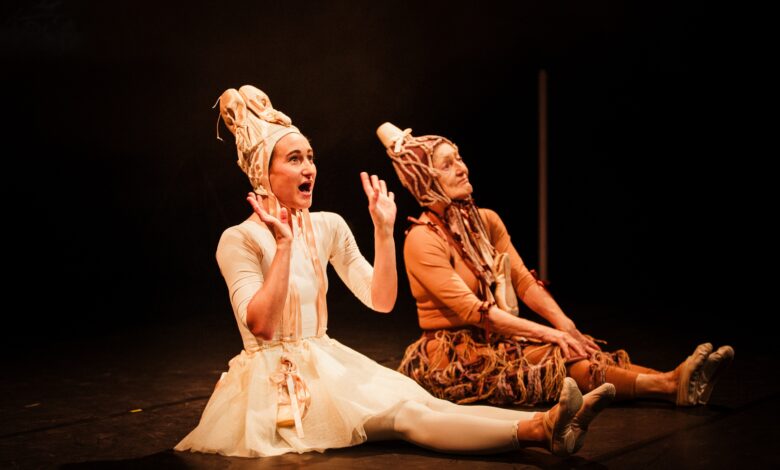
Kristin Winters delivers an elegant and engaging performance, even as she takes the stage dressed as an asparagus stalk. But not just any asparagus. This is spargel, or ‘white gold’, the most prestigious and sought-after of all. Winters’ white tutu and tall headdress are hung with delicate pink ballet shoes, which suggest the vegetable’s specific colouring and neatly link concurrent storylines. She’s joined by Christine Eiffes in a brown outfit, her skirt woven from woody roots, her headdress abruptly cut across, like a harvested stalk. Where Winters is the vegetable, Eiffes is its roots, equipped with seasons of knowledge and expectation.
The pair work beautifully together, swaying in the dance of life and portraying the joy of human connection. The story splits, however, and we then hear from a child who is an aspiring ballet dancer. Her dreams are supported by an absent mother who is perpetually away crop-picking, including the ‘white gold’. As the two tales weave together we learn about the European market, how the asparagus is farmed, its celebration, especially in Germany where whole festivals revere it, and what’s required from the workers to achieve this. White Gold examines the cost of aspiring to be elite – how it is more than just financial; who benefits and who suffers in the relentless, consumerist system – combining factual information with human understanding.
The performance shifts between stories effortlessly, using gentle clowning, monologue and music to evoke a blended sense of European fairytale, personal biography and timeless reiteration. Voiceover creates a tangible sense of distance, underscoring the absurdity of a situation where one person must be crippled by work for another to fulfil their ambition, with the latter not even understanding the sacrifice required.
A video screen effectively sets the scene of a field with stripes of black plastic marking out where the crop waits to be selected and extracted from the earth, but it also inserts documentary actuality into the tale, as it reveals the sad truths of the human cost of aspiration across generations. Reality is distanced, just as the euphoric consumers are set apart from the suffering of the workers. Throughout, moments of comedy contrast the tragedy being quietly enacted. The audience are at points lightly tested to consider the UK’s position, bringing laughter but also gentle provocation.
Within it all is a challenging contemplation of the role of women across generations – the sacrifice that they must endure for the greater good of their children. And the play questions whether, even when offspring do manage to get out of a country that feels restrictive, are they just being ‘peeled and boiled’ as they move into a different framework? A cameo clip of Luxembourgish chef Léa Linster, the first woman to win the prestigious Bocuse d’Or culinary award, gives a glimpse of a success that is achievable but incredibly rare, which is uncomfortably thought-provoking.
White Gold is a cleverly quirky piece of work that informs as it entertains, with splendid performances, music and oddity. Through its peculiarity it creates a unique space to think differently about the cost of our consumables and the wider issue of wealth disparity, and to challenge our understandings.
Written and directed by Larisa Faber
White Gold has completed its run at Camden People’s Theatre