Defiant, joyous and devastating, this is a play that celebrates the potential of the girls of Chibok, refusing to let them be defined by their captivity.Rating
Excellent
In 2014, Boko Haram fighters stormed a girls’ secondary school in Chibok, Nigeria, and abducted 276 students. More than twelve years later, around 90 are still believed to be missing. Girls is a play that celebrates their life and vigour, while unflinchingly confronting the horror of that act of sexualised violence.
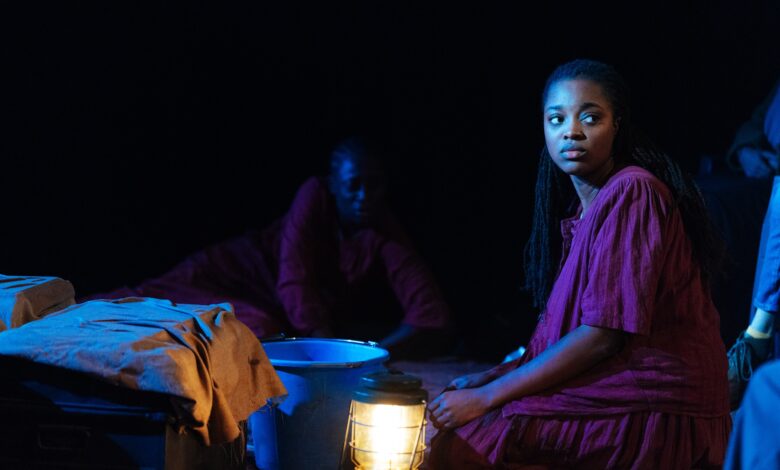
Raphaé Memom’s thrust staging in the Young Vic’s small Maria Studio creates intimacy, with the front row seated on individual chairs on the stage itself. A beautiful, colourful canopy of hibiscus blossoms hangs from the ceiling: a nod to the girls’ home. It is in stark contrast to the sand covering the floor: the camp where they now live. The only prop is a utilitarian metal storage unit draped with a blanket, while a row of small TV screens line the back wall. A low hum fills the space as the audience waits, and there is more than an edge of anticipation before the action begins.
Tisana (Hannah Akhalu), Haleema (Tara Tijani) and Ruhab (Sewa Zamba) burst onto the stage with an energy only teenage girls possess, teasing and dancing around one another, their camaraderie instantly apparent. Given the circumstances, it is a deliberately disorienting start and I wondered whether this was a scene from before their capture. It is not. Director Ewa Dina has consciously enabled characters that are not defined by their captivity but rather their zest for life and the promise their futures held: we only ever hear their voices and understand their realities, their captors are never mentioned. They have the naivety of girls their age, particularly when it comes to men and sex. Sadly, this shifts as the play progresses: fantasy gives way to experience-based information sharing, and their innocence recedes under the brutality of their lives.
Throughout, they remain resolutely real and human. Unsurprisingly, the girls are forced to confront their faith, and in particular which god they will follow. They respond with varying degrees of pragmatism and dogged refusal, a pattern repeated when one of them enters into a relationship. Their spirit and energy is wonderful. These are girls you would watch dance into a burger shop after school: joshing each other, mimicking their parents, swapping beauty tips and always looking out for one another.
Occasionally the TV screens flicker into life with sudden, dispassionate news flashes reporting other attacks, jolting the audience back to the gravity of the situation.
The pacing is spot on. We are only ever a moment away from horrific violence, but the contrast between the girls’ joyous exuberance and that ever-present threat means the audience is never numbed to their reality. Several truly harrowing scenes are played with stark realism, underlining the circumstances in which the girls find themselves. I never doubted for a moment that I was in a sandy, grubby tent in Nigeria, as the girls’ clothes grow steadily dirtier. It is an immersive experience, ending with a sombre news announcement and a stunned silence from the audience.
Written by Theresa Ikoko
Directed by Ewa Dina
Production Manager: Carmel Macaree
Set & Costume designer: Raphaé Memom
Lighting Designer: Elliot Griggs
Sound designer: Munotida Chinyanga
Video Designer & Programmer: Sophie Bramley
Composer: Fez
Girls is playing at The Young Vic until Saturday 21 November.