A brave performance, but an uncomfortable watch. Rating
Ok
The Waiting is part of Riverside‘s Bitesize Festival, which celebrates fifty years of supporting and championing new creatives this year. It is a great example of exactly that, with Nina-Lou Bricard performing and writing this forty-minute play. Bricard takes on the role of runaway bride Maeva and enters the space in full bridal attire.
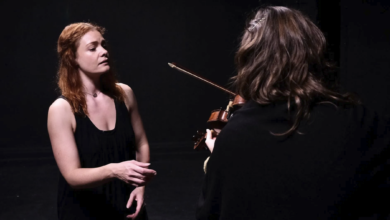
Described as feminist, punchy and sarcastic, Maeva is not immediately likeable. She comes across as troubled, unpredictable and, at times, unhinged. Bricard establishes this from the outset through her physicality. She paces around the space restlessly, repeatedly lifting her dark sunglasses to look directly at the audience before sitting at a table and ordering a drink. The interaction that follows is with a waiter who isn’t physically there, leading to a flirtatious conversation which gives us our first glimpse into Maeva’s personality. It also raises questions. Why is she alone in a bar wearing a wedding dress, and why is the waiter unfazed by this?
When Maeva tells the audience that she’s left her fiancé at the altar, there is an expectation that this will be the central thread of the story, but after a brief explanation, she moves on. The audience are then taken down a series of rabbit holes into Maeva’s past experiences and relationships, many of which occurred while she was working as a model in the fashion industry, mixing with high-profile designers and being invited to exclusive parties.
Several one-sided conversations take place throughout the performance. Some are recollections from Maeva’s past, while others happen in the bar and involve people who are left entirely to the audience’s imagination. This is an interesting theatrical device, and Bricard commits fully to these unseen characters, switching between conversations and reactions. At times, it feels as though we are being allowed into Maeva’s chaotic mind, where memories, fantasy and reality have become increasingly difficult to separate.
There is some well-observed and intelligent humour throughout, which lands well with the audience and provides welcome relief from the darker material. At several points, Maeva attempts to get the attention of the waiter, or “garçon” to chase up her drink order. On the night I was there, three latecomers entered the room holding beers, prompting Maeva to quip, “How come they got served before me?” This was a nice piece of spontaneous interaction and one of the moments when the character felt particularly alive.
Where the play falls short for me is in its structure and dialogue. There is a considerable amount of French, which is Bricard’s native language. However, for audience members who do not speak French, this means a significant amount of the dialogue and meaning is lost. The English conversations are short, and the subtext is not always clear, making the narrative difficult to follow.
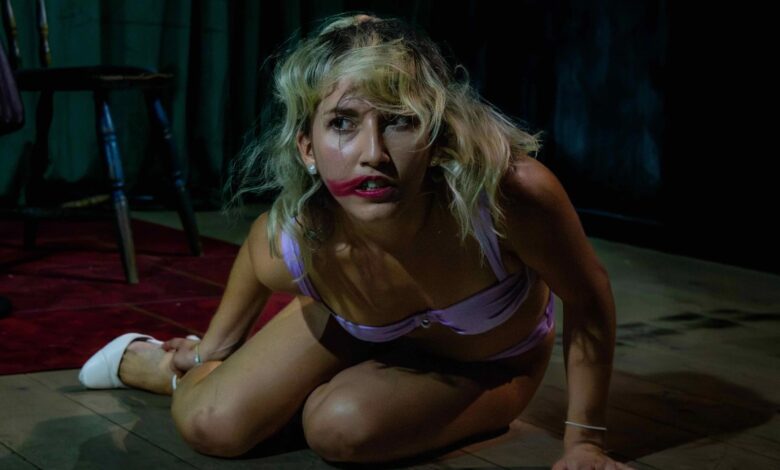
The darker themes are interspersed with humorous one-liners, creating an unsettling contrast. The play tackles abuse of women and the way women’s bodies are viewed, judged and used. These themes allow Bricard to display some strong physicality which is uncomfortable, but feels intentional.
Bricard performs this complex and emotionally demanding piece alone and in an intimate space, which deserves recognition and her commitment to the character is evident throughout.
The Waiting is a complicated play dealing with a difficult subject matter, and Bricard is clearly a performer and writer with something to say. With stronger, clearer dialogue and a more linear thread, Maeva’s experiences could become more accessible without losing the unsettling quality that makes this piece distinctive.
Written and performed by: Nina-Lou Bricard
Directed by: Daisy Roe
Produced and marketed by: Lucy Josèphine
The Waiting plays at Riverside Studios until Saturday 22 August.