A promising and poignant portrayal of addiction and role reversal.Rating
Good
There exists a peculiar irony in the human condition: that the hands which once rocked the cradle may one day require steadying themselves. Alex Viveash’s In Our Broken Hours lingers on this unsettling truth, exposing the raw, unspoken fractures that emerge when the ledger of care is torn up and rewritten by the cruel hand of addiction. It is a play about the inversion of roles, about the moment a child must step into the breach left by a parent’s collapse and the quiet devastation that follows.
Giulia Rose plays Emma, a young professional navigating the demands of full-time employment whilst balancing her relationship with her father Mack, played by Simon Ashton. She carries the weight of her father’s disintegration with a brittle composure conveying a mix of exhaustion and devotion. On the surface their relationship consists of haphazard phone calls from Mack – sometimes sober, mostly drunk – asking for financial support. Yet it’s clear this is a woman stretched thin; her love for her father a tether that keeps her from drifting entirely, even as it threatens to drag her under.
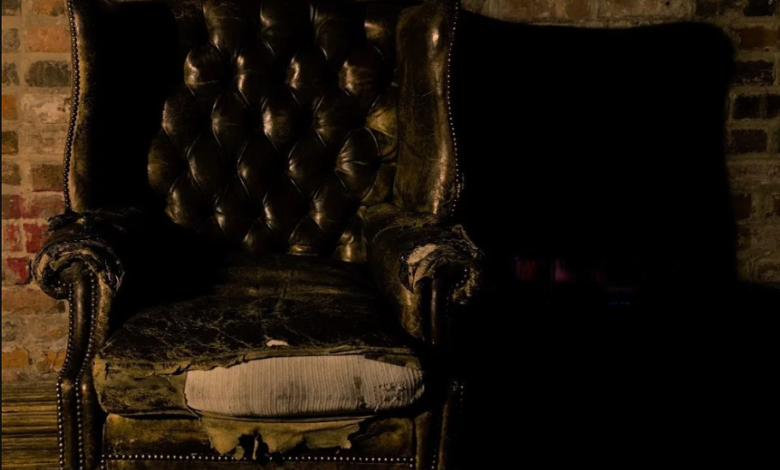
Opposite her, Ashton’s Mack is a man adrift in the wreckage of his own making and life’s cruel circumstance. He’s a man now reduced to evasion, with his banter and jovial demeanour a flimsy fortification against the encroaching tide of his failures. His room and fortress present indicators of his life: an overturned chair, a bag to hide the television in when the TV licence officers come knocking, a half-finished painting, the detritus of empty alcohol cans and bottles – all of which speaks volumes. Each detail is testament to a life stalled in the inertia of addiction. As Mack reflects on his past, his humour betrays the unspoken weight of his relationship with Emma, resulting in their exchanges being steered towards superficiality and a reluctance to delve deeper.
Viveash’s writing displays an understanding of the potency of subtext. His dialogue shines the most when the characters say everything but what they truly feel. That’s what elevates this from a simplistic, gloom saturated play to one of poignant, complex realism. There are light moments and a refusal to wallow in despair, even though the subject matter is undeniably sombre. The set, too, is a character in its own right: a space that is both a prison and a temporary sanctuary, where the half-finished painting and the hidden television become symbols of a life deferred.
For all its strengths, In Our Broken Hours occasionally stumbles in its execution. The performances, while largely strong, sometimes veer into over-emoting. The emotional beats feel hammered home with a bluntness that undercuts the subtlety of Viveash’s writing and there are moments where the pathos feels too heavy, too stated, rather than allowed to seep into the audience’s consciousness through the cracks in the characters’ armour.
Still, this is a play with the potential to burrow under the skin and stay there. With a deeper trust in the audience’s ability to feel rather than be told, In Our Broken Hours could evolve into something deeply heartfelt and engaging. For now, it remains a poignant exploration of care, collapse and the fragile threads that bind families together; a play that leaves one hopeful for its next incarnation, even as it lingers uncomfortably in the mind.
Written by Alex Viveash
In Our Broken Hours is at the Etcetera Theatre until Sunday 30 August as part of Camden Fringe.