A performance with added emotion when you realise that the building we are sitting in is the same building where the people it celebrates sat more than 30 years previous.Rating
Excellent
One of the wonders of fringe theatres is how so often they form part of their community; community hubs as well as theatre makers. Even so, Camdenwalla is the first show I can recall actually based on the building in which that theatre now sits. That theatre is the Camden Peoples Theatre, and it’s that special connection that gives this show such a personal feel that it is impossible not to love.
But what is that connection? It turns out that before it was a theatre this building at 58-60 Hampstead Road housed the Camden Monitoring Project, an organisation providing support to the local Asian community faced with the ever-present threat of racism. As well as providing safe transport, they recorded every incident, using it as evidence of race crimes that the police often refused to acknowledge. Yes, this building really has some history to it.
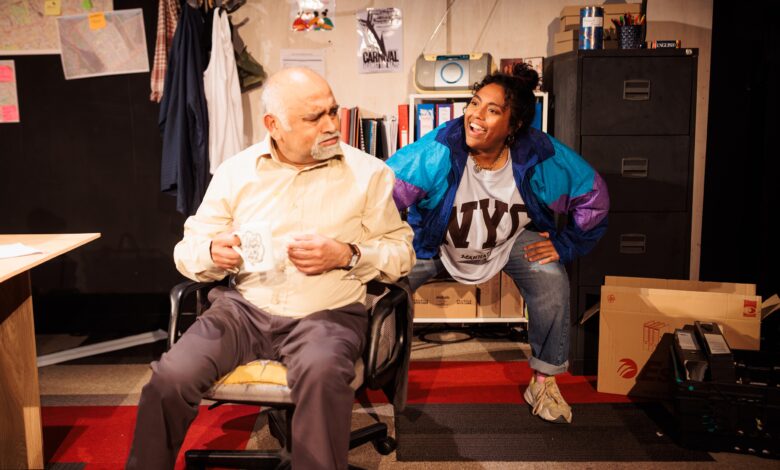
Set over one evening, Muhammed (Bhasker Patel) is alone, manning the phoneline, directing his single driver to pick up scared neighbours confronted with the threats at a time when racists felt empowered (history does unfortunately repeat itself as we know too well in 2026). But on this night his niece, Alima (Nusrath Tapadar) arrives with food for him, staying when Muhammed expresses concern for her being out alone. In staying she witnesses what her uncle really does, beginning a debate on the importance, or in her eyes, the wastefulness, of the Camden Monitoring Project.
Because what good is just recording incidents? In Alima’s eyes there should be more direct action. When she asks, “do you think racists are scared of spreadsheets?” it demonstrates their differences, while his repeated refrain of “fighting, fighting, die” is his reason for refusing to take more direct action. Both are clearly right, and maybe here the play fails in not showing us the real good that the Camden Monitoring Project must have done at the time. It is only when Muhammed declares “We can stand by each other. We can listen. We can bear witness” that you sense the real reason the Camden Monitoring Project, and others like it all over the country, were vital, and it is a shame this is not portrayed more obviously. Nevertheless, it is clear how much love and passion has gone into Camdenwalla, testimony to the vital role that the Camden Monitoring Project clearly played in the local community.
Rather than spend the play debating the project’s value, writer Jonny Khan instead immerses us in the uncle-niece relationship. It’s at times gloriously playful, Patel and Tapadar looking like they are having an absolute blast together. At other times there’s an attempt to show the generational differences of immigrant families and the worries they face. But it’s in the phonecalls where the real tension lies, and where more could have been made to better portray the project’s value. As calls become more frantic, and Alima gets to witness the true horror of the racism, we get a glimpse of what life can be like for those facing it. Those calls are cleverly presented as Alima becomes the caller, voicing the individual caller’s fear. Lighting and sound elevate that tension; shadows play across the stage, showing us that danger can lurk anywhere, while sharp sounds truncate each moment, again demonstrating how on edge they are made to feel.
Set at a time when racism was rife, Camdenwalla is a valiant attempt to express the fears that ethnic minorities have while showing the power we have when we stand together.
Written and directed by Jonny Khan
Design by Maariyah Sharjil
Lighting design by Skylar Turnbull Hurd
Sound design by Sarah Sayeed
Associate director and producer: Sam Edmunds
Associate Sound designer: Reuben Cook
Technical stage manager: Eliott Sheppard
Translators: Nikhat Hoque and Nishat Tamanna Oyti
Camdenwalla plays at Camden People’s Theatre until Saturday 4 July.
All shows are captioned in both English and Bangla.