With an engaging premise, good direction and a beautiful set, there’s a lot to like about Buonarroti, in spite of issues with chemistry.Rating
Good
I love a love story, particularly if it’s a queer love story. Particularly if it’s a queer love story that’s really about the making of art. Throw a bit of Renaissance into the mix, and I basically lose it. On paper, then, Buonarroti ticks all my boxes: set in Florence in 1501, it follows the story of Michelangelo Buonarroti (Katie Luchtenburg) and his friend turned lover turned muse, Francesco Granacci (Austin Daly), as Michelangelo approaches the creation of his famous David. It’s a great premise for heart-wrenching theatre about art, beauty and obsession, which the play mostly delivers.
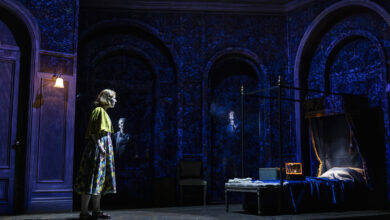
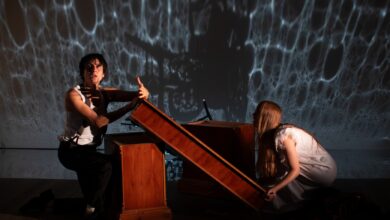
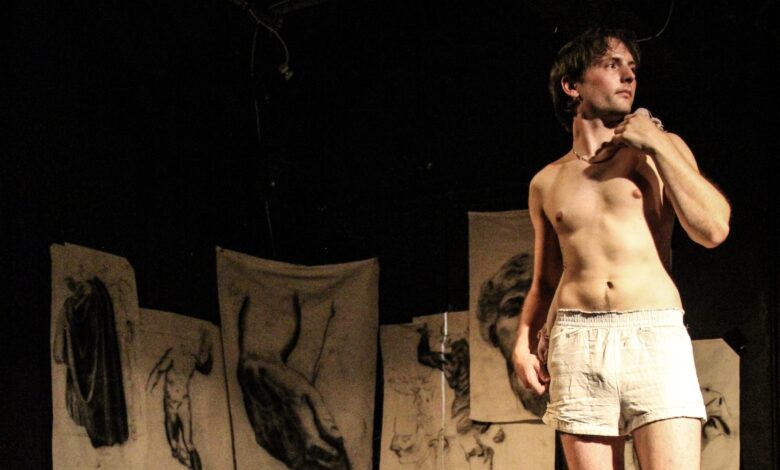
Of the many things to have happened to me in a theatre, being handed a sketchpad and pencil before taking my seat was not the strangest, but was one of the most fun. The ingenious framing device of turning the audience into members of an art class, instructed by Daly to sketch ‘the model’ (Luchtenburg), allows for necessary exposition about 16th century Florence without info-dumping. Charcoal sketches of Michelangelo’s art hanging from the black walls and strewing the black floor constitute a simple, beautiful set design, making best use of the fringe space of the Hope Theatre. Indie folk playing as the audience enters (Phoebe Bennett’s sound design is a clever mix of contemporary and Renaissance music) further contributes to the impression of an art class, before we’re abruptly catapulted into Michelangelo’s studio by rap music pumping loudly while Michel and Francesco simulate sex over the sketches.
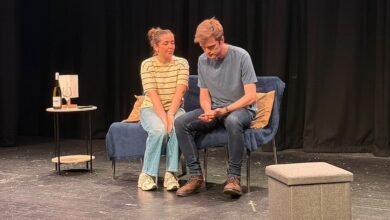
Daly moves seamlessly between art instructor and Renaissance artist, and if some of the awkwardness of the first lingers in the second that works all the better for the character of Francesco, besotted with Michelangelo. Crowning his performance as the kind of person who keeps returning to their situationship even though they should know better, Daly launches into an emotional monologue about Michel’s previous abandonment, showing a depth of emotion that is both startling and immediately convincing. Luchtenburg also shines at this point, in a vicious retaliation that captures all the arrogance and cruelty of genius. The directorial choice to put Daly centrestage for much of the action works well thematically: for most of the play, I found myself observing Francesco, studying the world through Michelangelo’s eyes. As a result, however, it was hard to gauge Luchtenburg’s performance. It became mostly experienced as a disembodied voice until they literally stood on a stool at the centre of Michelangelo’s studio, looking down on Francesco.
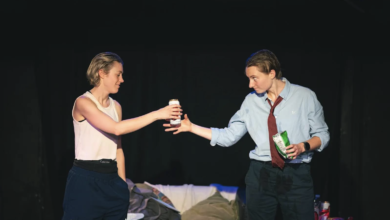
When Luchtenburg isn’t sketching Daly, the two of them are making out. Unfortunately, the couple show little chemistry in spite of continual demonstrations of affection. The characters’ seemingly unquestioned access to each other’s bodies erases any possibility of sexual tension. In fact, a general lack of tension (sexual and none) is the main flaw of the production: while the script never sags, exactly, it never got me on the edge of my seat. Unlike Liz Duffy Adam’s Born With Teeth (another queer two-hander about making art), Buonarroti fails to make the historical background pressing enough to drive the plot convincingly – perhaps because of some inaccuracies, like Francesco voicing fear of a ‘plague rat’ when plague wasn’t linked to rats until much later. Plague-nerdiness apart, Michelangelo’s knowledge of his own legacy is too on the nose, making the characters unaccountably aware of their own future and diffusing the tension about their destinies as artists, friends and lovers.
While there is room for improvement, there is also a lot to like about Buonarroti. The ease between the actors makes for some lovely, tender moments, and Violet Morris’s self-assured direction sapiently guides the audience’s gaze from muse to artist and back again.
Written by Adolaigh
Lighting & sound operator: Elise Piliponis
Directed and produced by Violet Morris
Sound design by Phoebe Bennett
Buonarroti plays at the Hope Theatre until Tuesday 30 June.