Molly G takes a dive into the 2025/26 Ballet Season
Did you know there’s a ballet “season”? Neither did many of our team until our reviewer Molly G mentioned it. For the football fans amongst us, it did throw up questions as to whether this meant there was a ballet transfer season; would the Royal Ballet be swooping in to poach the promising new left-back from Sadler’s Wells, and who might be out of contract and looking for a new challenge with a new team soon. Alas, this apparently doesn’t quite happen. Nonetheless, it felt a good time to look back at the season, and what it may have told us about the current trends in ballet. And who better to ask then than the one person who already knew all about the ballet season.
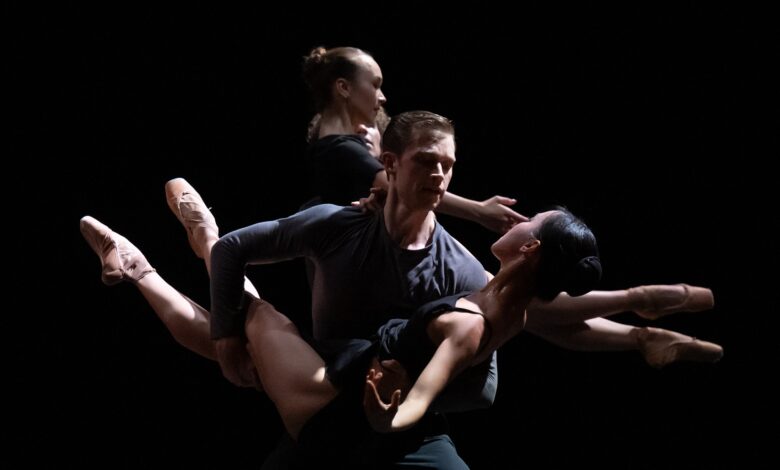
The 2025-2026 ballet season is drawing to a close and companies up and down the UK are preparing to begin their summer hiatus. This was a season where creativity and dancer centred programming took precedence over traditional narrative form, with mixed bills emerging as the dominant artistic structure. I’m taking a look back in my ballet season, in reviews.
Back in September, I headed to Cadogan Hall in leafy Sloane Square to review the ninth instalment of Ballet Nights, titled Bound in Motion. Ballet Nights consistently produce strong varied evenings, with its cast including a mix of students to Principal Dancers. It focuses on the raw talent of each performer, without the gimmick of spectacle. Compared by Jamiel Devernay-Laurence, the evening saw performances from Rambert School in an exciting new student choreographed piece, Royal Ballet Principal Dancers, and newlyweds, Fumi Kaneko and Vadim Muntahirov highlighting their craft mastery in George Balanchine’s Apollo Pas de Deux, and the debut of flamenco by Andrés Barrios and El Yiyo. Ballet Nights provides an exciting chance to see dancers beyond the confines of their company/classroom in “A perfectly mixed cocktail of ballet delights.”
Other excellent mixed bills this season have come from London City Ballet and Ballet Black in Momentum and Shadows respectively. This was my first time seeing London City Ballet perform, in what was their second full season after a near thirty-year hiatus. The Company was previously the resident company of Sadler’s Wells and now focus on touring around the globe performing mixed bills. Momentum saw the company tackle lesser known works by big name choreographers, including George Balanchine, Liam Scarlett, Florent Melac, and Alexei Ratmansky. They sprung new life into these somewhat hidden gems of choreographic works, and the entire company were “exquisite, and display incredible connection to the material…and are entrancing to watch.”
London City Ballet are a registered charity and are doing wonderful work at finding cost effective ways to showcase their exceptional work. Mixed bills are typically cheaper to run than full scale narrative works, with savings being made on set and large orchestra’s. This is allowing the company to reestablish itself whilst rebuilding its repertoire. This was my first five-star review of the season and I will be rushing to see London City Ballet next season.
Ballet Black’s Shadows remains memorable for artistic director Cassa Pancho’s adaption of Oyinkan Braithwaite’s bestselling novel My Sister the Serial Killer. The piece was striking with intricate choreography and a great sense of ensemble narrative commitment. This was aptly accompanied by A Shadow Work, choreographed by Chanel DaSilva. More abstract in nature and centred around the exploration of the human mind. It provided the perfect tonic for the narrative book adaption it is paired with, “taking the audience on a journey to the dark side.”
Birmingham Royal Ballet, the UK’s Leading Touring Company delivered a revival of their genre-blending fan-pleasing tribute Black Sabbath: The Ballet this autumn. It was a fitting year for this tribute to the band to grace our stages with the recent death of Ozzy Osbourne. The dancers of BRB are extremely talented, but this choreographic boiling pot fell short of allowing them to fulfil their potential. The fans of the band in the audience adored the evening, and were elated to see band’s guitarist, Tony Iommi, appear at the end, serving its purpose as a tribute, but a piece unlikely to be joining the ballet canon anytime soon.
Re-workings of classical texts is where Birmingham Royal Ballet shines, and the classical staple in my seasons diet was their revival of Carlos Acosta’s Don Quixote. Set in the height of Spanish summer Acosta’s version is lively and exciting. Arguably one of ballets most accessible stories, this “ballet RomCom”, showed what the company do best: brilliant technique and wonderful story telling. Momoko Hirata as Kitri, a role chock full of famous variations, was “less feisty and more playful than often the case“. This softer, somewhat more youthful Kitri is something I adored, showing a new interpretation of the character and breathing fresh life into the rigid stereotype.
This December, Matthew Bourne’s New Adventures revived their adaption of the classic film, The Red Shoes. Bourne’s ballets are narrative focussed and great for first time ballet goers and it was the perfect lighthouse in the sea of Christmas Nutcrackers. My second and final five-star. Review, The Red Shoes was “rich and playful, elegantly travelling from location to location, with comedy finely woven throughout”. It boasted a stellar central performance from Cordelia Braithwaite whose breath work was captivating and costuming by Lez Brotherston that firmly rooted itself in the 1940’s.
To round off my season, I was once again at Sadler’s Wells, this time to see BalletBoyz, who celebrated their 25 year anniversary with Still Pointless, a reworking of their inaugural show Pointless. The company, formed by former Royal Ballet Company dancers Michael Nunn and William Trevitt, performed a mixed bill comprising of eight choreographers and nine pieces to show the legacy and the future of the company. The dancers are more on the contemporary side of ballet and breathed new life into pieces I have only ever seen performed by classical dancers. The pieces were intersected by archival footage of Nunn and Trevitt, providing a welcoming and approachable air to the evening. The second act was stellar, the programming neatly sewn to show the full range of the company, with the evening proving a wonderful tribute to the company who are “25 years young”.
Companies across the UK this year have strived for technical prowess and smaller showcase snippets to excite their audiences. With reworking and new works, the classics have been left gathering dust on the shelves. Looking to the season ahead, we can expect to see a myriad of anniversaries curating the landscape of companies programming. With narrative form and emphasis on classical reworking being the popular choice, it is sure to be an altogether different but still none the less exciting season.