Polka’s teen Grads excel in their reviewing collaboration with ET
Here at ET we believe reviewing Theatre for Young Audiences is hugely important. It’s an often complex and uniquely creative sector that covers multiple age ranges, production styles and themes – where else might a reviewer need knowledge of drama, clowning, dance, opera and puppetry all in the same week?
Theatre is an important vehicle for young people to explore difficult life experiences in a safe space, learning about identity, collaboration and kindness. Beyond creating entertainment for a notoriously critical audience, it often offers deep social and educational impact, and you’d really have to go some to find performance that is more routinely inclusion aware. Yet so few reviews give it the same rigour as that offered to work for adult audiences, deeming it lesser because the audience is younger; preferring to comment on the ice creams than the three years of craft within a piece.
This being the case, we were delighted when Helen Matravers, Artistic Director of Polka Theatre, a venue dedicated entirely to children, invited ET to collaborate in a series of masterclasses. These would encourage young people to understand our approach to reviewing and give them the opportunity to try it out for themselves, while honing those critical skills that they routinely display as spectators. And who better to lead the session than our specialist in TYA, Head Editor Mary Pollard?
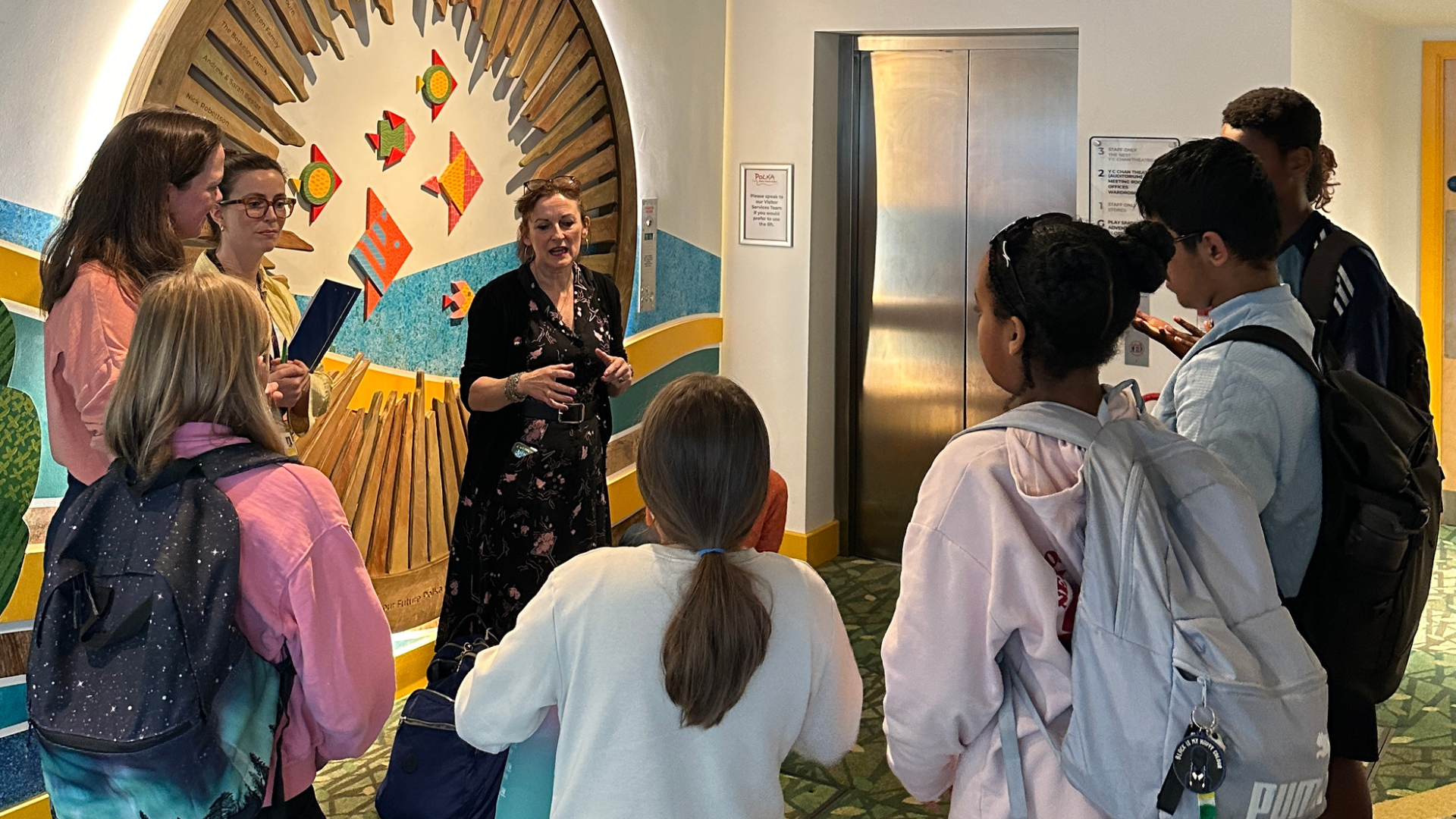
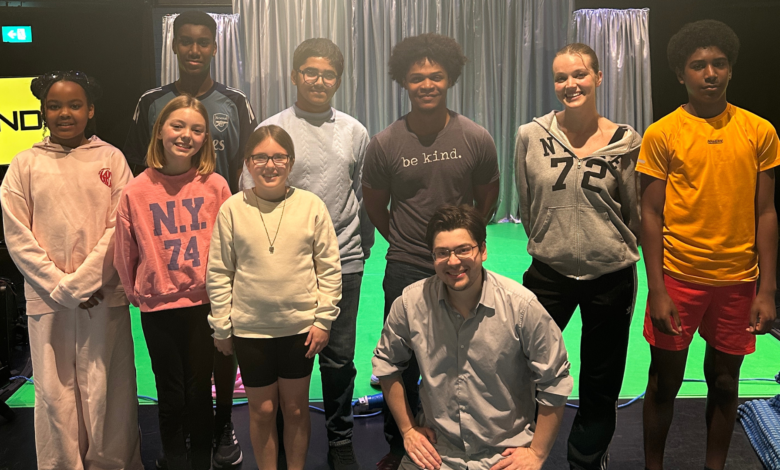
All productions at Polka are child-centred, meaning young people are involved in conversations throughout the creative process and well before the show gets to the stage. One group of consultants is the Grads, aged 12-15 years. It was these teens who came to our first masterclass, sharing a creative conversation before watching a performance of The Shivers by emma & pj, including a post-show Q&A with the cast, before being tasked to write a review.
Mary being Mary, she didn’t hold back in presenting an enormously comprehensive toolkit of ideas they might possibly use in their writing. They discussed mindfulness and the importance of writing about someone’s work with respect, acknowledging there is a human at the other side of the criticism. Then there was all the content and structure required in a review; from intro to conclusion; recognising a story arc and themes; ideas of access and writing for a specific audience. Interestingly, at Polka it’s not the intended audience of young people watching who buy the tickets – it’s their adults, so it was brilliant to have Helen available to give insight to the group on this. Fundamentally, this review would be their personal opinion which they must take responsibility for and which, if argued respectfully and backed up, has as much validity as any other.
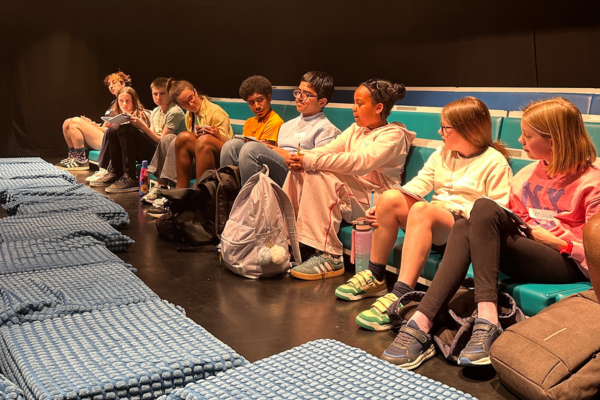
So what to expect from their write-ups? Were they overwhelmed by the complexity of the task? And 12-15 years old – “Ah bless!” These reviews are going to be about how it was ‘nice’ aren’t they? The jolly tunes? Well, think again reader! The Grads’ work was astounding! When they could have chosen to write about superficial aspects of the show, they instead dug deep and found insight.
Josiah commented on the effectiveness of the costumes and went further, noting the attention to detail and how the materials were specifically chosen to reflect the characters, such as the wires protruding from The Hacker character’s jacket.
Adelina considered the suitable age range, commenting that it might be more suited to an older audience as parts were chilling. Maya disagreed, observing that younger spectators attending the show with their families seemed to enjoy its playfully interactivity.
Eva also assessed audience responses to the play, showing awareness of whether or not they were restless and commenting on how engaged and focused on the performance they were.
Fadi described the show as ingenious and discussed how it “expertly [blends] a high-stakes thriller narrative with hilarious physical comedy.”
He also expanded on the relevance of the themes for both young and older children of spotting the dangers of technology and the internet, describing how the play “…offers a safe space to consider these difficult, modern themes.” Fadi additionally observed how confusion was acted out to immerse the audience in the issues described, noting how “the live video projections effectively illustrated the “muddled” world where truth is hard to find”.

Luke also talked about the use of technology and how it worked with themes of misinformation. He defined how “you felt like your mind was playing tricks on you, like you were in a different place, just because of the lighting”.
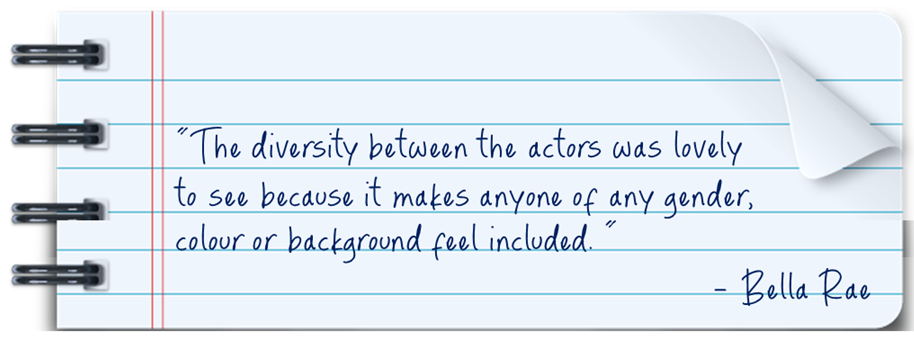
One thing we discussed in our masterclass was how sometimes a show reaches beyond the space of the performance, and this was not missed by our crack team of young reviewers. Bella-Rae talked about the diversity of the cast and how visualising representation was valuable to a young audience:
“The diversity between the actors was lovely to see because it makes anyone of any gender, colour or background feel included. I felt like I was able to relate to some of the characters in Shivers such as Agent Rookie, because even though he made a mistake of listening and doing something he knew was wrong he still tried and succeeded in fixing it. I think this could relate to all of us.”
I had a little tear in my eye for that one – of all the things she could have chosen to mention, what a brilliant takeaway.
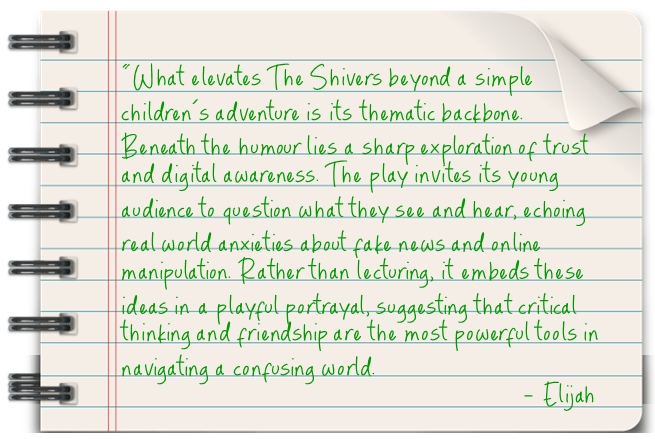
And Elijah – well, Elijah’s writing was so beautifully eloquent we actually searched online to make sure it wasn’t written by Chat GPT before agreeing we will be signing him up as a reviewer the minute he hits 18. Read this:
“At Polka Theatre, The Shivers bursts onto the stage as a frenetic, inventive adventure that manages to feel both playful and quietly urgent.
What elevates The Shivers beyond a simple children’s adventure is its thematic backbone. Beneath the humour lies a sharp exploration of trust and digital awareness. The play invites its young audience to question what they see and hear, echoing real world anxieties about fake news and online manipulation. Rather than lecturing, it embeds these ideas in a playful portrayal, suggesting that critical thinking and friendship are the most powerful tools in navigating a confusing world.
The Shivers is a bold, imaginative piece of theatre that succeeds in being both entertaining and thought provoking. While its animated style may sacrifice moments of reflection, it more than compensates with creativity, wit and relevance. For its target audience, and even for adults willing to keep up, it’s a vibrant reminder that theatre can be as smart as it is fun.”
Hard to believe eh?
It was thoroughly invigorating to interact with these young people, helping them to articulate their thoughts on the theatre being made for them; giving visibility and validity to their work, and indeed to ours. The quality of analysis has proven to be highly impressive, and ET is really looking forward to repeating the process with the next cohort of Polka Theatre Grads.
You can find out more about Polka’s Ambassador scheme and how to apply via the link below.