Pros: This show brings the “revue” theatrical style back to the masses.
Cons: Contemporary audiences may find it difficult to find a recurring theme or narrative running throughout all 24 short plays. A series of short plays, performed with gusto and cheek and genuinely side-splittingly funny at times.
summary
rating
Good
The artistic director of the Hampstead Theatre, Edward Hall, has pulled off a fantastic coup in persuading Michael Frayn, a theatre-maker of great renown who had all but given up active playwriting, into adapting his collection of short stories for the stage. Matchbox Theatre is a series of 24 very short plays that range from what Hall describes as “high seriousness to overt entertainment”. And this is exactly what we get.
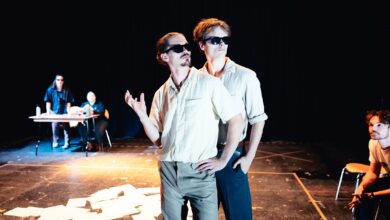
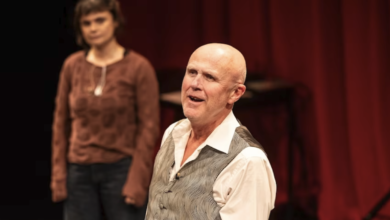
The opening short story details the plight of a long dead husband and wife team (650 years!) in a tomb who cannot cope with the noise of a neighbouring nightclub. It is over-the-top and side-splittingly funny, and helps to set the tone for a production that is often raucous and just plain silly. Esther Coles’ portrait of a provincial gossiper who races from one topic of conversation to the next without stopping for breath is hilarious. She drags her outrageously long telephone cord all over the audience and at one point entwines it around an audience member’s neck! Tim Downie as the talk show host who loses an award to a female rival is super. Felicity Montagu and Mark Hadfield are also brilliant in their many roles. In fact, the whole cast of six are pretty superb.
However, it is hard to get used to the evening’s revue strutcure. Contemporary English theatre is not known for paying homage to this French style of comedy sketches, so at times it can be quite hard to find the point of it all. On reflection it is easy to see that the point of the productions is entertainment for entertainment’s sake – pure and simple. However, I can’t help feeling that it would have been a more rewarding and enriching experience if there was a constant narrative running through all the mini-plays.
Michael Frayn’s talent lies in making the mundane nature of everyday existence hysterical. There is a scene in which two maths geniuses, Nina Wadia and Mark Hadfield, spend what seems an age going back and forth and spouting equations and not really talking about anything. Frayn’s final scene pokes fun at stage managers by portraying them as creatures that only come out in the dark, in a David Attenborough documentary fashion. It was possibly the best sketch of the evening.
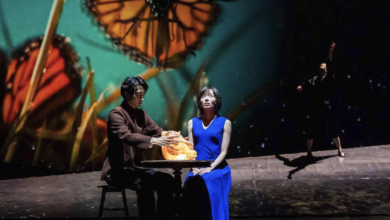
Director Hamish McColl made the correct decision in choosing to stage the revue in the round. It established the audience as cast members for the performance. Polly Sullivan’s sparse set is effective and highly theatrical, if for the simple reason that we the audience have to use our imagination at all times.
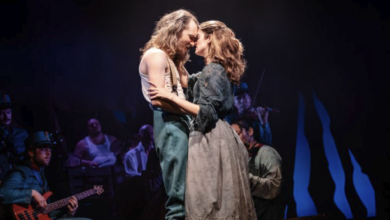
A lot of the sketches were silly, irreverent and in some instances puerile. But this was what was admirable about the entire production. It never took itself too seriously. And it is always affirming to see a group of actors who are reveling in the process, whilst the audience are lapping it up. A welcome return for Frayn to the Hampstead Theatre, which he was so instrumental in helping to set up many years ago.
On the whole the production is a success. Some sketches are stronger than others but I guess that that is the nature of the beast.
Director: Hamish McColl
Author: Michael Frayn
Producer: Hampstead Theatre
Booking Until: 6 June 2015
Box Office: 02077229301
Booking Link: http://www.hampsteadtheatre.com/buy-tickets/