Halfway Home is a strikingly simple drama that lays bare the tragedy of alcohol abuse and its aftermath. What it lacks in theatrical precision and poise, it makes up for in heart.Rating
Good!
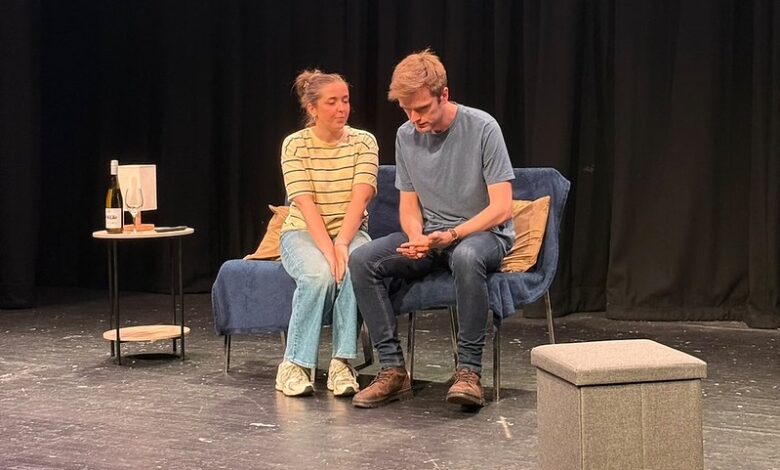
At the heart of Alexander Artis’ newest play, hitting Camden’s Etcetera Theatre after a successful run at the Edinburgh Fringe Festival, lies the tragedy of alcoholism, laying bare the pressure it places on to family, and exposing that recovery is never as simple as it might first appear. Halfway Home introduces Davie, a recovering alcoholic portrayed sharply by Artis himself, who has returned home from prison to bunk with his older brother Freddie, who himself is hoping to create an impression of his perfect life. Freddie is living with his fiancée Laura in the flat that they own, applying for a job that he believes most certainly has his name on it, yet Davie’s arrival still disrupts Freddie’s hard-fought-for stability. Buried within the nuanced story of Halfway Home lie the bones of a stark representation of life in conflict with alcohol abuse, and by truly honouring this central idea, which at present seems masked by excessive theatricality, these bones may finally rise to the surface.
Halfway Home adopts a simple plot that is acute and effective. This is ordinary working-class life in Scotland; our characters are getting on with it, and Davie’s struggle is a factor of their lives that they each must form a relationship with. Here, there is beauty in the mundanity, in the trying to love your brother despite it all, in neglecting your own needs to support your fiancée and in simply wanting to be a better person. When the production is brave enough to recognise its simplicity, it shines, but once it feels that it must complicate this simplicity in order to impress, it sadly loses impact.
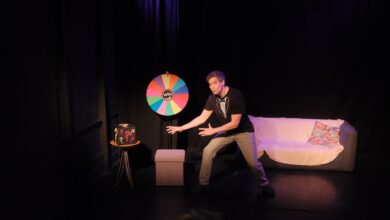
The structure is disjointed, where striking moments of naturalism are interrupted by monologues, spoken in response to a voice recording. Still, it is here that we truly come to understand this family. In Freddie’s interview for a much-wanted role in the Police Force, he describes that his brother must ‘invent chaos to survive,’ but these confessions disrupt the flow of action so invasively that I wonder if they’d hold more power in conversation, where their family can react to these truths. Equally, the play’s opening movement sequence sets it up on the wrong trajectory of abstract, rather than naturalistic, theatre.
There is undoubtedly enough strength in Artis’ writing to carry the play independently. In Halfway Home he demonstrates that he deeply understands alcoholism in its entirety, reckoning with all its effects. In a particularly pertinent affirmation, Davie admits that ‘booze never put a thought in my head that wasn’t there,’ and that ‘every morning’ he must ‘face yesterday.’ It is these observations of the humanity of alcohol abuse that really sit at the crux of the performance.
Still, there are a few less significant flaws amongst the piece, and I must question whether it is realistic for Freddie and Laura to leave an open bottle of Hennessy on the side table when Freddie’s alcoholic brother is moving in. It is imperative that every detail is offered with true precision. Yet, what is here is enough to mark both Artis’ potential as a playwright and lay the groundwork for a very promising piece of theatre that, at its core, reminds us that life will often be difficult, and so we’ve got to have each other.
Written by: Alexander Artis
Directed by: Chelsea Grace
A Deliverance Theatre Production
Halfway Home has completed its run at the Etcetera Theatre.