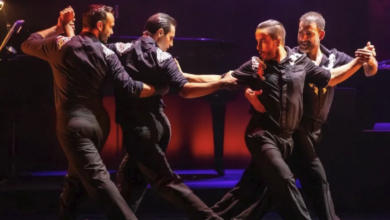
Three men stranded on a whaling ship face death in the frozen Arctic wilderness, in this bleak, tense and richly characterised drama, which boasts captivating performances from the whole cast.Rating
Excellent
A whaling ship is stranded in the Arctic winter when the sea ice closes around it. The crew slowly die leaving three men alone, unable to return home. What will they do? And could their salvation come in an unlikely form? This is the premise for Dogstar at Hampstead Theatre, a nerve-racking and claustrophobic drama that asks difficult questions about how we respond when confronted with our mortality.
Dogstar has a tight length of one hour and twenty-five minutes, running straight through, and upon entering, audiences are told that there is no re-admittance. Thus an intense experience is created that allows the tension to build to extreme heights. Minimal set, lighting and props focus the drama on the three men and the bleak fate that looms in front of them.
As this show foregrounds the interactions between the three characters, detailed characterisation is essential for transporting the audience to the small world they inhabit. Daisy Hall’s script deftly fills in the complex relationships between the three sailors, the conflicts, and the grief they all feel from the recent deaths. The shifting pattern of allegiances and clashes between the three makes up the meat of the drama. Sam (Abdul Jalloh) is young and inexperienced, headstrong and scared. Gorey (Adam Rojko Vega) has a criminal past and is trying to change in the face of death. Babben (Justin Edwards) is old, experienced and overbearing. All three have large egos, wounded pride and human frailties. Their relationships are fraught but there is also comradely affection between them. Fights break out, but peace is quickly re-established. A few moments after chastising Sam for bringing bad luck on the voyage, Babben is tenderly mending his coat. Gorey both mocks and protects Sam, who himself both respects and has contempt for his crewmates.
Dogstar offers nuanced insight into the relationships between men in a men-only environment, showing how quickly bonds can form, hierarchies are established, conflict arise, and sacrifices made. The script aids this portrayal by being conversational, fast moving and witty, and there is a constant tending back towards a fragile peace despite the bickering. Dialogue is Dogstar’s richest tool for defining character, and it is used well to develop the extensive emotional lives of the three protagonists. Hall’s writing transports the audience to the bleak world of the barren Arctic and then takes us inside the mind of people who are stranded, starving, and going mad.
The three actors fully inhabit their roles, with each performance feeling lived-in rather than played. Every character is finely observed, down to the smallest gesture. Jalloh, as Sam, delivers an outstanding performance, skilfully managing to express his character’s duality of confidence and fear.
Knowing this genre of dark storytelling well, I knew the characters were headed for a grim ending. Even so, when it came it made me physically stiffen in my seat. A plotline of magical realism, effectively conveyed through changes in lighting, is added at the darkest moments and genuinely surprised me. It provides a needed tonal variation to prevent the show becoming too bleak. The grim finale left me in stunned silence long after the final curtain call.
Hall’s script conjures a textured world, tightens the tension by degrees and lands a conclusion with real force, all of it deepened by performances that make the story impossible to look away from.
Written by Daisy Hall
Directed by Lucy Morrison
Designed by Hannah Schmidt
Lighting Design by Holly Ellis
Sound Design by Anna Short
Fight Director: Bret Yount
Assistant Director: Verity Richards
Production Manager: Steve Wald
Costume Supervisor: Sasha Earney
Stage Manager: Louisa (Lola) Glading
Dogstar plays at Hampstead Theatre until Thursday 5 December.