An urgent and important call to arms, identifying unspoken social influences that can lead to crime by women, and the human costs behind them. Masterfully performed and beautifully written. Rating
Excellent
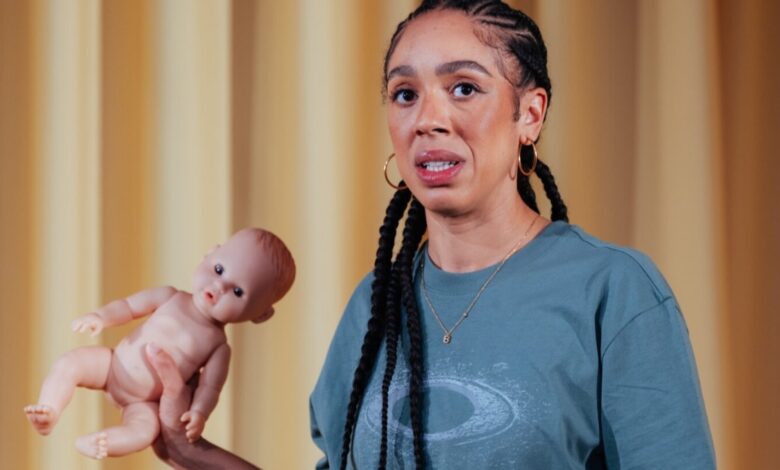
This premier of Baby by Gurpreet Kaur Bhatti is presented by Brixton House together with Clean Break, an organisation that gives voice to women with lived experience of the criminal justice system. It’s a visceral story of survival, focussing on an individual who has suffered from simply being a woman in society: abused, falling through the cracks and subsequently becoming incarcerated, with her own baby taken into care. Compellingly delivered by Pearl Mackie, the play is so much more than great storytelling, giving an important insight into marginalised real lives and exposing factors that exacerbate crime by women.
Baby is almost an everywoman, her very name speaking both of glorious potential and social suppression. She urges the audience not to be passive but to witness and spread the word of what we learn. We’re empowered, described as ‘real people’, rather than those invisible characters in the chain of events that contribute to her downfall. A cyclicality is established from the very beginning, as we’re propelled from pitch blackness to startling, disruptive light. The story surges forward with a relentless sense that time is limited, events inescapable, until Baby’s words are abruptly shut off as her time runs out. A constant hint of impending catastrophe suggests a classic tragedy where Baby is always doomed.
Mackie is grippingly engaging from the off, charismatically funny before stretching her meticulous performance across the whole gamut of emotions. She nails the charm and practicality of a passionate and resilient child, before a cruel learning curve leaves Baby defensive and hostile.
This is an intelligent and capable character, who in different life circumstances would be successful. At times it’s a hard watch learning about her appalling early life experience, with seriously disturbing themes covered including child and drug abuse, violence and coercion. Throughout, Bhatti underscores the importance of care and unconditional love, highlighting the damage done by their absence.
The play authentically illustrates known behaviours of women from abusive backgrounds. Her own childhood marred, Baby is emotionally immature, desperate for validation and people-pleasing, which leads to trouble. She is unable to regulate her feelings and without guidance can’t know how to be a parent herself. We’re shown the frustrations of trying to move forward in a system that is confusing and inconsistent. But things can change and do so when motherhood allows Baby to understand unconditional love and what she is capable of. The issue then is persuading others to see her differently and keep the flame of hope safely alive without getting burned…
Bhatti’s crafted writing is sensorily lyrical, couching difficult subject matter in detailed storytelling that illustrates minutely through descriptions of smell, touch and colour, yet is punctuated with humorous light relief. Baby’s own sensations range from utterly numb to suicidal, performed convincingly by Mackie. A hopeful moment where she allows herself to be hugged is deeply moving, demonstrating the capacity of caring touch to heal.
Baby’s instability is cleverly reflected in temporal and geographical scene swings, supported by organic lighting (Bethany Gupwell) and sound (Elena Peña) that help define the environment around her emotionally disturbed state. Meanwhile, Milli Bhatia’s precise direction evokes multiple characters in a handful of empty chairs, imagining the insubstantial nature of the relationships in Baby’s life. Mackie additionally articulates a choreographed (Gabriella Schmidt) expression of compliance in prison life superbly, “doing the dance” through unnaturally stilted physical movement.
Baby is a challenging but hugely informative and emotional piece of work that resounds with authenticity. It’s performed with skilful storytelling and obvious care, stripping back layers to expose important hidden truths about women and crime and equipping the audience with a candle to go forward and enlighten society.
Presented by Brixton House and Clean Break
Writte by Gurpreet Kaur Bhatti
Directed by Milli Bhatia
Set & Costume Design by Khadija Raza
Lighting Design by Bethany Gupwell
Sound Design by Elena Peña
Movement Director: Gabriella Schmidt
Company Stage Manager: Catherine Mizrahi
Production Manager: Sy Supersad
Baby runs at Brixton House until Saturday 31 October. A self-care guide is available here for those affected by the themes of the show or interested to know more.