Review: Animal Farm as Witnessed by Moses the Raven, Barons Court Theatre

A one-man show that manages to bring Animal Farm to life: you won’t believe that there aren’t chickens running between your legs or cows leaning their heads over a fence in the corner. Rating
Good
The works of George Orwell are scarily timeless. 1984 reads as an accurate prediction of what the world will, or now has, become (it’s also the only book that’s ever managed to make me jump out of my skin), and Animal Farm, an allegory for the Russian Revolution of 1917, still feels as strikingly true today as it must have in 1945. It’s important, but can one man really bring it to life under a pub in Barons Court?
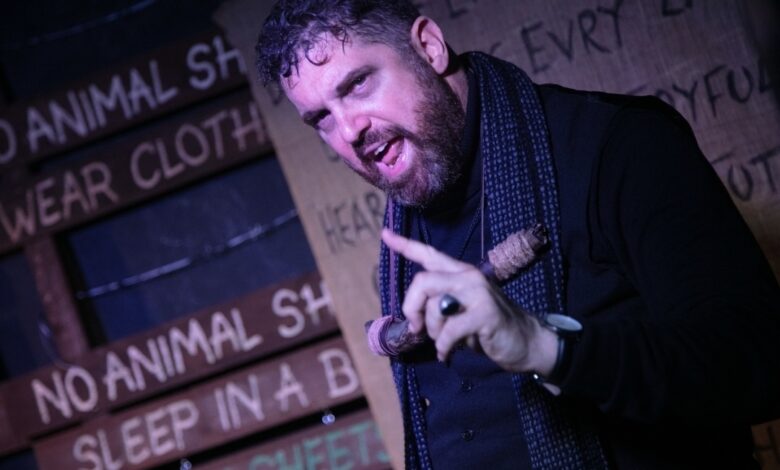
Dov Citron, both writer and performer of the show, does just that. He begins the show as the drunken Mr Jones, stumbling around the stage and amongst the audience as we take our seats. But as the lights darken, Citron takes on his role as the storyteller, Moses the Raven. It’s a useful device, however more of Moses’ perspective would have been welcomed, perhaps to inject a new interpretation of the story. In the novella, Moses portrays institutionalised religion, but this is not clear in Citron’s representation as he is more of a neutral storyteller.
Citron’s portrayal of all the animals is incredibly well done. He easily transitions from Napoleon, in his bowler hat and gruff voice, to Boxer with his can-do Soviet worker attitude and heartbreaking end. His use of props is measured yet effective, with hats to quickly show us who we’re watching on stage, a lectern to demonstrate the power of the speeches, a snare drum for the occasional gun shot, and a cane for Moses. His physical depictions of the animals are also brilliant: whilst a dark story that gives pause for thought, there are moments of light relief when he suddenly becomes a chicken or a cow. He’s a true chameleon and you soon forget that it’s just one man on stage, and not a large cast depicting a farm full of animals.
The set is really effective considering the size of the space. As you walk down the stairs into the theatre propaganda lines the walls, the stage is covered in straw, and the commandments of the Animalism manifesto hang on wooden planks, with space to amend them as the commandments change. The moment that he changes “All animals are equal” to “All animals are equal, but some animals are more equal than others” feels momentous and powerful. The simple set and strong performance combine to bring this text and its implications to life.
There are some moments when Citron comes into the audience, and although these are well received on the night there is some potential for audience embarrassment, particularly when cards are used to implicate Snowball’s spies. Citron approaches audience members and holds a card close to their face, which they then have to read out loud. For some people who struggle to read or hate public speaking, this could really affect their enjoyment of the show. At one point he squeezes himself between two women on the front row, and whilst it works in the context, you can’t help but wonder how the women felt about a man deciding to practically sit on them. Perhaps there are other ways to involve the audience without risks of discomfort.
Having said that, Citron is an engaging and delightful storyteller: despite the bleakness of the story he’s a real treat to watch. At the end of the play he comes out of character to tell us about their hopes to bring the show to schools. If you’re studying Animal Farm in a classroom, perhaps struggling to engage with the text, this play would be the perfect tonic.
Written by Don Citron
Original story by George Orwell
Directed by Victoria Waddington
Animal Farm as Witnessed by Moses the Raven plays at the Barons Court Theatre until Saturday 3 October.