A slow creeper of a play, humour and ranting leading you astray until the ending takes you completely by surprise.Rating
Excellent!
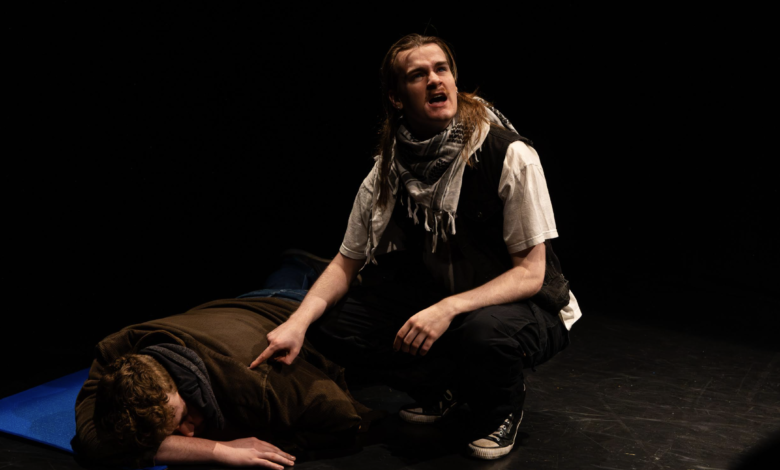
When James (writer Noah Xavier) finds himself thrown into a jail cell with an unconscious man he dubs Tiberius it seems a simple case of having been in the wrong place at the wrong time. That place is a protest about the sacking of a schoolteacher accused of showing her class inappropriate material, or as James suggests, her real crime was simply being queer. And James’ supposed crime? Throwing a brick that hit a policeman.
The opening tirade as he screams and shouts at the cameras in the cell is a work of art, the insults against the police who arrested him more and more ridiculous as he slowly loses steam. And all the time he is ranting, Tiberius remains unconscious on the floor, his flask of booze safely hidden. But these opening rants have no clear focus, other than to shout at “the man” – that authority that James sees as unaccountable.
His ranting and raging hardly subside throughout, yet slowly the focus sharpens. Issues are thrown in the mix that are, in one sense, misdirects away from where it is ultimately leading. And yet at the same time they are meaningful, all rallying against the injustices he sees in the world, from that sacked schoolteacher, his parents’ abandonment because of his sexuality, and a world where the status quo is maintained at all costs and protects its own, no matter what they might have done (Andrew Mountbatten anyone?).
The script is cleverly balanced to slowly focus in on its powerful ending. Each scene draws us a little closer. Their game of chess analogy is subtly brilliant, and you hardly notice when it is first introduced; James’ early moves appear scattergun, sacrificing pawns one by one to leave room for the power pieces to come into play, and ultimately checkmating us in one final killer move. The slow drip feed of information about James’ life and how he arrived here is equally as subtle, his radicalisation almost unnoticeable as he gets involved in protests to impress a guy. His research into the injustices all around is facts that many see, and yet for James they become reasons to want to fight a system set up to retain the status quo of the world, protecting those who have the money and power.
Xavier’s performance as James is glorious, aided by strong directing that always angles their focus in the right direction. While early rants are aimed at the watching camera in the cell, later his focus turns towards Tiberius, still prone on the ground, telling him “Hope is the act of being heard”, as if this unconscious body is listening intently, representing everyone repressed by a system crafted to keep them quiet. And as much as we all probably looked at the prone body thinking “I could do that role” you have to admire the physical effort of lying there for an hour, small movements, grunts and moans of a drunken man perfectly timed. It’s almost a surprise when he springs up at the end to take the applause without complaining about his back.
What begins as a rally against all the injustices of the world turns into a focused cry against a single injustice, but one which is a microcosm of the entire system being fought against; a rallying call as to why young people take drastic actions when they feel there is no other way to achieve fairness in a world that for many looks increasingly fixed against them. It’s a play that slowly builds to that final crescendo, and when it arrives, leaves us in no doubt what it wants us to hear.
Writer: Noah Xavier
Directors: Maria Ramjee & Ren Flashner
Produced by Left for Dead Theatre in association with BoonDog Theatre
Brick plays at C Venues until Sunday 30 August, as part of the Edinburgh Fringe Festival