Review: Slaughterhouse-Five (Or The Children’s Crusade), Southwark Playhouse
The Little

War, time travel, and trauma collide in an impressive, compassionate adaptation of Vonnegut’s notoriously difficult novelRating
Excellent
Kurt Vonnegut’s book Slaughterhouse-Five (or to give it its full title: Slaughterhouse-Five, or The Children’s Crusade: A Duty-Dance with Death) is, like War and Peace and Ulysses, one of those books I always wanted to read but never got round to. I didn’t see the 1972 movie or the production that played at the Jack Studio last year, so I was delighted to see that the same production has transferred to the Southwark Playhouse.
Adapting Kurt Vonnegut’s Slaughterhouse-Five (or to give the play’s full title: Kurt Vonnegut’s Slaughterhouse-Five (or The Children’s Crusade)) for the stage is the sort of challenge that sensible theatre-makers avoid. How do you dramatise a novel that ricochets through time, blends science fiction with wartime horror and treats narrative structure with disdain? Well, Eric Simonson has done just that and answers that question with remarkable ingenuity.
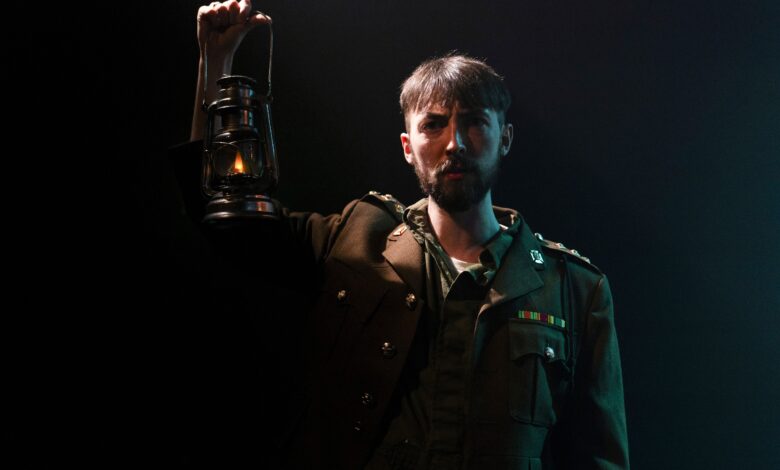
The play follows Billy Pilgrim, a Second World War soldier who becomes “unstuck in time”, slipping between key moments of his life: his experiences as a prisoner of war during the bombing of Dresden, his mundane post-war existence and his encounters with the alien Tralfamadorians. It sounds unwieldy on paper, yet this production embraces the story’s fractured logic rather than trying to tame it.
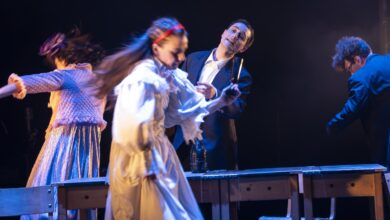
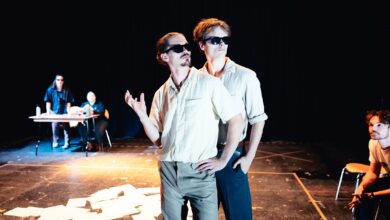
Working in a very small space, director Douglas Baker transforms its limitations into strengths. The production moves with the restless energy of a fever dream, scenes bleeding into one another as if Billy’s subconscious is rifling through old photographs. Three of the four-person cast perform theatrical gymnastics, slipping between numerous characters with impressive fluidity. Sofia Engstrand, Alex Crook and Ethan Reid handle the rapid-fire role changes with a combination of precision and playfulness that keeps the audience oriented even when the story deliberately isn’t; their versatility becomes one of the evening’s greatest pleasures. The fourth member, Patrick McAndrew, plays Billy Pilgrim, seemingly confident that he’s been abducted by time-travelling aliens whilst dealing with the reality of war and its aftermath, PTSD.
What makes this production really stand out is Baker’s video design, Laurel Marks’ lighting and Calum Perrin’s sound design, between them creating a vivid sense of dislocation without overwhelming the human story at the centre. The multimedia elements feel fully integrated into the storytelling rather than bolted on as flashy embellishments, a hallmark of a company that clearly understands how to use technology in service of narrative.
The comedy and the absurdity of the situation are allowed to coexist with the tragedy. A laugh is often followed by a gut punch; an apparently whimsical scene suddenly reveals a deeper wound. The result is that horror and humour are very much uncomfortably close companions. This is an ambitious and intelligent piece of work, and production company So It Goes Theatre should be commended for taking on such a difficult mission. Rather than attempting the impossible task of reproducing Slaughterhouse-Five exactly, it has made theatre that’s funny, strange, humane and quietly devastating.
It’s not an easy watch and sitting concentrating for nearly a hundred minutes straight through – it’s a task all of its own, but as the phrase that is repeated throughout the play goes, “So it goes”, and so should you.
Adapted by Eric Simonson
Directed by Douglas Baker
Video Design by Douglas Baker
Composition & Sound Design by Calum Perrin
Lighting Design by Laurel Marks
Movement Direction by Matthew Coulton
The show plays at Southwark Playhouse’s The Little until Saturday 4 July