Light and dark worlds collide in this assured production.Rating
Excellent
Before this performance of Much Ado About Nothing, my guest, who was at the Globe for the first time, nervously confessed to being apprehensive. Distant memories of picking apart Shakespeare word by word at school had left him fearful that he would be locked out of understanding the play as it unfolded in front of him. Somewhat confidently, I reassured him that the Globe’s strength was bringing Shakespeare to its audience rather than the other way around.
Thankfully, they did not let me down.
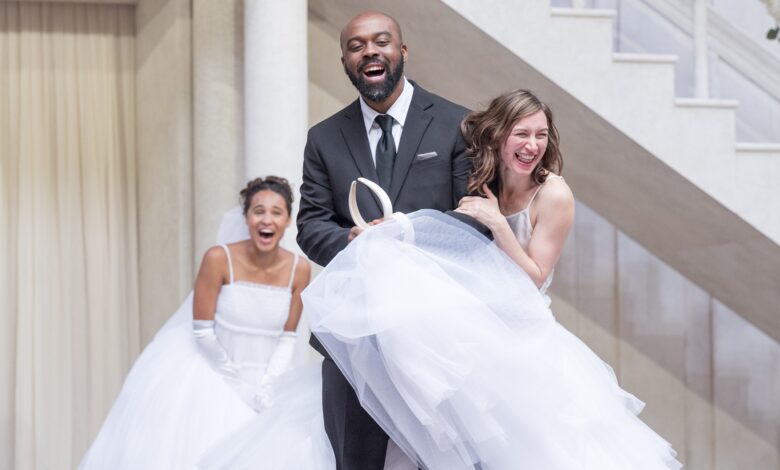
Chelsea Walker‘s production, like much of the Globe’s work, is rooted in a deep understanding of the text. From that, abundant comedy, bountiful romance, delicate intimacy and dark tragedy are mapped out through skilful visual and verbal storytelling. There is a deep respect for, and trust in Shakespeare’s language that feels completely natural. Within minutes, it wasn’t simply the attractive contemporary setting of wedding cake colours and tailored couture that had brought Messina to London’s South Bank, but a command of the play’s nuances that made every note feel as contemporary as the music that underscored it.
Walker’s canvas is huge: the vast stage of the Globe boldly extended in Sami Fendall’s design with a thrust reaching deep into the audience. Every dimension is put to use, the action enveloping and including the audience, with plenty of scope for overheard conversations, plotting machinations and secret trysts. However, at times, the scale of the physical and emotional canvas proves too much for some of the players as voices tire and crack.
Central to the appeal of the play is the sparring between Beatrice (Pippa Nixon) and Benedick (Ken Nwosu), and these performances do not disappoint. Nixon’s Beatrice is as feisty as an alley cat while Nwosu’s Benedick has the audience eating out of the palm of his hand with his effortless charm. There is such chemistry between them that it seems almost impossible that they can sustain it and still transform their relationship into a convincing romance by the end, yet they do so with seemingly limitless energy.
Similarly, Richard Katz’s Dogberry is a delight, his complete certainty in his own authority matched only by his spectacular incompetence.
But there is a much darker side to this play that is often skipped over or handled with less skill. The false accusations thrown at Hero (Assa Kanouté) and her humiliation at her own wedding, fuelled by misogynistic assumptions, are dark clouds that appear suddenly. Walker’s command of the tonal shift is assured: we are laughing one minute and stunned into silence by the brutality of the accusations the next. Kanouté carries these scenes with dignity, ensuring that Hero never becomes merely a victim of the plot but remains the wounded heart of it.
When Claudio (Joshua John) seeks atonement for his actions, his grounding of himself in the dirt of Hero’s grave while dressed in an immaculate suit symbolises Walker’s bravery in plunging the frivolous and the comedic into the darkest corners of the human psyche.
Much Ado About Nothing is one of Shakespeare’s more complex creations. Comedy, romance, cruelty and redemption are carefully balanced throughout. Yet the ultimate measure of the evening lay not on the stage but beside me. My companion arrived fearful that Shakespeare would be beyond him and left utterly charmed by the world he had just been welcomed into.
Written by William Shakespeare
Directed by Chelsea Walker
Designed by Sami Fendall
Original music composed by Angus MacRae
Movement direction by Aline David
Much Ado About Nothing plays at Shakespeare’s Globe until Saturday 24 October