Gentle, cartoonish clowning that feels like stepping into a low-budget arcade game which has somehow become sentient.Rating
Good
HOTDAWWG feels like stepping inside a low-budget arcade game that has somehow become sentient. The show turns the repetitive logic of a cooking simulator — something like Papa’s Pizzeria or Hot Doggeria — into live clown theatre, trapping its characters inside a loop of service smiles, panic and absurd labour. It is slight, strange and meticulously controlled.
At the centre is Ines Aresti, playing a hotdog vendor with the jerky, limited movements of a video game NPC. She sways nervously behind her tray, lifting hot dogs into the air with an over-eager grin and offering them to unsuspecting audience members. The comic premise is almost aggressively simple: how many different ways can someone give away a hot dog? Yet the show commits so fully to this tiny idea that it develops its own bizarre internal logic.
Aresti is joined by Tom Kinsella as her boss, whose presence introduces a layer of status politics into the game. He stalks around reprimanding and directing her like a cartoon supervisor, creating the sense that the entire performance runs on invisible workplace rules that nobody fully understands. At only around half an hour long, HOTDAWWG never expands much beyond this setup, but its appeal lies less in narrative development than in the precision of the clowning itself. The whole piece rests on rhythm, restraint and control.
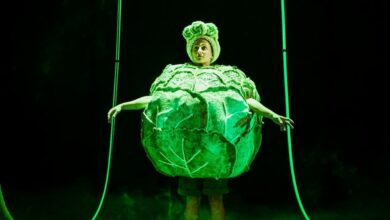
The sound design is crucial to creating the show’s comic-book atmosphere. Ambient stadium noise hums constantly in the background, acting almost like the blank white space of a comic strip: a neutral field against which every tiny gesture becomes exaggerated. Familiar cartoon sounds — horn honks, abrupt musical stings, distorted effects — are chopped up and redeployed to punctuate jokes. One particularly memorable moment arrives when Kinsella appears dressed as an enormous hot dog, whispering “cómeme” (“eat me”). Aresti cautiously takes a bite from one of the sausages on her tray, and he instantly collapses to the floor dead. The joke is stupid, abrupt and perfectly timed.
The bilingual nature of the show adds another comic tension. Dialogue slips between English, Spanish and indistinct muttering, with Aresti mainly speaking Spanish while Kinsella barks instructions in English. The mismatch in language sharpens the power imbalance between them and gives their exchanges a constant sense of near-miscommunication. Much of the humour comes from watching Aresti desperately trying to follow instructions she may not entirely understand.
As the low-status clown, Aresti is deeply endearing. Her stretched customer-service smile barely conceals mounting anxiety, and the audience quickly becomes complicit in wanting her to succeed. Our laughter and participation feel like the only things keeping her safe from managerial punishment. Kinsella, meanwhile, avoids becoming genuinely threatening. With his exaggerated growls and finger-wagging, he resembles an overbearing toy conductor more than a real authority figure.
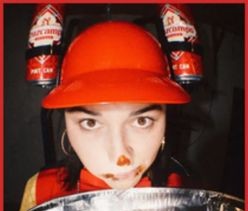
Still, HOTDAWWG remains closer to a performance piece than a fully developed comedy show. Its ideas arrive as a series of neat little comic sketches rather than escalating into something genuinely chaotic or surreal. Despite the poster’s promise of grotesque madness — a ketchup-smeared face emerging from darkness — the show never becomes especially wild, shocking or psychologically strange. Instead, it maintains the same gentle register throughout. That restraint is both its strength and its limitation.
Writer and created by Ines Aresti
Directed by Wambui Hardcastle
Dramaturg by Tallula White
Design by Lolly Whitney-Low
Produced by Ines Aresti, Zarmeeneh Khan
HOTDAWWG played at Theatre Peckham as part of Peckham Fringe, and has now completed its run.