A well acted and fast paced adaptation which keeps the audience's interest but with a busy narrative that sometimes lacks depth.Rating
Good
The first book in Malorie Blackman’s acclaimed Noughts and Crosses series was published in 2001. It has been adapted for TV and become a GCSE set text. Tonight’s audience included a number of school outings no doubt preparing for their exams.
The story is set in an alternative reality where power and privilege lies with Black people, known as Crosses. The white noughts (always written in lower case in the novel) are oppressed and impoverished. Government Minister Kamal Hadley’s daughter Sephy plays with his housekeeper’s son, Callum, as children. In a Romeo and Juliet tale, their friendship blossoms into forbidden love.
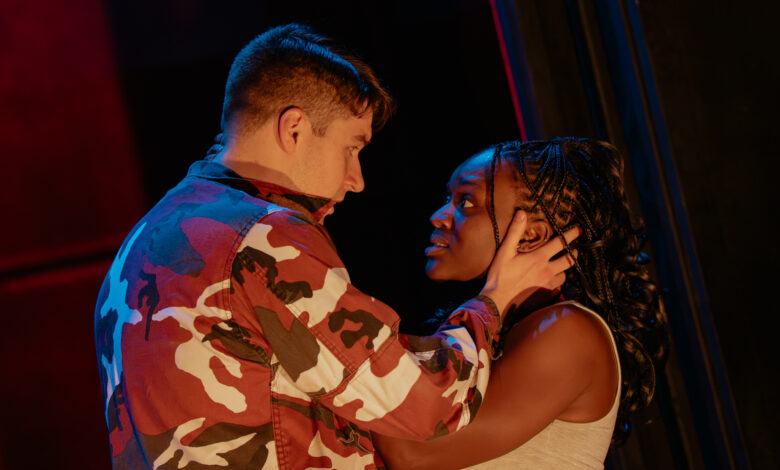
This is a stylised adaptation and the narrative unfolds in episodic incidents with Sephy (Brianna Douglas) and Callum (Lewis Tidy) regularly stepping out of the action, speaking directly to the audience to move the plot forward. It’s an interesting device, mirroring the novel’s structure of having alternate chapters written from Sephy’s and Callum’s viewpoint. The downside is that the story sometimes becomes a little stilted and loses narrative flow. The novel is meaty and it feels as though adapter Sabrina Mahfouz has tried to squeeze so much of it on to the stage that character development takes second place and some events feel rushed. For example, having been apart for three years and living very different lives, Sephy and Callum move from antagonism to ripping each other’s clothes off in a heartbeat.
Douglas and Tidy do well playing their characters from children to young adults. There is clear development as they mature, with changes in their appearance and physicality. They are believable as children but convince fully after the three year long interval. Douglas in particular looks and sounds very different when Sephy returns from boarding school.
The staging is noteworthy, with both families often appearing simultaneously. The contrast between how noughts and Crosses live is clearly demonstrated, but both have their issues. Sephy complains that her mother is an alcoholic and she never sees her busy father. Callum complains that his home is shabby and there is no help for his mentally ill sister. The noughts and Crosses dress differently; Sephy’s mother wears a bright blue outfit. Callum’s mother is in washed out trousers and shirt. Set changes are choreographed and mainly done by noughts, which is a clever touch, reinforcing their menial roles.
The narrative follows the novel and there are no compromises. The system is authoritarian and tough on any nought who steps out of line. The repercussions for any resistance are severe and there are no noughts on a jury. When the set silently opens to reveal a staircase leading to a gallows it is genuinely disturbing. Noughts and Crosses doesn’t quite capture the full intensity of the source material but the ending is powerful, if bleak, describing a world that feels oppressive and unhappy, even for the privileged Crosses, and where there is little to bring hope. It is a well acted production and absorbing throughout.
Written by Malorie Blackman
Adapted by Sabrina Mahfouz
Directed by Esther Richardson
Set and Costume Designed by Simon Kenny
Lighting Designed by Ben Cowens
Music & Sound by Arun Ghosh & Xana
Sound Designed by Adam McCready
Video Designed by Si Cole
Original Video Designed by Ian William Galloway
Associate & Movement Director: Xolani Crabtree
Voice Coach: Gurkiran Kaur
Fight Director: Kenan Ali
Intimacy Director: Asha Jennings-Grant
Noughts and Crosses plays at the Lyceum, Sheffield, until Saturday 23 May where the UK tour ends its run