Strong performances and gothic design cannot rescue this geriatric 1935 thriller from feeling like a museum piece.Rating
Good
There’s no getting around it: The Old Ladies is, well, old. It opened in the West End in 1935 and belongs to a lineage of pre-war British thrillers that graced the West End in the days that dear John Gielgud (who directed) was a bright young thing and a film-maker called Hitchcock was experimenting with talkies. The story is ridiculously tame by today’s standards. The old ladies of the title bicker melodramatically, but not much happens. Billed as a brooding horror, apparently, when it originally transferred to Broadway, there is little to raise the pulse in West London in 2026.
There are hints of rich, dramatic themes. Beauty, religion, friendship, lost love, grief, and poverty all hover around the edges, but the text remains stubbornly immune to subtext. Everything is spelt out in exposition-heavy, repetitive dialogue that quickly becomes a grind. Thank God the art of playwriting has evolved over the last 91 years. Things are not helped by staid, conservative by-numbers direction that sees the cast wander round a creepy set and occasionally sit in darkness with little sense of purpose. An opportunity for camp fun, or at least a touch of irony, has definitely been missed somewhere. Why so serious? Even in its first iteration, all those years ago, this was surely a piece of schlocky pulpy entertainment. Ibsen, it ain’t.
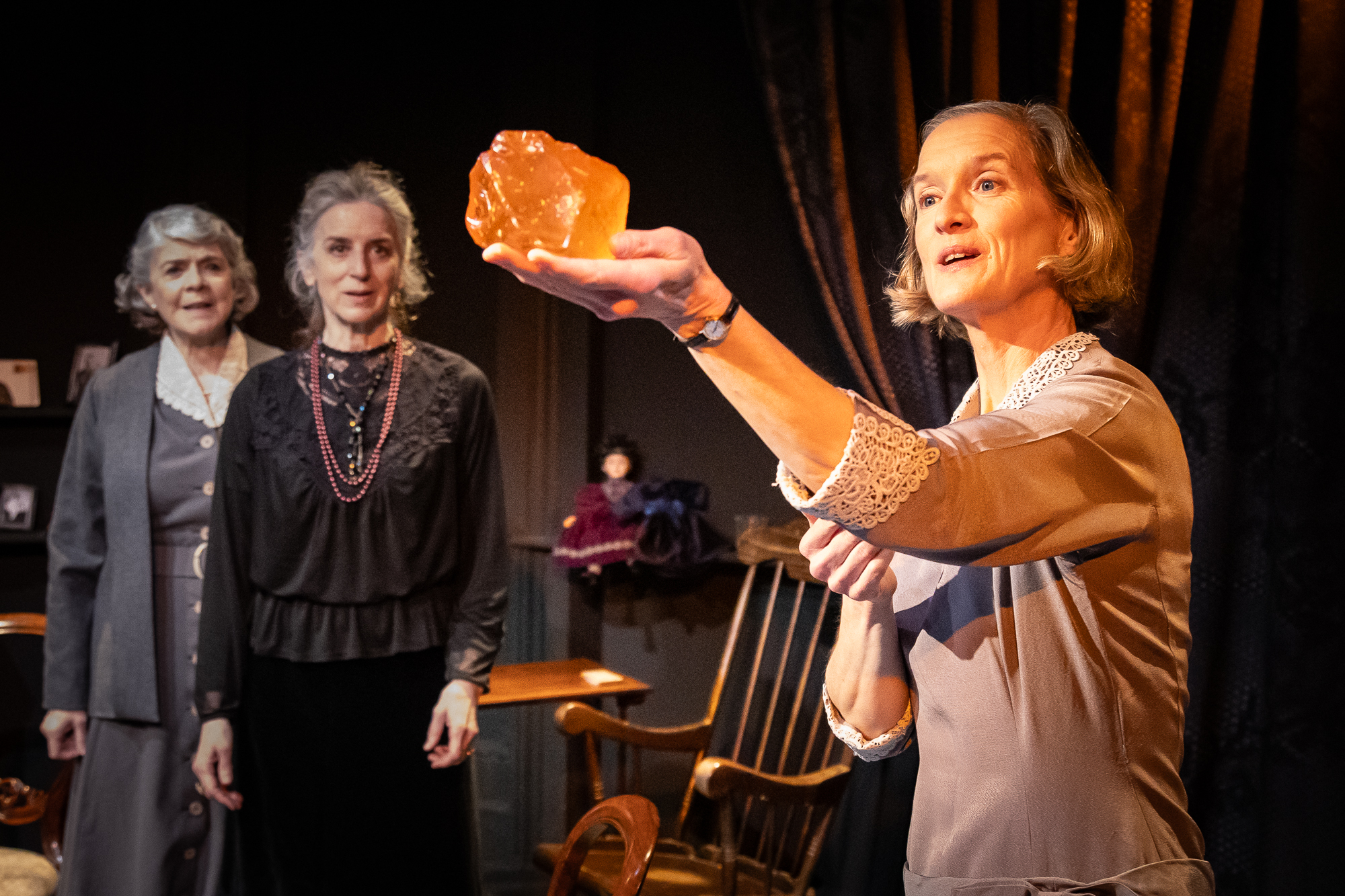
The aforementioned creepy set is at least entertainingly and macabrely lit by Mark Dymock. Old furniture and props, looming in the shadows, are also on point. Juliette Demoulin’s set is, however, confusingly one room and three rooms all at the same time. There are clumsy moments where characters refer to doors, walls and hallways that are quite definitely not there. These references could easily have been cut. In fact, there is a fair amount that could have been red-penned. 90 minutes without an interval failed the ‘checking my watch’ test by at least twenty minutes.
Much fuss will be made of the cast. Quite rightly. They work wonders with the dated material they’re given. They don’t, it has to be said, seem particularly old. I’m not just being charming. The script put me in mind of ancient, haunted ghost-like figures, not spritely 60-year-olds. Widow Mrs Amorest (Julia Watson) is caught between bag-of-nerves Mrs Berenger (Catherine Cusack) and spooky tarot card-wielding Mrs Payne (Abigail Thaw). They bump along in the night in their boarding house until… one of them doesn’t.
Cusack is tremendous. Even when her character is being, frankly, annoyingly neurotic, she’s entirely believable and eminently watchable. Thaw is asked to vacillate between versions of crazy lady by the script’s thin characterisation, but still manages to land many of the show’s best, funniest lines. Watson portrays the kindly matriarch at the centre of the story with warmth. These are undoubtedly three impressive performances. Sadly, they can only paper over the cracks. The Old Ladies really is a creaky old piece of theatre. The Finborough seems to be London’s unofficial home for long-lost, forgotten plays these days, which is admirable. Beyond theatre historians, though, I’m not entirely sure who this latest revival serves.
Written by Rodney Ackland
Based on the Novel by Hugh Walpole
Directed by Brigid Larmour
Set Design by Juliette Demoulin
Lighting Design by Mark Dymock
Sound Design & Composition by Max Pappenheim
Costume Design by Carla Joy Evans
Assistant Direction by Mark Diaz
Production by Andrew Maunder
The Old Ladies plays at The Finborough Theatre until Sunday 19 April.