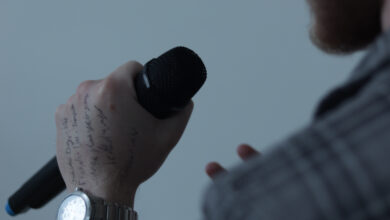
Mike Carter Looks Back at His 2025
We continue our review of 2025 with Mike Carter, who this time last year told us about his year avoiding trauma theatre. This time around Mike turns his attention to his growing need for human connection and how that has influenced his reviews during the year.
Of course, sometimes theatre arrives like a bull in a china shop or a firework display, all colour, noise, big names and razzle-dazzle. I have enjoyed that thrill over the years, but, reflecting on 2025, I realise something has shifted. Theatre, as an art form, hasn’t changed, unless I’ve missed a meeting. Reading my reviews, though, it seems that I have. It may be advancing years, but I am clearly getting bored of showbusiness technique and pretence. In today’s theatre landscape, I crave something else, something more precious and elusive perhaps. I am looking for authenticity when I sit in the dark room waiting for the curtain to go up.
Authenticity isn’t to be confused for quiet, intimacy and introspection. The theatre I saw for Everything Theatre over the last 12 months still covers the full spectrum of scale and ambition, but my attention was, almost without exception, elsewhere. I was not impressed by bombast or spectacle. I was seeking honesty and vulnerability. I stopped asking if a show impressed me and started asking if I recognised anything real about it.
That realisation crept up on me at The Play’s The Thing, a one-person Hamlet at Wilton’s Music Hall. This stripped-back version of Shakespeare could easily have become a gimmick. Instead, I found myself pulled into the performance because it felt like watching a mind work and a human spirit unfold right in front of me. The bareness of the stage did not strip the play down; it stripped everything down to a one-to-one, heartfelt plea for understanding. For similar reasons, I enjoyed The Mikado at the Drayton Arms Theatre for stripping out all the Japanese cultural appropriation nonsense. I just wish they’d been as bold in cutting down design excesses. There were a lot of distracting costumes and props to contend with.
My focus on people rather than performance followed me to Dealer’s Choice at the Donmar Warehouse. Patrick Marber wrote the play in his mid-twenties, in the 1990s, and you can feel his youth and the times in the writing. Loud, but not deep or particularly insightful. I pretty much hated it, but did, tellingly, respond to the cast. The plot barely registered, but the emotional resonance did. Humanity, not the words, made the night worthwhile.
Authenticity featured strongly in The Weir at the Harold Pinter Theatre, again led by actors. Another 1990s play revival, it solely comprised pub-table conversations, circling truths the characters could not articulate over one evening in an Irish local. The real point came not from the stories, but from silences around them, from things left unsaid, the desperate need for connection, and the small acts of kindness that we depend on.
Honest, real, human connection led the conversation in smaller fringe work, too. Sunland at the Lion and Unicorn Theatre presented us the apocalypse with, to be fair, varying degrees of success, but what stayed with me had nothing to do with climate collapse and the end of days. It was about four quarrelling friends and the strange violence and cruelty of sharing space and time. The show’s small scale amplified the truth because, frankly, there was nowhere else to hide.
Some productions were not subtle at all. Born With Teeth was a dense literary imagining of Shakespeare and Marlowe, clever and polished and arch, but, fatally, lacked heart and was difficult to care about. As a similar theatrical experiment, English Kings Killing Foreigners could have collapsed under the weight of its ideas. It did not, because at its core, the problem of history was presented as an authentically human dilemma by actors playing a delicious game with us, who gets to speak and who gets to represent the English on stage.
Private Lives, at The Rose in Kingston was a disappointment because it’s light touch lacked the emotional weight required to invest in Noel Coward’s satiric tale of posh people in distress. A Midsummer Night’s Dream at Shakespeare’s Globe pushed a play we all know into uncomfortable territory, but the shifts felt forced, an unnatural experiment that hadn’t quite been thought through. I celebrated its boldness, but I cannot claim to have felt very much at all.
I did see one glorious production in 2025, in the middle of the year. It perfectly delivered the sense of authenticity I’ve been wittering on about here. In Praise of Love at the Orange Tree won my heart and earned itself five stars. Why? More than anything else, it simply told the truth.