Diverse City’s Claire Hodgson discusses Mid Life
There are many subjects that need more public discussion and the menopause is most definitely one of them. Although there are a few shows about the subject doing the rounds, Mid Life from Diverse City is different, aiming to open up a conversation that is fully accessible and prioritising voices that are often excluded from the discussion. The show opened to acclaim in 2020 but returns this spring to tour venues across England. We were intrigued to know more so called on Claire Hodgson, the company’s Artistic Director, to ask.

Hi Claire. Thanks very much for talking to us today. I know you must be really busy ahead of the upcoming tour! Firstly, can you tell us a bit about the show and the story it tells?
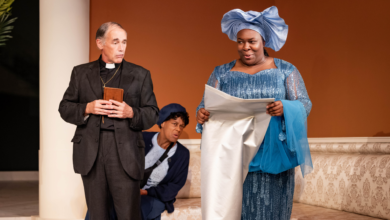
Mid Life starts with Claire – played by me. My character wants to perform her one-woman stand-up show called “Mid Life”, in celebration of her 50th birthday. Claire in the show is cool but maybe also a bit frustrated; she works in human resources and is passionate about performing. She is always up for a laugh, does panto, and was the 1982 Disco Dancing Champion of the Southeast of England (that bit is true – I was!).
‘Claire’ is giddily excited, however her performance soon becomes subject to interruption by audio describer Karen, BSL interpreter Jacqui and the after-party DJ she’s booked. They all have things they want to say to Claire and want her to include their voices and experiences. And on top of all that, menopausal symptoms start to derail her performance.
We created Mid Life to reveal menopause through different lenses from our experiences alongside a wide range of researched stories from hundreds of women. We really wanted to initiate honest, hilarious and difficult conversations between the cast, shed some of the shame and loneliness and unite everyone through a glorious shared experience with a good old disco dance at the end.
What inspired you to create this production in the first place?
When I hit menopause I was shocked by how little accessible, reliable information there was. I found it difficult to find good resources, so I had to do a lot of educating myself and I had to work hard at finding other women to talk to about this natural phase of life.
I wanted to create a show that I wish I’d seen in my early forties – one that not only presents the facts about menopause but also celebrates the privilege, potential, and vibrancy of ageing and getting older. There are so many great role models of older women who are living really exciting and full lives, and Diverse City wants to share these stories to transform a challenging experience into a celebration. As a charity, our mission is to empower people with knowledge and build a supportive community through accessible theatre.
How was the research process for the show? I understand you talked to a lot of people!

Yes, we did. We undertook extensive research to capture the diverse experiences of menopause. The performers in the show interviewed their mums, friends and people in their family. We collaborated with researcher Isabel de Salis, who had conducted in-depth interviews with 50 women over five years, all going through menopause.
When we read the transcripts from all the interviews, we realised that we had great and interesting takes on menopause.
We also made a deliberate effort to connect voices that are often underrepresented in the media, including lesbian women, women of Bangladeshi heritage, Black women, and working-class women, as well as Deaf and disabled women. This inclusive approach ensures that the show reflects a wide range of experiences of menopause and mid-life.
What have you learned in your investigations?
We discovered that while every woman’s experience of menopause is unique, there are common threads that unite us. There are over 40 recognised symptoms and many of these most people are unaware of. Menopause is both physical, emotional, and psychological: the experience can vary dramatically from one person to another, but it’s within these three categories. For some people, the physical symptoms will be the strongest element. For other people, anxiety and depression might be their biggest symptom.
For myself, dealing with the emotional and psychological changes was the most challenging. I had to do a great deal of understanding about what was happening to me and talking with friends and family and other support to really be able to get through this time.
Ultimately, I think the journey through menopause often leads to a deeper understanding of themselves and their body, giving them a clearer vision about the sort of person they want to be.
Can you tell us about the access features you’ve included in the performance?

Accessibility is at the heart of our production, reflecting our commitment as a charity to include as many people as possible.
Every performance is fully accessible – full BSL, audio description and captions, not just the occasional one during a run. This enables people requiring these access features to be able to attend any performance with friends instead of having to select a specific date that’s accessible.
Our performances are also chilled, meaning that people can make sound if they need to and come in and out of the auditorium as they wish. We do this so that performances can be seen by everyone, and that people can feel relaxed and comfortable in the theatre and not anxious or under pressure.
Is this just a show for women, or is it aimed at a wider audience? Who else might enjoy it?
Well, menopause happens to half of the population, so it probably touches almost everyone’s life, either through relationship, workplace dynamics or family life – the challenges and celebrations of ageing affect us all.
It is about menopause, but it is also about the experience of ageing and the things that we often confront during that process, like bereavement, our children leaving home, becoming a grandparent parent, and sometimes deciding what sort of life we want to lead.
There are parts of the show that will connect with a very wide range of people.
So, I would say that these stories and insights mean the show connects with a very wide audience, inviting everyone to reflect on the ageing process and sometimes deciding what sort of life we want to lead.
And you’re travelling across England to venues from Cornwall to Leeds. How do you hope audiences will respond in these very varied places?
Both Karen Spicer and I have personal connections to many of the regions we’re visiting – she is from Nottingham and I grew up near Brighton.
I think we are all looking forward to the conversations we have with the audience after the show and to celebrate with them in the live DJ gig that happens for an hour after each show with our cast member, Judith Jacob, who is both an actor and a DJ.
I think there will be lots of opportunities to share experiences and dance together. It’s a brilliant opportunity to see how the show resonates with audiences across the country, and a wonderful chance to highlight the work of our charity, Diverse City, in making theatre accessible and inclusive for more people.
Diverse City is a charity fighting for a fairer, more representative performing arts world.
We exist to get people in, on, seen, and heard – because the theatre should belong to everyone. And we really mean it – we don’t just talk about change, they make it happen.
• We create radically inclusive creative spaces
• Bring unheard stories to the stage
• Ensure accessibility is the norm
Find them online @diverse_city. Charity Number: 1176855
Thanks very much to Claire for taking the time to tell us about this disco-tastic show! Mid Life is a Diverse City production, co-produced with Theatre Royal Plymouth. It runs from 27 February to 29 March and tour details can be found here.