(You can also hear a recorded interview with Tom Foreman, first broadcast on Runn Radio on 23 June, here)
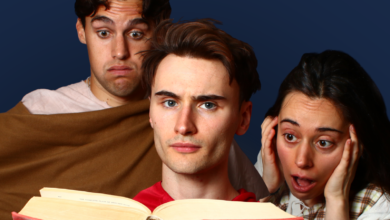
Big Boys is the first play from Tom Foreman Productions. It takes aim at the meaty topics of male mental health and coming of age in a time when we feel more divided than ever. We liked the sound of this, so we thought why not catch up with writer and director, Tom Foreman, to find out more.
Let’s dive straight in with the obvious, what is Big Boys all about then?
Big Boys is, at its simplest, a story about two boys growing up together. You see them from 11 until about 19, and all the ups and downs that that period of life throws at them. It’s hopefully a bit more than that though too! Firstly, it’s a bit of an ode to the past 10 years and coming of age in that time. Most nostalgia pieces I see focus on the 90s or early 00s, but there’s a generation of us entering adulthood who hit puberty in the early 10s. Secondly, it’s also an exploration of male friendship. I don’t think it’s something you see that much explored for its own sake, so I wanted to dive into it and really try to grapple with the dynamics of male friendships, warts and all. In extension of that, the play also focuses quite heavily on themes like mental health. The fact that suicide remains the leading cause of death for men under 30 has become so commonly quoted that it’s now become almost meaningless, but when you stop and think about that for a minute, it’s crazy. As a 21 year old male, I’m more likely to be the cause of my own death than any illness, accident or other. We still have such a long way to go with destigmatizing mental health, particularly among men, and so whilst I don’t profess to have the equation to solve it all, I really wanted to scrutinize what it is about male friendships that make them so closed off at the times they need to be the most open. I hope that gives some flavour of what it’s about!
You had a previous play called “Big Boys Don’t Cry”, is this a reworking of that piece? Was the past year without theatres being open an opportunity to rework it into something new?
I did. It was the original version of Big Boys, which we performed in 2019. After those performances, I got a huge amount of feedback, and I decided there was a lot that I still wanted to explore. So I went on this process of pretty brutal refinement and reworking. I was hesitant at first to edit it so much because the reception had been so positive and I didn’t want to risk losing that, but ultimately the writer in me won out over the businessman. I decided to change the name to Big Boys instead of BBDC because it really is a completely different show now. The past year has certainly allowed me to refine it even more. BBDC was originally programmed into Paradise at the Vaults at the Edinburgh Fringe 2020, so it’s pretty crazy that its (new) version will only see the light of the day for the first time in July 2021. Ultimately though I think it’s only crystallized in that time and the narrative and themes have become clearer, so I’m stoked to finally be sharing it with people.
The play starts in 2011, is that a special year for you? And was Angry Birds really that long ago!
2011 was the year I started secondary school! And it certainly was, Angry Birds was released in late 2009 so it was certainly in it’s boom phase by 2011. I’ve based all the timings on my own life, since so much of the play is based on my experience, hence starting in 2011.
You’ve written and directed the play, are these two roles you feel can work together, is that any concern that maybe in doing both you could not spot any issues that need addressing?
Personally I find the writing and directing go hand in hand, because I have such a visceral image of it all when I put pen to paper (or fingers to keys?) What I’ve been more concerned about is starring in it as well. I’ve taken the role of one of the boys in it because as a writer who also acts, I find that writing to my acting strengths is really helpful, however also because the play is so close to me that it felt like something I wanted to do respectfully. I really admire writer/directors like Jim Cummings or John Krasinski because I always think you can feel how much the projects mean to them which only draws me in deeper as an audience member, although maybe that’s just some cognitive dissonance on my behalf! It’s definitely challenging because when blocking and acting, I can’t see it from an audience perspective and especially on stage being aware of those sightlines and perspectives is absolutely essential. Luckily I have a wonderful assistant director, Pip Pearce, who joined the team and has been enhancing the project from the first online Zoom rehearsal. I’m really lucky to have him and his artistic vision on the team.
Clearly male mental health is a big theme of the play, still a topic you think men are scared to talk about too often?
Absolutely. With suicide still being the leading cause of death in men under 30, we have a huge way to go in this department. The ground we’ve made in destigmatizing mental health has been valuable, but we can’t get complacent. So much of it starts at a young age, and we have to realise that targeting these awareness campaigns at young men isn’t going to make much of a dent if they’re still growing up in environments that promote toxic masculinity and norms of ‘manning up’. I’m very aware of this stuff, but even I sometimes take it on myself when I’m having a rough day and find it hard to be honest with my mates. So absolutely, there’s a deeply engrained idea of what manhood should be for guys, and put bluntly, it’s killing us. We need preventions as much as we need interventions, and it’s on all of us to keep up the fight against mental health issues.
Have you drawn from much personal experience in writing the play?
Largely, yes. I went to an all boys school with a co-ed sixth form, and when the girls arrived when we were 16, I suddenly realised how bad the masculine culture was. It’s so easy for those toxic norms to ferment when you’re surrounded all day every day by only other guys, and what had been lurking in the shadows was suddenly under a spotlight as soon as there was a break in that routine. So a lot of the experiences of myself and those of my friends and peers are reflected in the show. In fact, a lot of the stories they tell are genuinely true, and just pinched from my own life (I’ll let you try to figure out which are which!) Drawing it from my own experiences and those of my friends was important to me in producing something that felt real. However, I was also really aware that, given the weight of the topic, I needed to respect that. Accordingly I did a lot of research into others’ experiences of growing up male, having male friends, and navigating coming of age. I looked on forums, YouTube, anywhere I could. So I guess it’s really an accumulation of all the research, both personal and non-personal, that I conducted before writing the play so long ago now.
Besides drawing from your personal life, what other research went into the writing?
One of the earliest things I did was chat to Richard Pacitti, who’s the chair of Mind in Croydon, the mental health charity. Richard was wonderful in helping me understand the mental health endemic among young men, and he gave me some really insightful thoughts on a very early draft of the script. We had a long chat in his kitchen about the issues, and it really helped to inform the direction the script should take. Besides that as I say I did a lot of research online, and I’ve also just finished studying Psychological & Behavioural Sciences at Cambridge, and part of my early studies was psychological issues like depression and OCD. So in the end I had quite a holistic idea of it, although of course still for every person it’s so so different. But yes, throughout I have tried to pay close attention to it being sensitive and responsibly explored.
Who do you hope this play will appeal to? And what message would you hope they leave the theatre with come the end?
It’s the hardest question you get asked when you apply for theatres and festivals: who’s your target audience? We have a tendency as performers to cry to the sky “but everyone will enjoy this piece! It’s so deep and multifaceted!” That response doesn’t tend to go down well though, unfortunately. Joking aside, in terms of a demographic, I think certainly those aged 18-28 will appreciate the nostalgia and celebration of growing up in the 10s the most, so I think it’ll really resonate with young theatre goers. However, in truth, anyone seeking a self-examination or a critical address of mental health issues we face at the moment (particularly given the psychological impact of Covid), will, I hope, enjoy this play. On top of that, I’ve made it sound very heavy but the play is genuinely very fun for the most part too. It’s intense, it’s fast paced, and you get to see two young adults play 11 year olds, so it’s a great laugh too. I’m always hesitant about admitting what I want the message of the play to be. For me, whatever someone takes from the play is the most valuable thing they could have taken. However, for me, if it sparks one conversation about male mental health, or mental health in general, I think I will have been successful in my job as a writer. A couple of conversations about sour skittles and Lucozade may also suffice, if people enjoy the nostalgia.
And finally, would it be bad of us to point out Woolworths closed in 2009 (Woolworths is mentioned in the press release as things that happened in the 10s)
God, I’ve just looked it up and you’re right! When I wrote the marketing, I could swear I read somewhere that whilst it shut down in 2009, the very last store to close was in 2011, although I can’t find that anywhere now so I guess I was dreaming (who doesn’t dream of Woolworths?) Luckily Woolworth’s doesn’t actually feature in the show (spoilers) because otherwise I may have had to change that to HMV (another high street giant I lay a flower for before bed.)
==================================
Thanks to Tom for giving up his valuable rehearsal time to chat with us for this interview.
Bad Boys will be playing at Lion & Unicorn Theatre between 6 and 10 July. Further details and tickets can be found via the below link.