Weird, inappropriate, bewildering and unexpectedly entertaining, this play is so meaningless that it actually makes sense.summary
Rating
Excellent
Spectators expecting to receive an interpretation of Richard Foreman’s Pain(t) might be utterly disappointed, as this play is intended to be entirely devoid of meaning. This is by admission of Patrick Kennedy, the creative mind behind this European premiere of Foreman’s 1974 play, which is part of a triple bill, celebrating the author’s 50th anniversary of theatrical engagement.
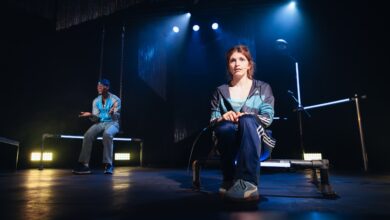
In 70 minutes a number of scenes follow each other, connected merely by the recurrence of the same characters. Each vignette revolves around Rhoda (Emma Gilbey), an ambitious painter who seems to be exploring her femininity, discovering her sexuality and questioning her role in society. The script is bare, delivered in a robotic manner with the help of head-worn mics and portable speakers. The tone is artificial and the lines are often pointless observations or standalone questions that remain unanswered. The whole is interspersed with a substantial list of sound and lighting queues which, at times, contribute to generate a comic effect.
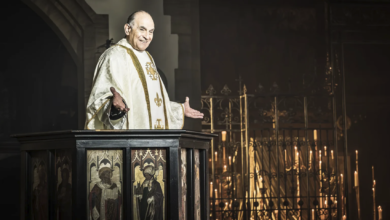
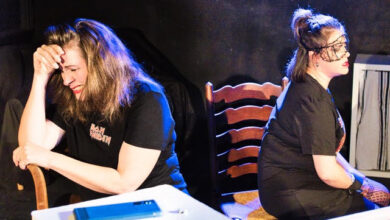
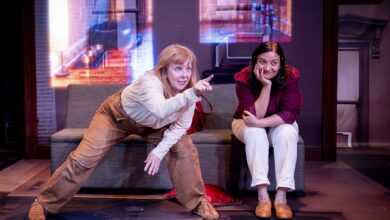
The actual design is inspired, elaborate and offers a strong visual impact. Three women and two men appear on stage in Renaissance costumes, assuming awkward poses and adopting several odd props which fuel a sense of confusion. Rubber masks with animal heads or gigantic hands and feet are worn randomly, whilst clothing is occasionally removed. A doll with black stitches on a cheek is tied overhead and sometimes illuminated by a spotlight. Meanwhile, an invasive soundtrack spans from Mozart’s aria Der Hölle Rache to a female voice loudly enjoying an orgasm.
The outcome is stunning. Kennedy’s organised mess feels refined and studied in its finest detail. Every element of this daring production comes together in a fully-fledged surrealistic tableau vivant, where the actors require physical endurance and pinpoint movements, whilst maintaining a deadpan demure. Their delivery is impeccable and the very backbone of an otherwise challenging piece which can hardly appeal to the general public.
New York-born Richard Foreman is one of the last living avant-garde masters and his pioneering works have rightfully spanned across decades and continents. Written at the beginning of his seminal career, Pain(t) preserves to this day its intriguing radiance and beyond-words charm. Weird, inappropriate, bewildering and unexpectedly entertaining, this play is so meaningless that it actually makes sense.
As a part of the “Foreman at Fifty” trilogy, Patrick Kennedy and his Phenomenological Theatre Company will return to the New Wimbledon Theatre Studio in July with Lava and in December with Zomboid!.
Author: Richard Foreman
Directed, Designed and Produced By: Patrick Kennedy
Box Office: 0844 871 7615
Booking Link: https://www.atgtickets.com/shows/richard-foreman-at-fifty-season-pain/time-and-leisure-studio/
Booking Until: 16 March 2019