In this true crime musical depicting the murders of Andrew Borden and Abby Gray, culminating with the trial of their daughter, Lizzie Borden, expect a loud rock score and energised cast.summary
Rating
Good
Lizzie Borden took an axe, and gave her mother forty whacks. When she saw what she had done, she gave her father forty one.
If you’ve heard this nursery rhyme, it’s safe to assume you know about Lizzie Borden and the trial that captivated America in the late 19th century. On the 4th of August 1892, Andrew Borden and Abby Gray were “found” murdered at their home in Fall River, Massachusetts. But for me, LIZZIE was my first introduction to this infamous case.
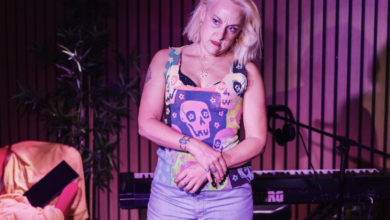
Premiering in New York in 2009, LIZZIE is now playing at the Southwark Playhouse Elephant. Featuring a cast of four women, this revenge thriller is angry and very loud. Each of the cast has a belt with a loop to carry their microphones in (think Six) that they sing into for extra amplification. In ‘Gotta Get out of Here’, this is utilised well and highlights Lizzie’s pain.
Apart from the microphones, the costumes keep to the time period with old fashioned dresses – one of which becomes incredibly blood stained. The restrictive Victorian dress reflects the claustrophobia Lizzie (Lauren Drew) and her sister Emma (Shekinah McFarlane) feel whilst living with their father and stepmother. The anomaly occurs during the finale when the cast come out in modern dress; it feels random and unnecessary.
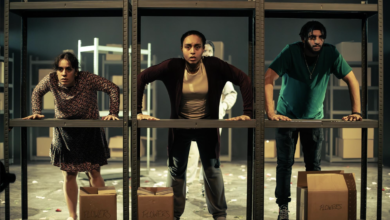
The set depicts a wooden barn: a safe haven for Lizzie to escape the abuse she suffers in the house. There are two doors which slide back and reveal space behind them. These, the cast frequently use, but unfortunately, if you’re sitting on the left- or right-hand side of the stage, you are unable to see anything that happens in there. I missed Lizzie’s axe-wielding bit during ‘Somebody Will Do Something’. This was rather disappointing as an enthusiastic audience member told me during the interval that it was the best moment of the show so far.
Apart from plastic birds that are littered around to represent the pigeons Lizzie cared for, the stage is bare, allowing the cast to use it for dancing. At times the choreography is questionable but the routine for ‘Questions Questions’ worked really well.
There is not much dialogue, and instead, rock songs play one after another. This succeeds in keeping up the high energy of the show, but it is sometimes difficult to understand what is going on, particularly if you are unfamiliar with the case. Nevertheless, Drew’s voice is perfect for the titular role. She has a unique ability to sound soulful even when she’s seething with rage.
It was interesting to see Lizzie interact with her friend/love interest Alice (Maiya Quansah-Breed) and Irish maid, Bridget (Mairi Barclay), as they play a quasi-angel/devil dynamic. Alice pleads with Lizzie and tries to persuade her to be rational in her decision-making, whereas Bridget encourages her to go for the kill.
In ‘Shattercane & Velvet Grass’, Bridget hands Lizzie a book of household poisons, implying that she could find one to make and put in Abby’s tea. Additionally, in ‘Somebody Will Do Something’, she tells her “Your stepmother’s cleaning the guest room upstairs. All by herself.” It would have been interesting to understand Bridget’s motivations for having them killed, as her determination seems unjustified when viewed from her perspective.
LIZZIE has a fantastic cast with incredibly talented singers. Each gives a strong and impressive performance. The true crime musical is unique and absolutely captivating but could be even better with a few alterations. It’s a fun, killer night out where the energy is infectious and the atmosphere is electric.
Written by: Steven Cheslik-DeMeyer, Tim Maner and Alan Stevens Hewitt
Directed, choregraphed and produced by: William Whelton
Set and lightning designed by: Andrew Exeter
Costumes designed by: Rachel Tansey
Musical supervisor and orchestral manager: Katy Richardson
LIZZIE plays at Southwark Playhouse until 2 December. Further information and bookings can be found here.