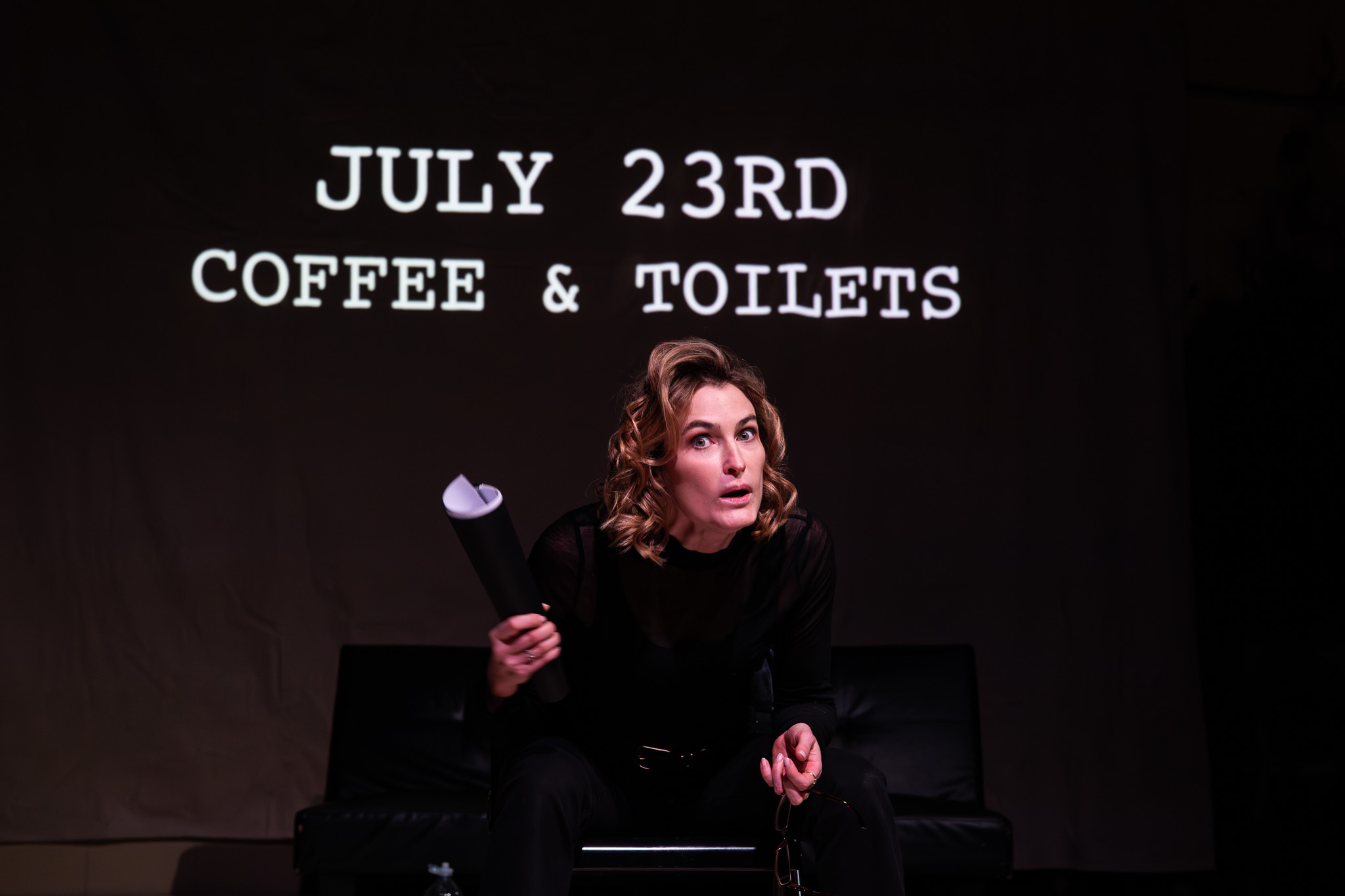
A strong and engaging performance, in which an actress is forced to reflect on her choice to play a role which could cause great offense to modern audiences.Rating
Good
A screen at the back of the set displays a series of WhatsApp messages as we wait for the formal start of the play. Clearly a parent group chat – the normal stream of inane questions, casual racism, and delegation of all responsibility to the class rep flows through continuously. Funny and accurate, yes, but also a reminder of the microaggressions experienced in everyday virtual life. Opinions are given, offence is taken, and members of the group “flounce” off. It is an arresting start, incorporating the spectator immediately in present day, where virtual interaction and judgement from strangers is ubiquitous.
Laura Kay Bailey then strides to sit centre stage, facing out to speak to the audience who represent a variety of characters for her to bounce off of. Confident, attractive and powerful, she moves between personas, accents and time to demonstrate her life to date and continued desire for an acting job despite decades struggling for success. WhatsApp makes several more on-screen appearances to represent off-stage conversations.
As background, in 2024 Bailey played J K Rowling in a controversial play at the Edinburgh Festival called TERF. TERF stands for “Trans-Exclusionary Radical Feminist”; it’s a staple term in any trans debate and, as most will know, J K Rowling herself is very vocal on her refusal to accept trans men and ridicules trans women. The play received an extraordinary amount of adverse publicity and threats of violence, much of which was directed towards Bailey herself.
Rowling In It, we are told in the show’s publicity, is a self-penned show inspired by the tumult of that time which forced Bailey to defend her own complicity and responsibility for the trans debate, despite it only being a character she played.
Complex and absorbing though Bailey’s performance is, much of the script focuses on the chaotic rehearsals and frequent script rewrites that were part of the preparation for the original fringe production, making it difficult to separate that experience from any subsequent reflection. They are funny and it makes for good theatre, but that was clearly not the intention, and the differential between time periods, and even character vs self is not clear.
Bailey’s performance is interrupted by phone calls to bring her back to the present by a caller marked as DV. The ring is that of the Darth Vader March and the caller appears to be her spouse although we only hear her responses rather than the full dialogue. What is clear is that is in an unsatisfactory relationship, in which she is gaslit, frequently shut down and challenged in a threatening manner. She makes references to family life and her own speech to reinforce the conflict she experiences in juggling domesticity and her career. And then the play is brought to an abrupt, if striking, end by Bailey declaring that her experience in playing Rowling could be likened to those who have experienced domestic violence. Which may also insinuate that Bailey does…?
I thoroughly enjoyed this experience, and Bailey is a strong and endearing performer who I would pay to watch again. Nonetheless, I am not sure the script achieves its stated aims. Edits adding clarity of voice and separation of settings are much needed in order to better differentiate between then and now.
Written and Performed by Laura Kay Bailey
Directed by Dominic Shaw
Rowling In It plays at King’s Head Theatre until Sunday 19 April.